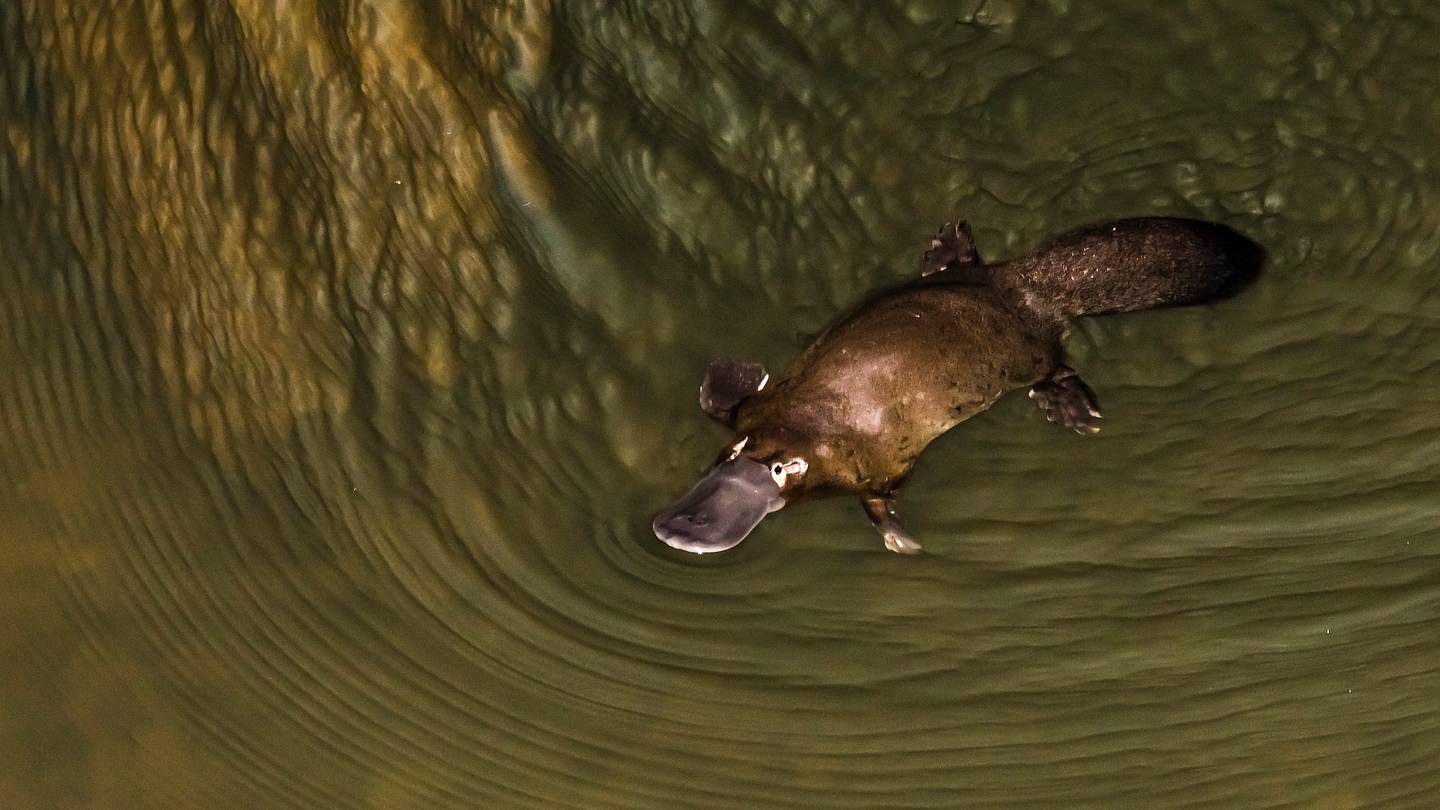
The platypus is arguably one of the most distinct animals on the planet. Here are a few things you might not have known about this quirky creature.
Platypuses ( platypodes and platypi are technically also correct, but much rarer in use) arenât the only animals to forgo an acid-producing part of the gut; spiny echidnas, and nearly a quarter of living fishes all have a gullet that connects directly to their intestines.
A platypusâs bill has thousands of cells that give it a sort of sixth sense , allowing them to detect the electric fields generated by all living things. Itâs so sensitive that the platypus can hunt with its eyes, ears, and nose all closed, relying entirely on the billâs electrolocation .
The ancient versions of a lot of modern animals, including penguins , were oversized monsters compared to the animals we know today. Platypuses are no different: In 2013, the discovery of a single tooth helped researchers identify  a prehistoric platypus that was more than three feet longâdouble the size of the modern animal.
Platypuses are one of only five species of extant monotremesâjust them and four species of echidnaâwhich split from the rest of the mammals 166 million years ago. These egg-laying mammals get their name from the hole that serves as both an anus and a urino-genital opening. In 2008, scientists deciphered the entire DNA of the duck-billed platypus and determined that, in accordance with the animalâs somewhat bizarre appearance, the platypus shared genes with reptiles, birds, and mammals.
Although platypuses are born out of leathery eggs, the babies nurse from their mother. Female platypuses, however, donât have nipples. Instead, their milk is released out of mammary gland ducts on their abdomen. The babies drink it up by sucking it out the folds of their mother's skin, or her fur.
Platypuses are one of just a few venomous mammals, which is one of their more reptilian characteristics. But unlike snakes, a platypusâs venom isnât in his teeth. Instead, males have a hollow spur on each hind leg from which venom is dispensedâbut only sometimes. Although the spur itself is always there, the venom gland to which it is connected is seasonally-activated and only produces venom during mating season, indicating that its use is for fending off competing males.
Although they can only stay submerged in water for a few minutesâthey are mammals, after allâplatypuses are much better suited to scooting around in water than they are on land. Much like an otter, they prune their thick coat to add air bubbles that act as insulation in the cool rivers where they hunt. Out on land, the platypusâs short limbs mean it has to exert 30 percent more energy than a similarly sized land-based mammal just to move around. All that said, they do have one particular adaptation to ease their terrestrial travel: The webbing between their front clawsâa boon when paddling through streamsâ retracts when the platypus ambles up the riverbank to expose sharp claws.
When the first platypus specimen was sent back to England from Australia in the late 18th century, the scientists who examined it thought that someone was playing a trick on them. âIt naturally excites the idea of some deceptive preparation by artificial means,â zoologist George Shaw wrote  in the first scientific description of the platypus, published in 1799. One of the most remarkable and weird aspects of the platypusâits ability to lay eggsâwasnât discovered for another 100 years.
Platypuses donât have teeth inside their bill, which makes it difficult to chew some of their favorite foodsâbut they have worked out a pretty ingenious solution. Along with worms, insects, shellfish, and whatever else these bottom-feeders scoop up to make a meal out of, the platypus also picks up gravel from the riverbed. The platypus packs it all into pouches in his cheek to carry it up to the surface where it munches away , using the bits of gravel as makeshift teeth to break up tougher food.
Unlike beavers, which have very visually similar tails, platypuses donât use their tails to slap the water in warning, or even to move them through the water. Most of the time, the primary function of the platypusâs tail is just to store up to nearly half of the animal's body fat in case of a food shortage. A female platypus also uses her tail to hold incubating eggs against her warm body.
In 2014, the International Union for the Conservation of Nature (IUCN) deemed the platypus ânear-threatened.â The animals live in freshwater wetlands along Australiaâs east coast (including Victoria, Tasmania, South Australia, Queensland, and New South Wales). The fact that, according to the IUCN, â[t]here has been no robust assessment of the population size of the Platypus either nationwide or for the key states in the speciesâ geographic rangeâ makes the speciesâ true numbers hard to determine. There may be an adult population of 300,000, but that number is on the decline. Habitat destruction and pollution of waterways are major threats .
If youâre lucky enough to see a platypus in the wild, leave it where it is. The animals are protected by law and âcannot be captured or killed, except for scientific research,â according to the Australian Museum. Doing so carries major penalties: One man who recently nabbed a wild platypus from a waterway in Queensland faces up to $289,000 in fines.
A version of this story originally ran in 2018; it has been updated for 2023.
Loading recommendations... Please wait while we load personalized content recommendations