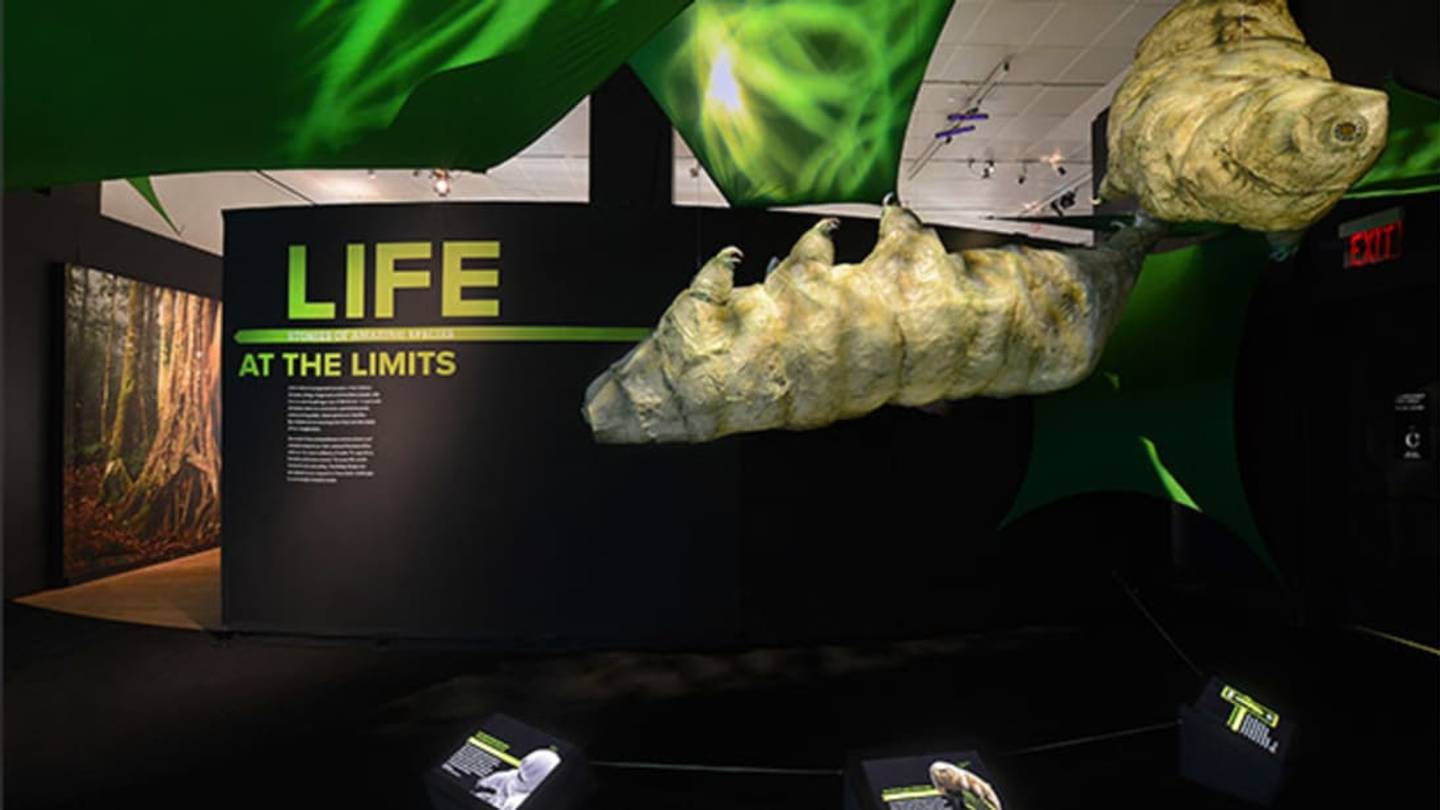
There are some incredible animals on this planet, and many of them have evolved incredible specializations to find food, attract mates, survive, and thriveâsome of which arenât too far off from superpowers. You can learn all about these awesome adaptationsâand get up close and personal with live nautiluses, mantis shrimp, and axolotlsâat the American Museum of Natural Historyâs latest exhibition, Life at the Limits , which opens Saturday, April 4. Here are a few things we learned from a preview.
1. Black Swallower fish ( Chiasmoden niger ) are capable of swallowing prey up to 10 times their weight! Scientists arenât really sure how they do itâthe fish (modeled above) live at depths of 2300 feet, and not much is known about themâbut this specialization doesnât always work to the animalâs advantage. In the deep sea, where food can be hard to find, it's helpful to have an extendable stomach and the ability to unhinge the jaws âso [the fish] can eat whatever they come across, within reason,â John Sparks, co-curator of the exhibition and curator in the museumâs Department of Ichthyology, tells mental_floss . âBut the downside is, most of these that have been collected have floated to the surface becaus e the fish inside them has been so big that it decomposed before the Black Swallower could d igest it, and the bacteria kills them.â
2. Â Any ants reading this should steer clear of the giant anteater, which can suck down up to 35,000 of the insects in a single day.
3. Â The tiny, eyeless waterfall climbing cave fish ( Cryptotora thamicola ), above, found in just two caves in Thailand, has enlarged fins for navigating rocks in fast moving streams.
4.  If you're a predator , you might want to give the desert tortoise ( Gopherus agassizzi )  a wide berth: It pees when threatened!Â
5.  The pupils and lenses in the eyes of Anableps anableps  fish are divided: The top half is for looking above water, while the bottom half is for looking below.
6. Â Elephant seals can descend nearly a mile and stay there for up to two hours to hunt, thanks to lots of hemoglobinâthe molecule that carries oxygen around the bodyâin its blood.
7.  The ocean sunfish ( Mola mola ) is the worldâs heaviest bony fish, and it lays more eggs at one timeâ300 million!âthan any other animal. The animals start life p inhead-small but can grow up to 10. 5 feet high.
8. Â A brown kiwiâs egg weighs almost a poundâas much as six jumbo chicken eggsâwhich is pretty big for a bird thatâs the size of a chicken!
9. Â Next time you see a fish, take a good look into its mouth. Does it have a tongue, or a Cymothoa exigua , the tongue-eating louse? In the only known case of a parasite replacing a host organ, these parasites enter a fishâs mouth through the gills then clamp onto its tongue, drinking the blood until the tongue falls off. Then the louse just hangs out there, right where the tongue used to be, feeding on its hostâs blood and acting as its tongue.
10.  Unlike other salamanders, axolotls  ( Ambystona mexicanus ), above, spend their entire lives underwater and retain many of their juvenile featuresâincluding those cute frilly gills. Scientists are studying the animalâs incredible ability to regenerate lost limbs and crushed spinal cords with hopes of applying that knowledge to human medicine.Â
Loading recommendations... Please wait while we load personalized content recommendations