Animals have been getting roped into human warfare for millennia and have played many parts in and out of battle: the practice of using war horses dates back to as early as 4000 BCE, while trained specialists like carrier pigeons and the much-decorated Sergeant Stubby (whose 1926 New York Times obituary noted the dog had â[entered] Valhallaâ) have been celebrated for their crucial contributions to modern warfare.
But while Hannibalâs elephants made all the history books for their (almost entirely fatal) battlefield glory, thousands of animals have endured testingâand even occasional deploymentâas living deliverers of disease, flying bombs, and detonators on legs in almost total obscurity.
To honor our feathered and furry friends who almost performed the ultimate sacrifice in war (or, in some cases, very much did), here are 10 military plans to weaponize animals.
As was summarized by the BBC , a 1957 document reveals a planâone seriously considered by the British Civil Serviceâto bury a seven-ton nuclear land mine in West German soil as a preventative measure against any encroaching Red Army forces. However, as the BBC points out, ânuclear physicists at the Aldermaston nuclear research station in Berkshire were worried about how to keep the land mine at the correct temperature when buried underground.â
The proposed solution, according to this document, was to fill the bombâs casing with live chickens, which, âgiven seed to keep them alive and stopped from pecking at the wiring,â would generate enough heat living out the rest of their poultry lives âto ensure the bomb worked when buried for a week,â after which it would be detonated remotely. Thankfully for the birds (and West Germans), the plan was never realized.
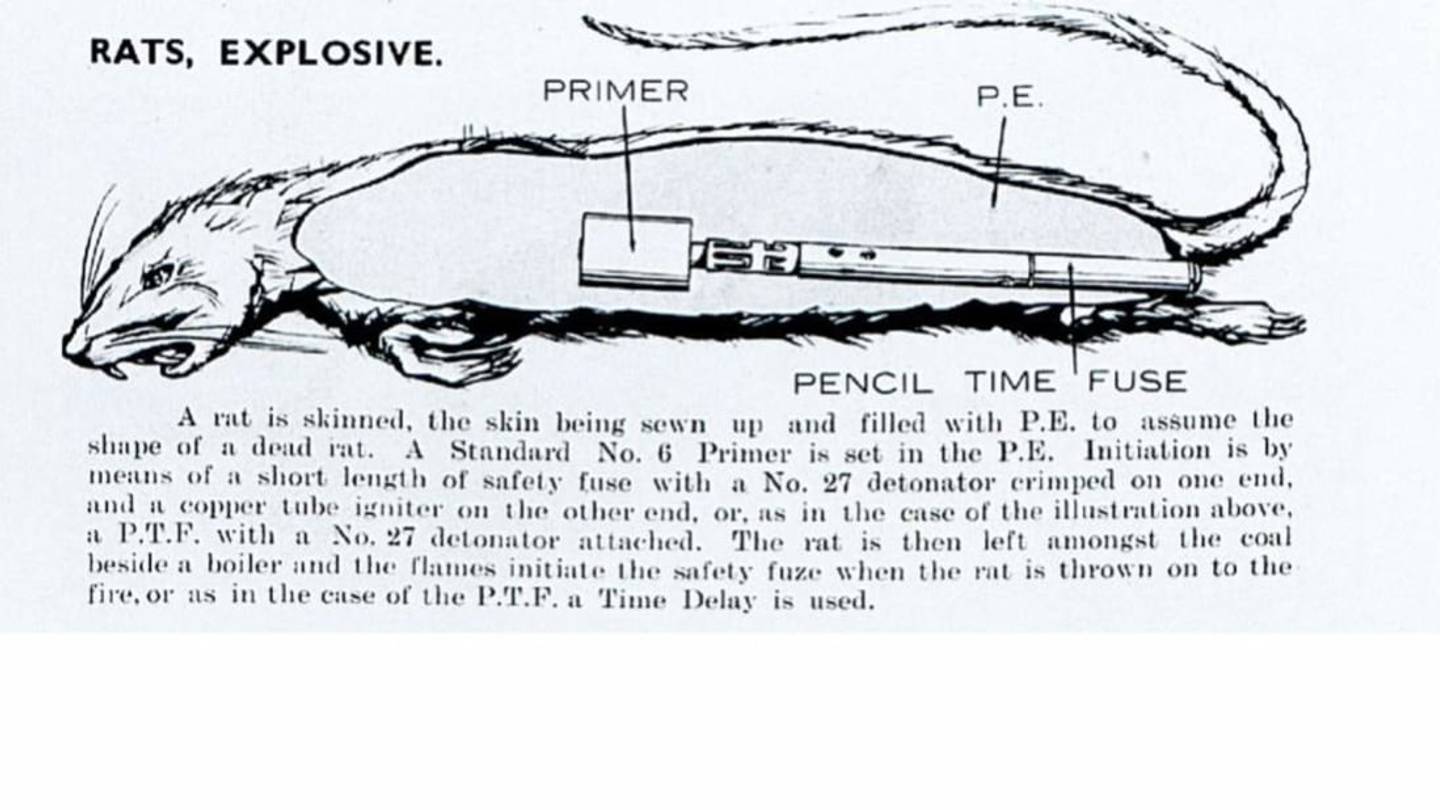
The British Special Operations' idea to slip explosive-filled dead rats in enemy coal loads was developed in 1941, the BBC notes , and sought âto blow up the enemy's boilers ... with the fuse being lit when the rat was shovelled into the fire.â Dead-rat warfare was never put into practice, though, âas the first consignment was seized by the Germans and the secret was blown.â
The BBC points out that German military leaders âwere fascinated by the idea, however, and the rats were exhibited at the top military schools,â leading German forces to perform searches of their coal stores for rat bombs before satisfying themselves that the plan had fizzled out. As to where British forces got their supplies of dead rats, it was a fair example of the Biblical idiom âthey know not what they doâ come to life: âThe source of the dead rats was a London supplier, who was under the mistaken belief that it was for London University.â
During the same war, Soviet military researchers proved that a ratâs value as a weapon isnât limited to being stuffed with explosives. In 1942, Soviet forces used disease-bearing rats against Friedrich von Paulus's troops during the Battle of Stalingrad; rather than attempt to sicken the Germans with plague or anthraxâwhich was too dangerous for their own side as wellâthe Soviets instead infected rats with tularemia, a serious bacterial infection that causes weakness, fever, and skin ulcers at the site of infection. The result? As biological weapons experts Milton Leitenberg and Raymond A. Zilinskas explain:
As historian Steven J. Zaloga explains (and this footage seems to illustrate), Soviet forces began to develop âa âguidedâ anti-tank mineâ in 1941 using trained dogs, and which canât be called a rousing success for either the animals or the army:
Seem reasonable? In any case, German forces âsoon learned about this scheme from prisoners, and in sectors where they appeared, dogs in the combat area were shot on sight.â And while sources in the Soviet army âclaimed that 16 dogs destroyed 12 German tanksâ in the 1943 Battle of Kursk, âGerman sources claim that the mine dogsââwith their speciesâ famously keen sense of smellâ"were not very effective, apparently because they were trained under diesel-engined Soviet tanks, not petrol-engined German tanks,â and tended to head toward the home team when in doubt about their dinner.
Maybe four-legged creatures simply werenât the right delivery system for bombsâa thought that mightâve occurred to the U.S. teams who spent part of the second world war trying to perfect the bat bomb instead.
Sadly for those WWII soldiers and dogs involved in the âguided anti-tank mineâ scheme, their Stavka masters apparently werenât very familiar with the history of the American Civil War. In 1862, Union forces in Texas similarly attempted a âparticularly cruel scheme to 'mow down guys in gray like ripe wheatââ using two mules. Historian Marilyn W. Seguin explains:
The strange tactic did have a beneficial effect for the Union army, however, if an unintended one; Robert Lee Kerby points out that âthe explosions stampeded a herd of Confederate beef cattle and horses into the Union's lines, so depriving [Confederate] troops of some much-needed provisions and horses.â
Dogs and rats aside, research on weaponizing animals in the past century has mostly focused on the potential impact on an enemy of infected insects. "At the turn of the 20th century, man started to understand that insects are the vector of disease," explained University of Wyoming professor Jeff Lockwood to the Casper Star Tribune . "The Japanese, French, Germans, English and the United States all had entomological disease programs active during the golden years of 1930 to 1970ââincluding the Japanese World War II program Unit 731, the Tribune points out:
The Tribune notes that this history of these attacks remains largely unknownâsomething that Lockwood suggests âis because the United States cut a deal with the Japanese unit not to try them as war criminals if they would share their information on insect weapons.â With their new knowledge, U.S. military researchers âeventually settled on the use of yellow fever mosquitoes during the Cold War, and even dropped uninfected mosquitoes on its own citizens in parts of Georgia to test the frequency of bites,â the Tribune writes.
Military historian Reid Kirby explains that U.S. forces have also experimented with using fleasâhaving a strong track record of transmitting deadly Black Plague several hundred years earlierâas a delivery system for disease:
The bombs used were designed to hold as many as 200,000 fleas each, and Operation Big Itch tests reportedly âshowed that the fleas could survive the drop and would soon attach themselves to animal hosts on the ground.â There was an obvious downside, though: Some canisters would come open while still in the air, and in addition to the poor, patriotic guinea pigs on the ground, âthe pilot, the bombardier and observers on the planes were also bitten many times.â
Nonbiting bugs have had their place in the history of animal warfare, too, including the seemingly humble Colorado potato beetle. As the BBC reports, the early 1950s saw a number of East German press reports of âcases in which planes flying overhead had been followed by a plague of potato beetles,â which were previously uncommon in the region and seriously threatened already strained food supplies. As a result, â[politicians] raged against the âsix-legged ambassadors of the American invasionâ and [the] âcriminal attack by American imperialist warmongers on our people's food supply,'â and started an aggressive propaganda and farming how-to campaign encouraging children to help eradicate the pests one by one.
French forces had, in fact, âconsidered importing beetles from the U.S. and dropping them over Germany after World War Iâbut the plan was abandoned due to fears it might also damage French agriculture.â German military researchers themselves even âperformed a number of tests dropping specially-bred potato beetles out of planes in 1943,â but the idea never got airborne.
Entomological warfare doesnât always have to be so complicated, of course. Jeffrey A. Lockwood suspects early Paleolithic humans were using insects in battle 10,000 years ago or even earlier. At the time, humans often "lived in caves and rock sheltersâprime targets for a hurled nest of bees or hornets and related wasps," and while "an inanimate objects thrown over a stockade was unlikely to find its mark, a hive of bees was another matter altogether ⦠an angry swarm," perhaps pacified by smoke and transported in a bag to the enemy's gathering point, "might break the siege and drive a frantic enemy into the open."
In addition to being tried out as delivery systems for bombs and biological warfare, some animals were even given special skills in the name of military innovation. In WWII, the U.S. navy was faced with the problem of trying to quickly improve their "large ⦠primitive ⦠rudimentary electronic guidance systems" so as to pose a real threat to tough German Bismarck battleships with more accurate missiles, Military History Monthly notes. Always game (and usually successful) in a pinch, Harvard psychology professor and "jack-of-all-trades" B.F. Skinner stepped up with a solution: trained pigeons, placed inside missiles' nose cones, would guide them by "tapping a target on a screen with their beaks to control the direction." Pigeons were trained in laboratories to peck at shapes or projected images of target ships and were rewarded for the accuracy with grain, and were so effective at this task that Skinner "vowed never again to work with rats."
Nevertheless, the program was shelved by the military in October of 1944, as military leaders, the magazine notes, "were of the opinion that âfurther prosecution of this project would seriously delay others which in the minds of the Division have more immediate promise of combat applicationâ. Namely (although unbeknownst to Skinner), Radar."
The result of the project, in the end, was that "Skinner was bitter. âOur problem was no one would take us seriously,â he complained."
Loading recommendations... Please wait while we load personalized content recommendations