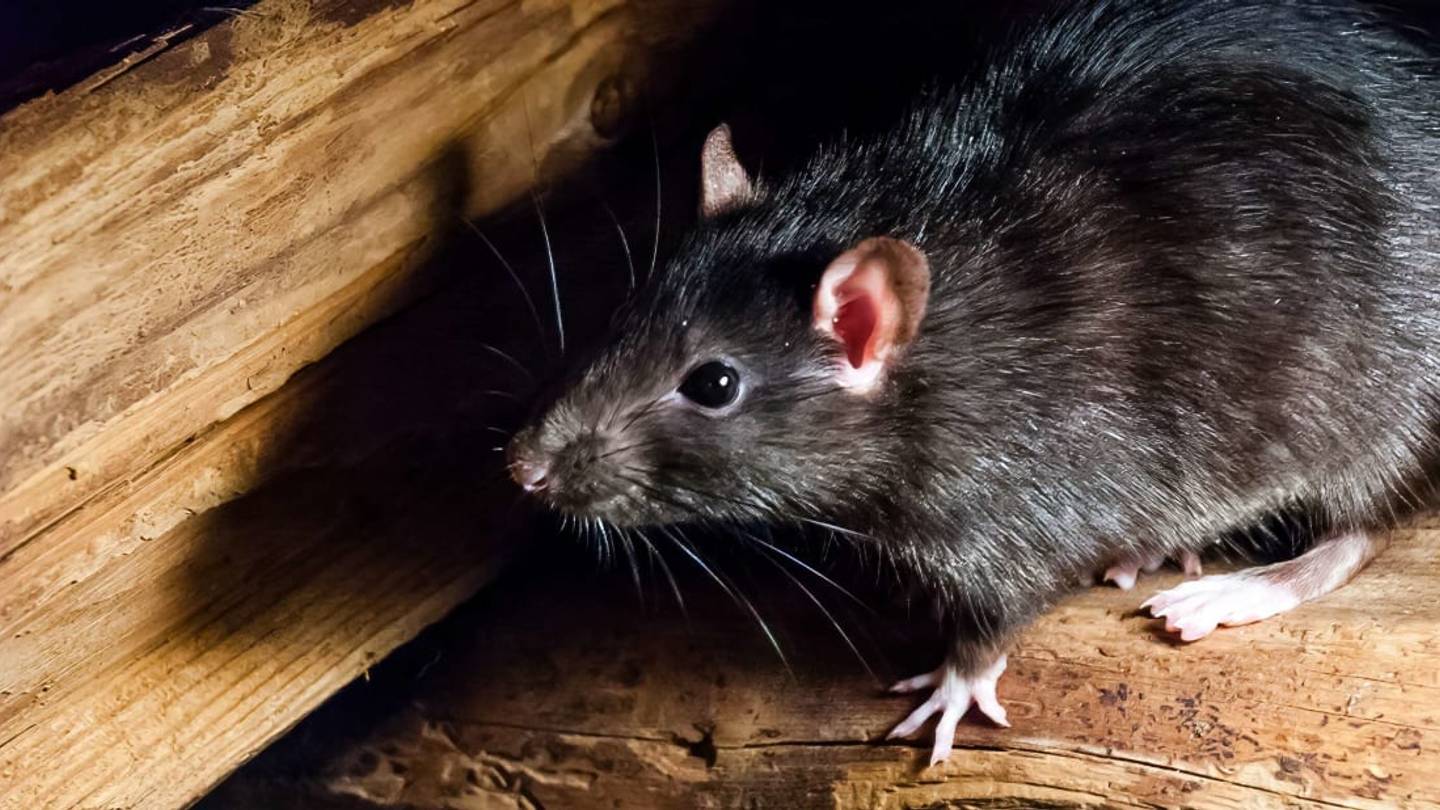
Rats are up there with snakes and spiders when it comes scaring the pants off people. One glimpse of a beady-eyed, yellow-toothed rat scuttling across the basement floor or darting down a city sidewalk is enough to make most people scream.
There is much to admire about ratsâthey are smart, surprisingly well-groomed, and they make excellent pets. But letâs face it: They are also the stuff of nightmares. These facts about the two kinds of rats that love to live around peopleâbrown rats (a.k.a. Norway rats, Rattus norvegicus ) and black rats (a.k.a. roof rats, R. rattus )âwill fill you with terror, or awe, or perhaps both.
A rat can squeeze through a hole the size of a quarter, thanks to its collapsible skeleton. Its ribs are hinged at the spine
and can fold down like an umbrella, which means that any hole thatâs big enough for a ratâs head is big enough for the rest of him.
Rats can chomp through thick wood, metal pipes, brick walls, and cement. Their front teeth are longâthey grow about 5 inches every yearâand also very sharp, with a nifty self-sharpening feature: The edges of the upper and lower teeth rub against each other, having the effect of a knife on a whetstone.
Rats will usually only bite when cornered. But then they bite hardâ very hard. Their jaws are built like an alligatorâs and can exert as much as 7000 pounds of force per square inchâwhich means their teeth can easily slice down to human bone, as one state biologist in New York discovered when he picked up an errant lab rat with his hand. "It put its teeth straight through my index finger," Stephen C. Frantz told Richard Conniff in his book Rats! The Good, The Bad, and The Ugly . "The membrane over the bone is quite sensitive, and it was grinding its teeth back and forth. I get chills thinking about it."
The long claws on a ratâs feet allow it to scale brick or cement walls with Spider-man-like ease. Getting down isn't a problem, either: A rat can fall 50 feet and land on its feet without injuries. Rats are also phenomenal jumpers; they can leap 2 feet in the air from a standing position. With a running start, rats add another foot to their leapsâwhich, according to Conniff, is equivalent to a person jumping on top of a garage. According to one study [ PDF ], rats can lift objects that weigh nearly a poundâmore than the average ratâs body weight .
Rats can swim for three days straight (in laboratory conditions), they can hold their breath underwater for up to three minutes, and they can perform their skeleton-collapsing trick while swimming. All of which means that, yes, they can paddle through sewer pipes, squeeze through your plumbing, and pop up in your toilet.
Rats leave rabbits in the dust when it comes to reproducing. âIf they are not eating, rats are usually having sex,â writes Robert Sullivan in his delightful book Rats: Observations on the History and Habitat of the Cityâs Most Unwanted Inhabitants . During a single six-hour period of receptivity, a female rat may mate as many as 500 times, which helps explain how, according to Sullivan, a pair of rats can end up producing 15,000 descendants in one year and why they are the most common mammal in the world.
On average, the brown rat is about 16 inches long (including its tail) and weighs less than a pound. If a rat lives near a steady food source, like a dumpster, it can grow to be 20 inches long and weigh 2 pounds. But thatâs tiny compared to the Bosavi woolly rat, which was discovered in 2009 by a BBC expedition to an extinct volcano in Papua New Guinea. The 32-inch-long beast weighed more than 3 pounds and showed no fear of humans. Itâs thought to be one of the biggest in the world, and itâs a âtrue rat, the same kind you find in the city sewers,â mammalogist Kristofer Helgen told the BBC. Donât worry about meeting it on the street, though: The rat, which is believed to belong to the genus Mallomys , lives only in the area of the volcano.
Rats make high-pitched chirping sounds (especially when they're being tickled by humans ) that humans canât hear, but which scientists think may be the equivalent of laughter.
Itâs not easy to poison a rat. The animals can detect infinitesimal amounts of poison in foodâas little as one part per million. "Thatâs like being able to taste a teaspoonful of chocolate in 1302 gallons of milk," Conniff writes. Rats are also cautious when eating unfamiliar foods; they'll start by eating just a tiny bit to make sure they donât get sick.
Occasionally, where there are heavy infestations, rats will bite peopleâs faces and hands at night while they sleep, drawn by food residue on their skin. That might be a good time to move to a new town because, once a rat bites you, the ratâs chances of biting another human go way up. Itâs like how, after finding a new favorite food, you order it at every restaurant you visit. In 1945, Curt Richter, a biologist at Johns Hopkins University, fed human blood to captured rats [ PDF ] and concluded that "a strong craving for blood might explain why, once having bitten a person, the rats apparently are apt to bite another."
During the 1950s, roof rats living on Enewetak Atoll in the South Pacific confounded scientists by surviving atomic bomb testing. While the details are sketchy, itâs believed that early nuclear testing obliterated the Polynesian rat population, and that the atoll was then repopulated with a different species of rat that burrowed deep down to survive future testing.
Additional source : Frightlopedia : An Encyclopedia of Everything Scary, Creepy, and Spine-Chilling, from Arachnids to Zombies
Loading recommendations... Please wait while we load personalized content recommendations