When British explorers happened upon Kangaroo Islandâa Puerto Rico-sized drop of land south of what today is the city of Adelaideâthe animals took them by surprise. Unlike the wild âroos of the mainland, who knew to keep their distance, these creatures were utterly tame and approachable (so much so that the arriving crew reportedly slaughtered 31 for a giant kangaroo stewâgotta love those colonial instincts). The reason the animals were unaccustomed to humans (and tragically unfamiliar with their bad habits) was because no humans lived there. Aboriginals had once inhabited the island, but theyâd abandoned it at least 2000 years prior, for reasons unknown.
After a couple of centuries of life alongside human settlers, the animals here are understandably a little more waryâbut the humans, for their part, have gotten a lot more respectful. Which means that today, this one of the most incredible places to get up close and personal with some very interesting creatures out in the wild. The best way to meet them is to tour with a local company like Exceptional Kangaroo Island. Experienced guides are familiar with the animals and their habitatsâso they can probably find you a tricky-to-spot echidna and point out where a koala is likely to be hiding in the crook of a treeâbut they also ensure that you wonât bother the animals in the process. (And in lieu of kangaroo stew, they serve fantastic lunches that highlight the local produce.)
KI has itâs own subspecies of kangaroo (aptly called the Kangaroo Island, or Sooty, kangaroo). Theyâre shorter and stockier than their close relatives, the Western Gray, and chocolate brown in color. Like all âroos, they can hop very swiftly using both sets of paws and their tailâhopping is a highly efficient method of locomotion, because it ârecyclesâ energy, like bouncing on a pogo stick. Tour companies have special access to areas of the national parks that are closed to the public, where you can see wild kangaroo populations which have been carefully acclimated to respectful visits from humans up close.
Fifty years ago, the Cape Barren goose was about to go extinctâbut thanks to rehabilitation projects their population is healthy again. And yet, this light gray gooseâwhich has a striking bright yellow billâis one of the rarest in the world, making its home primarily along Australiaâs southern coast.
They look something like a porcupine mixed with an anteater but arenât related to eitherâthe echidna is a monotreme, or egg-laying mammal, the only surviving relative of the platypus. There are lots of weird things about this creature, but one of the weirdest is that they donât have a permanent pouch to stash their eggs inâthey create a temporary pouch by contracting their abdominal muscles. (Both males and females can do it, so determining gender is difficult!) KI has its own subspeciesâ T. a. multiaculeatusâ which basically means âfast tongue, very spiny!â They have a 9-inch tongue that can flick in and out 100 times in a minute, scooping up insects and larvae.
Black Swans live across the southern regions of Australia, moving nomadically between salt and freshwater wetlands. Preferring areas where eating and nesting materials are plentiful, they can also be seen in the spring in flooded pastures, like this one.
Wool export has long been an integral part of the local economy; there are 400,000 sheep on the island today. This flock lives at the Stranraer Homestead, a functioning sheep station and utterly serene bed and breakfast, where lots of delicious sheep-derived haloumi cheese finds its way into the homecooked meals.
Despite its name, the New Zealand fur seal is a native of southern Australia. At a stunning rock formation called Admirals Arch in Flinders Chase National Park, you can find hundreds of them resting between fishing trips.
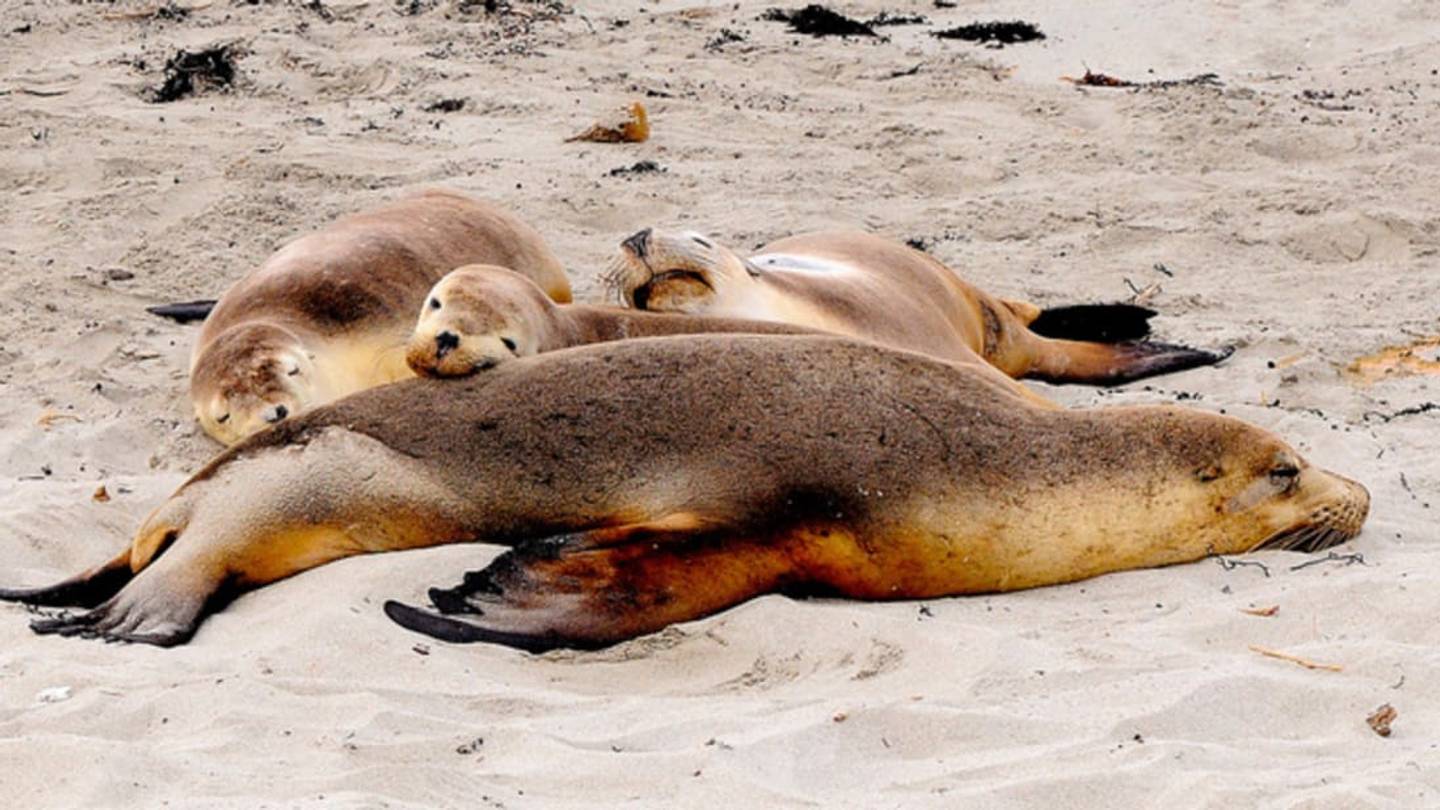
Found only on the south and west coasts of Australia, the Australian sea lion is recovering from threatened status. Females will spend up to three days swimming out to sea and feeding before returning to the beach where their pups await feeding time. Then they catch up on their rest!
The Australian Pelican is a medium-sized pelican, but it boasts the largest bill of any birdâthe longest on record was 20 inches.
The smallest of the wallabies, the rabbit-sized gray tammar can drink sea water!
In the 1880s, Kangaroo Island settlers imported a dozen hives of of honey bees from Liguria, in northern Italy, to help with crop pollination and honey production. The forward-thinking beekeepers at the time had the foresight to have KI declared a bee sanctuaryâlimiting the import of other bee varietiesâwhich today makes it the home of one of the only pure strains of bees anywhere in the world.
The problem for koalas has never been underpopulationâin fact, the opposite has threatened this introduced species' survival on the island. Overpopulation once meant that a sadly common sight was a starving koala in a stripped-bare tree. In recent years, sterilization programs have helped get populations back to sustainable levels, so this is now a good place to spot a (well-fed) one in the wild.
All images courtesy of Jessanne Collins.
Loading recommendations... Please wait while we load personalized content recommendations