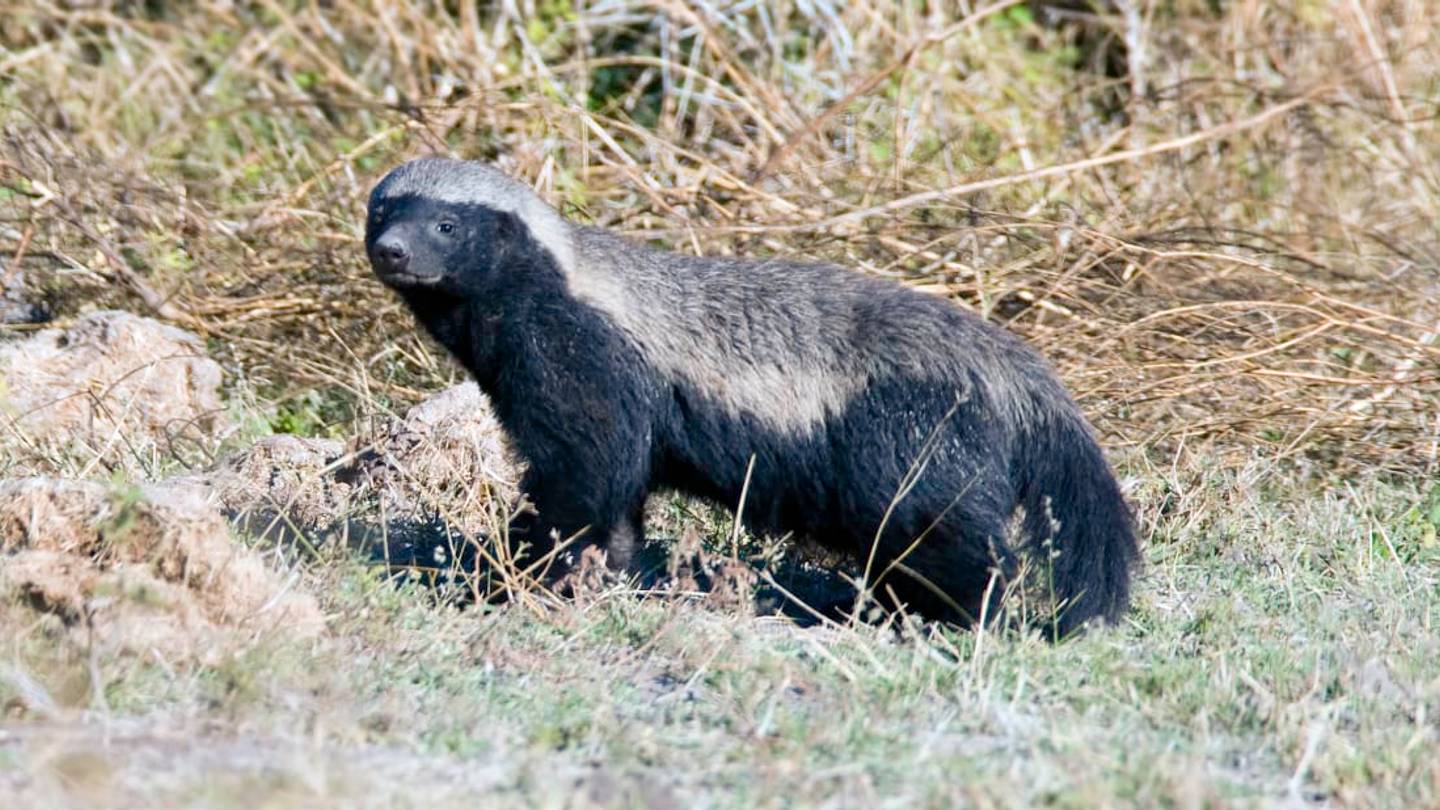
Youâve probably heard all kinds of things about the honey badger and wondered, âAre these claims substantiated?â (First and foremost: Is it true that honey badgers donât care?) Here are a few things we know for sure.
Mellivora capensis is the speciesâ Latin name, which means âhoney eater of the cape.â These little monsters love the sweet stuff. âThe capeâ is the Cape of Good Hope in South Africa, one area where the animal lives (they can also be found in the Middle East and India). Another one of their names is ratel , an Afrikaans word that according to the Oxford English Dictionary might be derived from the Dutch word for honeycomb, raat . (An alternate etymology ties the name to the Dutch word for "rattle," which could relate to one of the noises the honey badger makes).
Honey badgers are in the same family as weasels , and honey badgers are pretty solitary. According to some sources, they only come together to mate (some older studies, however, suggest that the animals can live in pairs ). Honey badgers typically have one kit (and sometimes two), which is raised solely by the female, who takes care of it until it's a year or two old.
Aside from their physical similarities, the honey badger also boasts a gland at the base of its tail containing a stinky liquid. Generally, itâs used to mark territory and scare bees  away from hives, but should the animal find itself in distress, its biological knee-jerk is to release what the San Diego Zoo calls a " stink bomb " (unlike skunks, they don't spray).
Using their long claws, honey badgers dig burrows to rest in, sometimes on a daily basis . Theyâll do it anywhereâin the ground, in a tree trunk, or even into an old termite mound. If needed, they can dig themselves a hiding hole in a matter of minutes and use their natural excavation skills to capture prey underground.
If a honey badger isnât in the mood to make its own bed, itâs not shy about making itself at home in someone elseâs residence. The creatures have been known to get comfortable in the dens of aardvarks or in the tunnels of foxes, mongooses, or springhares. (Really any crevice or hole will do for the honey badger.)
Honey badgers are tough, but despite their aggressive reputations, they usually try to avoid a tussle . When confronted, however, they don't hold back: In those situations, according to Mpala Live , "the badger faces its enemy, produces a rattle-roar, stands its hair on end, emits a stink bomb, and then charges." Hyenas, lions, leopards and pythons are all foes.
Honey badgers are omnivores who will go after mammals, birds, reptiles, insects, larvae, plants, fruit, eggs, and rootsâand of course, they love honey (and the honeybee larvae in it!).
Honey badgers can weigh up to 30 pounds and stand up to 11 inches tall at the shoulder; males are bigger than females. The animal has thick skin, which is also loose enough that, should a honey badger get caught in the mouth of a predator, it can writhe around and break loose or turn back and snap at the would-be predator with their sharp teeth. The honey badger may even have a resistance to snake venom and is sometimes able to sleep off a bite. (Their thick skin comes in handy in this way, too.) Snakes compose a quarter of their diets.
You might have heard that honey badgers and honeyguide birds have a good partnership going. The honeyguide leads the badger to the hive and then eats up after the honey badger destroys it. But that seems to be a myth: As Claire Spottiswood, who penned a paper on honeyguides, told Discover in 2011, âThere is no persuasive evidence that honeyguides ever guide honey badgers ... You might have seen the YouTube clip of a honeyguide seemingly guiding a honey badgerâI'm afraid that was a set-up with a stuffed honeyguide and tame badger!â
Ferocious, fearless, and pugnacious animals arenât always the smartest, but honey badgers appear to break the mold: They have big brains relative to their body size, and some even appear to use tools, as the video above shows. One honey badger in captivity routinely broke out of his cage by opening gates and creating stacks of rocks to get over walls. If the Planet of the Apes franchise ever loses steam, it seems like we might have another animal to suggest for a spinoff.
A version of this story ran in 2015; it has been updated for 2021.
Loading recommendations... Please wait while we load personalized content recommendations