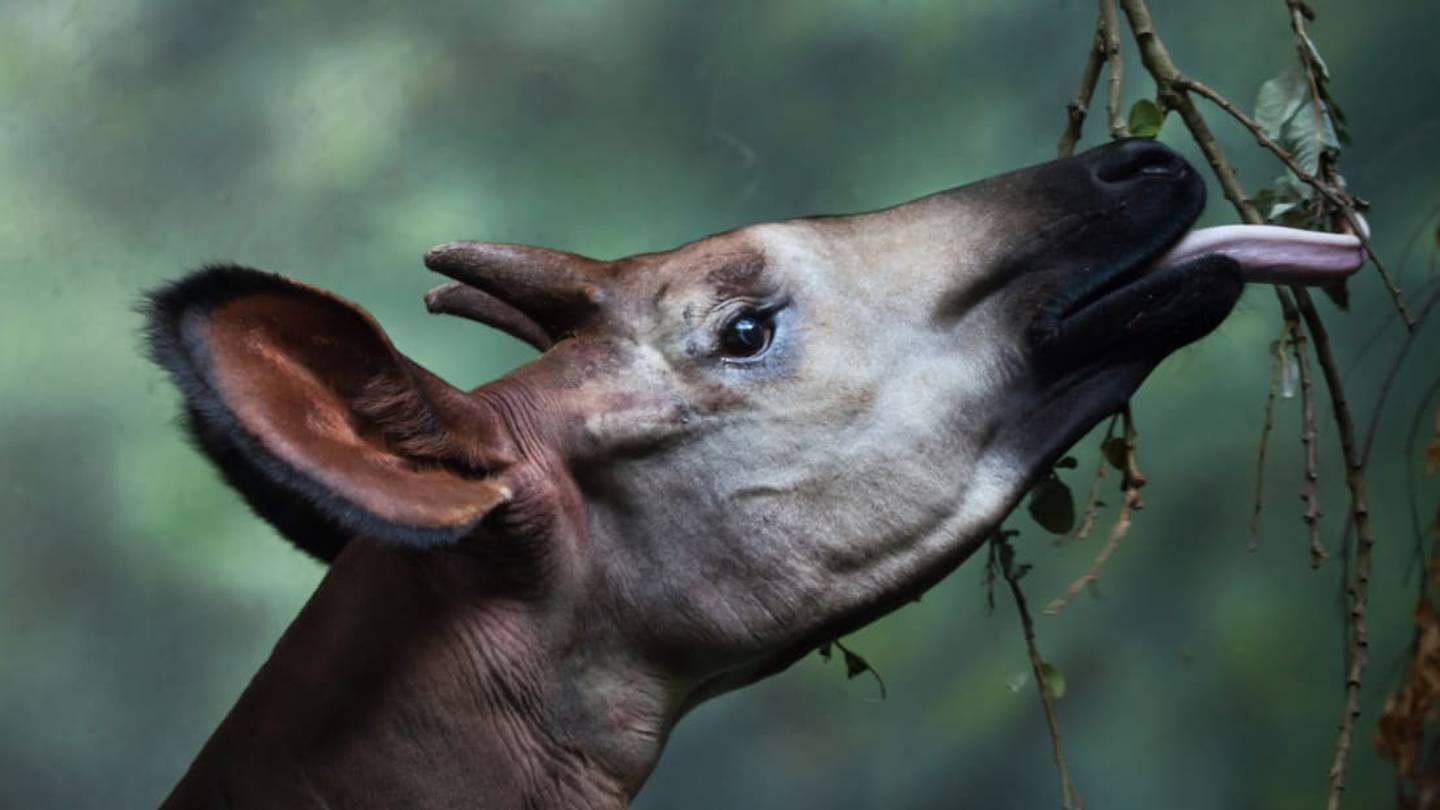
The giraffeâs closest living relative is a striped, long-tongued beast called the okapi. These forest-dwelling creatures are elusiveâso much so that the species wasn't discovered by western scientists for centuries. Hereâs what every animal enthusiast should know about okapis.
While traveling through central Africa in the 1800s, European explorers would sometimes hear reports of a shy, hoofed, forest-dwelling mammal with distinctive striped hindquarters. During the late 1870s/'80s, a Russian adventurer named Wilhelm Junker managed to obtain a sample of the animalâs hide. Noting its stripes, he misidentified its owner as some new species of zebra, antelope, or chevrotain .
Rumors about the mystery creature eventually reached Sir Harry Hamilton Johnston , a British colonial administrator with a passion for biology. In 1899, he was appointed Special Commissioner of Uganda, and the following year, Johnston was given two shoulder belts made with the skins of an animal the locals called â oâapi .â Then, in 1901, he received three more specimens: an entire hide and two isolated skulls. Their anatomy demonstrated that the species was in fact a close cousin of the giraffe. By the end of the year, a correspondent of Johnstonâs had announced the existence of this animalâwhich we now know as the okapiâin a scientific paper, with the scientific name Okapia johnstoni .
How did the okapi, which stands over 5 feet tall and can weigh between 440 and 770 pounds , go undiscovered by scientists until 1901? The speciesâs preferred habitat played a big role in keeping it off the radar. Even today, scientists have a hard time locating or monitoring okapis because they live in dense, inhospitable forests. Since the striped herbivores are so difficult to observe in the wild, we know very little about their social habits. But with this said, it would appear that okapis lead a solitary existence. According to data collected from radio collars, adults spend most of their lives inside of a territory that might overlap with those of other individuals, but okapis seldom cross paths. While newborn calves will hang around their mothers until they mature, the evidence suggests that full-grown okapisâunlike giraffesâdonât travel together (although other researchers have noted that okapis might travel in pairs on rare occasions).
Both of these herbivores have long, prehensile tongues that help them pull leaves off of tree limbs. The tongues are bluish or grayish in color over the first several inches, which scientists believe prevents them from getting sunburned . A giraffe can be up to 19 feet tall âso relative to its smaller body size, the okapiâs 14- to 18-inch tongue is more impressive than the giraffeâs 20-inch tongue.
We know from a range of evidence that okapis once lived in Uganda. Unfortunately, they seem to have gone extinct there. Currently, wild okapis can only be found within the neighboring Democratic Republic of the Congo, where they live in the dense forests of the northern and central recesses. Population estimates vary , but most scientists think that just 10,000 to 50,000 non-captive okapis are left in the world. Theyâve recently been classed as endangered across their entire range.
Okapis are sexually dimorphic, which means there are visible differences between the sexes that have nothing to do with their reproductive organs. For example, male okapis have a horn structure called an ossicone (like a giraffe), but females donât have real horns, and instead have bumps . When mating season arrives, rival bucks will often use the horns to flank one another.
These browsers subsist on a varied diet that includes the seeds, fruits, and leaves of more than 100 different types of plants, and the occasional fungi. To obtain important minerals, okapis will also lick clays that they find at riverbanks and eat charcoal off of scorched trees.
Nobody knows why, but newborn okapis usually donât defecate for the first time until theyâre four to 10 weeks old . (But itâs still unknown how much the peculiar situation of zoos affects this timeframe. Until the late 1970s, many baby okapis were suffering from rectal prolapse because of bored mothers overlicking their youngâs rectal area.) This could be a survival strategy: Fecal material can attract predators, so maybe the absence of bowel movements early on helps to conceal the calvesâ scent from leopards and other carnivores.
On each foot, an okapi has a peculiar gland that sits between the toes and secretes a pungent, waxy material often described as tar-likeâand during forest excursions, they sometimes leave that material behind. Itâs been speculated that this helps okapis mark their territories , which theyâll also do by spraying urine over shrubs. While an adult female will generally ignore other individuals who wander onto her home range, males apparently behave aggressively towards each another and try to ward off intruders of their own sex. (In the process, those horns are put to good use.)
Giraffes and okapis differ from the majority of quadrupedal animals in the way that they walk . To get from Point A to Point B, most quadrupedsâincluding dogs and catsâwill simultaneously move one leg on their right side and another leg on the left side. In contrast, okapis and giraffes swing both right limbs forward at the same time, then theyâll do likewise with both left limbs. (For a visual aid, check out the above video.) However, when thereâs a need for speed, the two species will gallop in a horse-like manner .
Okapis may not be the most vocal of animals, but they arenât mutes either. âWe hear coughs, bleats, and whistles quite often,â Dr. Matt Anderson, a behavioral ecologist whoâs studied the okapis at the San Diego Zoo, notes in a blog post . Mothers will also communicate with their calves by releasing infrasoundsânoises that fall below the normal limits of human hearing. Bioacoustics expert Elizabeth von Muggenthaler recently discussed this phenomenon in a 2013 paper. By keeping close tabs on okapi behavior, sheâs found that you may be able to tell when an okapi is making infrasounds by watching the creatureâs body language. As they generate ultra-low-frequency calls, the animals are known to rapidly jerk their heads upward and point their noses to the sky [ PDF ].
Human cells generally contain 23 pairs of chromosomes, or 46 in total . Dog cells have 78 overall while 38 can be found in those of cats. But okapis are different. Although most have 46 per cell, a few specimens feature 44 or 45 . Whatâs truly baffling about this is that okapis with an atypical chromosome count appear perfectly normal and healthy. The individuals who have 45 per cell are especially perplexing. Animals with an odd number of chromosomes usually exhibit physical abnormalities. Yet in a bizarre twist, the 45-chromosomed okapis look ordinary, as do their offspring . Geneticists are still trying to figure out whatâs going on here.
Loading recommendations... Please wait while we load personalized content recommendations