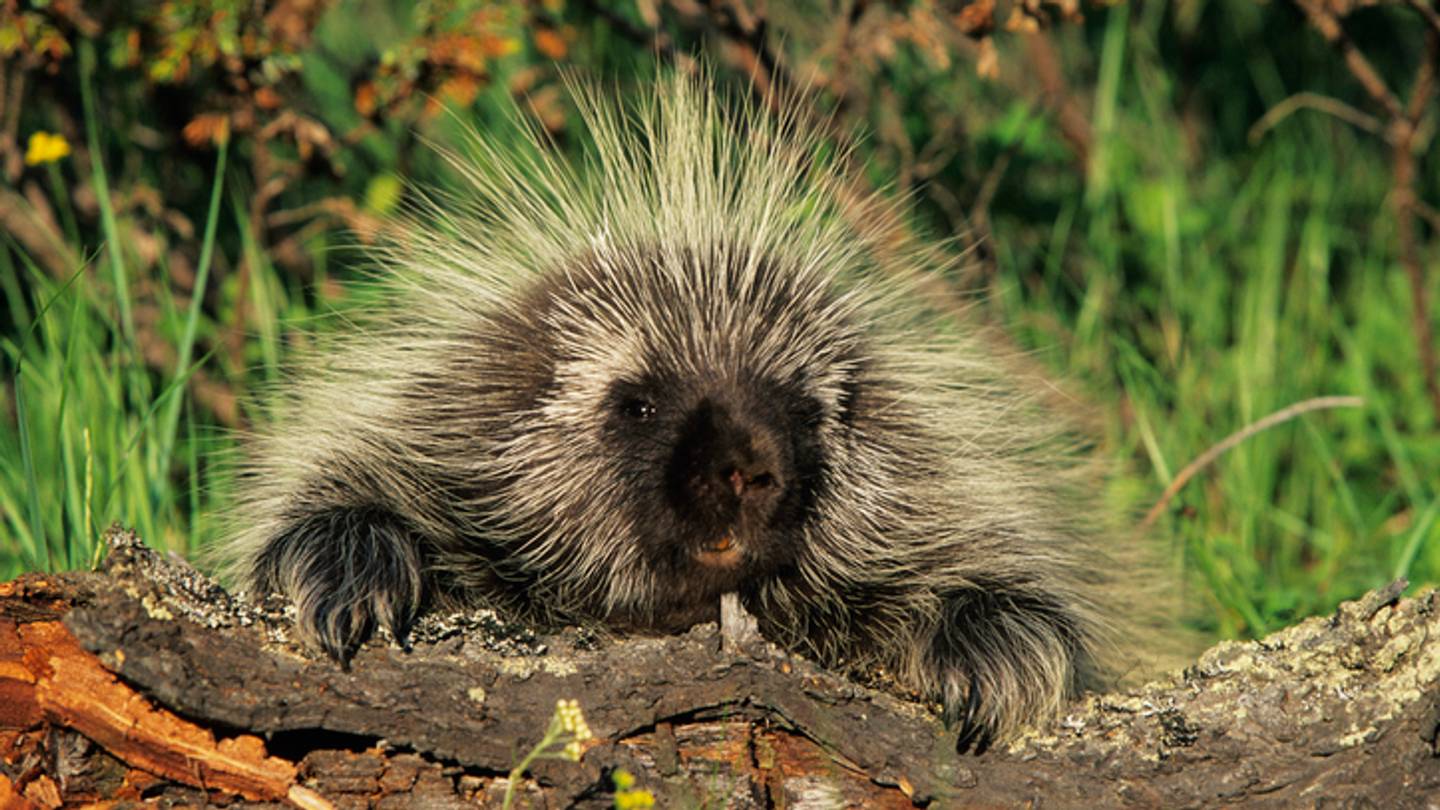
Porcupines might be considered a prickly bunch, but youâll discover these animals are quite docile once you learn more about them.
The word porcupine  is a derivative of the Old French phrase porc-espin , meaning âspiny hog.â Middle and Early Modern English variants included porkenpick and porkpen , as well as porpentine , Shakespeare âs version in Hamlet .
Theyâre behind beavers (in second place) and capybaras , the reigning champs, which are native to South America.Â
When a porcupine feels threatened, it tenses up and attacks predators with a swat of its quill-covered tail. Some quills may become embedded into the predatorâs skin. Occasionally, loose quills fall out before it strikes, creating the illusion that they're being shot from the porcupineâs body, but porcupines canât actually eject them.
A typical porcupine has soft hair mixed in with quills , which grow from its back, sides, and tail.
Old World porcupines in the family Hystricidae live in southern Europe, Asia, and Africa. New World porcupines in the family Erethizontidae are indigenous to North and South America. There are 23 species of porcupine worldwide.
New World porcupines, on the other hand, are adept at climbing trees. They are capable of clinging to branches with their tails and catching surrounding branches and twigs if they fall.
Porcupines are primarily creatures of the night that rest in hollow logs, trees, and crevices during the day, and come out at dusk to feast on tree bark, grass, twigs, stems, berries, and the like.
Each quill is coated with a topical antibiotic âa self-defense mechanism to prevent infection by accidental self-quilling. If you get stuck with quills, the injury wonât necessarily lead to an infection for that reason.
When they grow accustomed to fending for themselves at about 6 months old, baby porcupinesâcalled porcupettesâ leave their mothers.
Each quill boasts between 700 and 800 barbs along its tip.
Typically, two male porcupines fight over a single female. The males are careful not to injure themselves during the fight, and the winner urinates on the female so that she knows to move her tail aside for safe, quill-free mating.
A version of this story was published in 2015; it has been updated for 2024.