If you were asked to name an onomatopoeic word, youâd probably says something like boom , boing , whizz , or smash . Theyâre all perfectly good examples, of course, but onomatopoeia is actually responsible for a lot more words than you might think. For instance, etymologists believe that pebble might have been coined to imitate the sound of flowing water. Laugh might have been invented to sound like, well, a laugh. Owl , crow, and raven are all descended from Old English words ( ule , crawe , hræfn ) that were meant to imitate the owlâs hoot and the crowâs and ravenâs squawks. And the 32 names listed here are all meant to represent the bizarre whoops, chips, peeps, and wows made by the animals they describe.
As well as being a contender for the worldâs shortest animal name, ai (which should be pronounced âah-ee") is another name for a three-toed sloth, especially the pale-throated sloth, found in the far northeast corner of South America. Although sloths are generally fairly docile, the name ai is apparently meant to resemble the high-pitched cry they can make when theyâre agitated or alarmed.
As the name of a type of water bird, no one is entirely sure where the name bittern comes from. The most likely theory is that it is a mangled version of a Latin word essentially meaning âbull-heronââand if thatâs the case, then the name is probably meant to be a reference to the bitternâs bizarre booming or âmooingâ call .
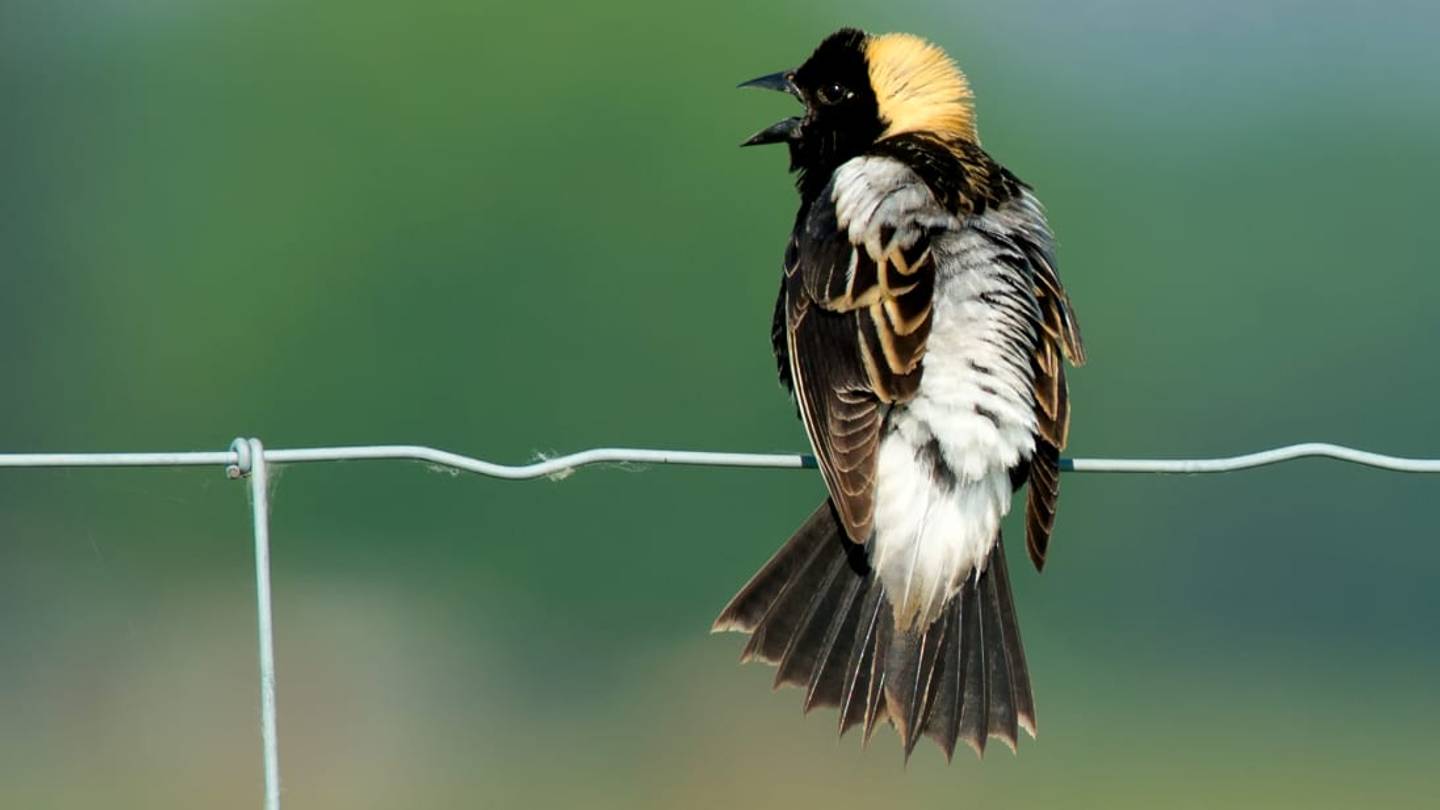
Bobolinks can produce very long and surprisingly complex songs, but their usual go-to noise is a brief four-note call thatâs commonly said to sound like someone saying âBob-o-Lincoln.â The name Bob-o-Lincoln eventually was shortened to bobolink in the 1800s.
Catbirds are family of medium-sized songbirds found across the Americas, Africa, and Australasia. Their name refers to their raucous wail-like calls , which supposedly sound like the mewing of a cat. This bizarre sound is even the origin of the birdsâ taxonomic name: ten of the worldâs 14 known species of catbird belong to a genus named Ailuroedus, which literally means âcat-voiced.â
The chiffchaff is one of the most widespread members of the warbler family of birds, found across Europe, western Asia, the Middle East and north Africa. Throughout that range, itâs been given a number of different names meant to replicate its simple but instantly recognisable two-note call . It might be called the chiffchaff in English, but in Dutch itâs the tjiftjaf; in Welsh itâs the siff-saff; in Turkish itâs the çıvgın (pronounced âchiv-ginâ); and in German itâs the Zipfzapf.
One theory claims that the name chipmunk is an English interpretation of a native Ojibwe word, ajidamoo , meaning something like âred squirrel.â But because chipmunks were originally known as âchipping squirrelsâ in English, it seems more likely that the name is actually an English invention, in which case itâs probably meant to describe their short âchippingâ call.
The chowchilla is type of logrunner, a small thrush-like bird, thatâs native to Queensland, Australia. For a bird not much larger than a robin, the chowchilla has a particularly noisy call that to early European colonists and explorers apparently sounded like âchow-chilla-chow-chow.â The chowchilla was also once known as the âauctioneer bird,â apparently because (with a bit of imagination) its song sounds like an auctioneer 's incessant chattering.
A cousin of the better-known whippoorwill, the chuck-willâs-widow is another species of nightjar (a family of nocturnal birds related to swifts and martins) native to the southern United States and much of Central America. Dozens of different species of nightjar are found all over the world, and they all share incredible camouflaged plumage and strange whooping callsâso if the âwhippoorwillâ makes a noise that sounds like poor Will is about to be whipped, then the âchuck-willâs-widowâ makes a sound like poor Willâs widow is about to be chucked .
Crakes are a large family of birds related to coots, moorhens and rails. No one is entirely sure whether their name was coined in English (in which case itâs probably meant to echo the weird croaking sound they make), or whether it comes from an old Scandinavian word for a crow, krakr (which was likewise invented to sound like the croaking of a raven). In the case of the corncrake bird in particular, however, the name is doubly onomatopoeic: the corncrakeâs Latin taxonomic name, Crex crex, as well as its common English one, is meant to reproduce its bizarre, grating call .
Weâll get onto geckos in a moment, but first itâs worth singling out the New Caledonian giant gecko or âdevil-in-the-treesâ in particular. The largest species of gecko in the world, the New Caledonian giant reaches an impressive 14 inches in length from nose to tail. Among English speakers (and gecko enthusiasts) itâs known as the leachie; both this and its scientific name Rhacodactylus leachianus are meant to honour the 19th century English zoologist William Elford Leach. But to the native New Caledonians, the leachie is better known as the devil-in-the-trees, thanks to the spooky, demonically rasping noises that it makesâwhich, in the darkness of a tropical forest, could understandably sound fairly unnerving. Local tradition even claims that the giant geckoâs super-sticky feet give it the ability to pull a soul out of a personâs body.
Also known as the little meadowlark, the American dickcissel bird takes its name from its chirruping call that, with a little bit of imagination, supposedly sound like a repeated âd-d-dick, ciss-ciss-cissel.â
Barely a foot tall at the shoulder and weighing as little as 8lbs, dik-diks are among the smallest antelopes in Africa. Their name derives from their alarm call, and is meant to imitate the short, repeated notes the dik-dik produces when threatened.
One of only a few species of woodpecker that are migratory, American flickers are said to take their name from their chattering, âflickeringâ call . A number of the birdsâ regional nicknamesâincluding harry-wicket, walk-up, heigh-ho and wake-up birdâare likewise said to be based on their characteristic back-and-forth calls.
The peculiar croaking noise made by the gang-gang cockatoo of southeast Australia has been likened to everything from a creaking wooden door to a cork being pulled from a wine bottle. However you might want to describe it, the onomatopoeic name gang-gang was adopted into English from a Wiradhuri name that was supposed to imitate it.
They might be best known for their ability to walk upside down on the ceiling thanks to their amazingly specialized feet, but geckos also make a name for themselves (quite literally) by producing a whole range of bizarre croaking soundsâincluding a characteristic two-note rising and falling call that is believed to have given them their name.
Yes, this is a real bird. Yes, itâs grey. And yes, itâs call really does sound like someone saying âgo away.â
Itâs fair to say fish arenât among the noisiest of animals, but the grunt is at least one exception. Grunt fish are found mainly in the north and west Atlantic, and are so called because they produce a loud scraping âgruntâ sound when threatened. The sound is made by grinding together tiny rows of pharyngeal teeth the fish have hidden behind their gills.
The hoolocks are a family of three different species of gibbon native to parts India, Bangladesh and southwest China. Their name comes from the local Assamese language of east India, and is supposed to replicate the raucous whooping sound the hoolocks make.
The hoopoe is a striking-looking songbird whose name is meant to imitate its strange whooping call. Their bizarre appearance has also helped make them the frequent subject of myths and folktales over time: the Ancient Egyptians worshipped them and drew pictures of them inside the pyramids; the Romans believed that they were filthy creatures because they fed on dung and frequently nested in graveyards; and at least one old European legend claims that the younger birds look after the older ones in their old age, restoring their youth by plucking out dying feathers and licking blindness from their eyes.
Katydids make their loud and often three-syllable âka-ty-didâ call by rubbing their forewings together. They hear each other, incidentally, with ears located on their front legs. There are more than 6000 species in the katydid family, found on every continent except Antarctica.
The name macaque was borrowed into English via French in the late 17th century, but itâs thought to originally derive from an old Bantu name, kaku , for any of the numerous monkey species found in West Africa. The name kaku is in turn supposed to be imitative of a monkey call, and itâs from the plural form of kaku ânamely makaku in Bantuâthat the word macaque eventually evolved.
Also known somewhat less memorably as the Tasmanian spotted owl, the morepork is a small forest-dwelling owl found in southern Australia and New Zealand. Its name is supposed to imitate its characteristic hooting call , which is supposed to sound like someone asking for âmore pork.â Or at least thatâs one interpretationâother local names for the morepork that are likewise said to replicate its call include boobook, bug-bug, ruru, and herooroo.
The American white-throated sparrow is also known as the peabody bird. It might be tempting to presume that name must refer to the birdâs discoverer, but actually itâs a concocted name based on nothing more than the similarity of the birdâs call to the surname Peabody. As the Oxford English Dictionary explains, the peabodyâs song is ârendered as âSow wheat, Peabody, Peabodyâ¦ââ Another interpretation claims it sounds more like âOld Sam Peabody, Peabody!â, while another suggests its call sounds more like âO, sweet Canada, Canada.â You can decide for yourself here .
A type of plover with characteristic green plumage and a long curled crest, the northern lapwing has a number of nicknames in Englishâincluding the peewit , the swipe , the peepsweep , the teewhit , and the teeack âevery one of which is supposed to emulate its noisy alarm call. The common name lapwing , incidentally, refers to the birdâs tactic of feigning a broken wing in order to distract predators from their nest when they feel threatened.
The petchary is a large shrike-like bird found across the Gulf of Mexico and the Caribbean, from Florida, Cuba and the Bahamas in the north to Panama, Colombia and Venezuela in the south. First recorded in 1840, the name petchary is apparently meant to imitate the birdâs trailing, descending three-note call âthough today, it is better known as the gray kingbird.
Piet-my-vrou is another name for the red-chested cuckoo, a species of cuckoo found across much of sub-Saharan Africa. Cuckoos are well known for their instantly recognizable call, and itâs the loud three-note descending call of the piet-my-vrou (which literally means âPete my wifeâ in Afrikaans) that gives it its name.
Okay, weâre bending the rules a little for this one. Also known as the snowy tree cricket, the thermometer cricket is so called not because of the sound makes, but the rate at which it makes it. Like all crickets, the thermometer cricket makes a soft chirruping sound. Count the number of chirps it makes in 15 seconds, then add 40 to that total, and youâll have a fairly accurate estimate of the current ambient air temperature in degrees Fahrenheit. Incredibly, thereâs a wealth of scientific research behind this calculation, and even a somewhat complex ruleâknown as Dolbearâs Law âto describe it.
The veery is an American thrush, whose name according to Merriam-Webster is âprobably imitative of its downward-spiraling song .â
Never heard of a whistlepig? Actually, you probably have. This is just another name for the American groundhog, so called because it makes a loud whistling sound when threatened or alarmed.
The wistiti is another name for the common marmoset, a small monkey native to the far northeast of Brazil. It derives from the French word for a marmoset, ouistiti, which is itself meant to imitate the creatureâs high-pitched cry.
Gibbons are famous for their lengthy and surprisingly complex songs, and the whooping or âwowingâ call of the wow-wow or wawaâa local Indonesian name for either the agile gibbon or the silvery gibbonâis no exception. Sadly both species are now listed as endangered, due to their localized distribution and on-going habitat destruction.
The bizarre Z-hogging word Zyzzyx has two claims to fame. Firstly, itâs often touted as the last dictionary word in the English language. Secondly, it appeared in the title of the 2006 movie Zyzzyx Rdâwhich set an all-time record when it earned just $30 at the box office. Besides that, itâs also the name of a genus of sand wasp supposedly suggested way back in 1930s as an attempt to imitate the characteristic buzzing sound the insects make.
This story first ran in 2014.
Loading recommendations... Please wait while we load personalized content recommendations