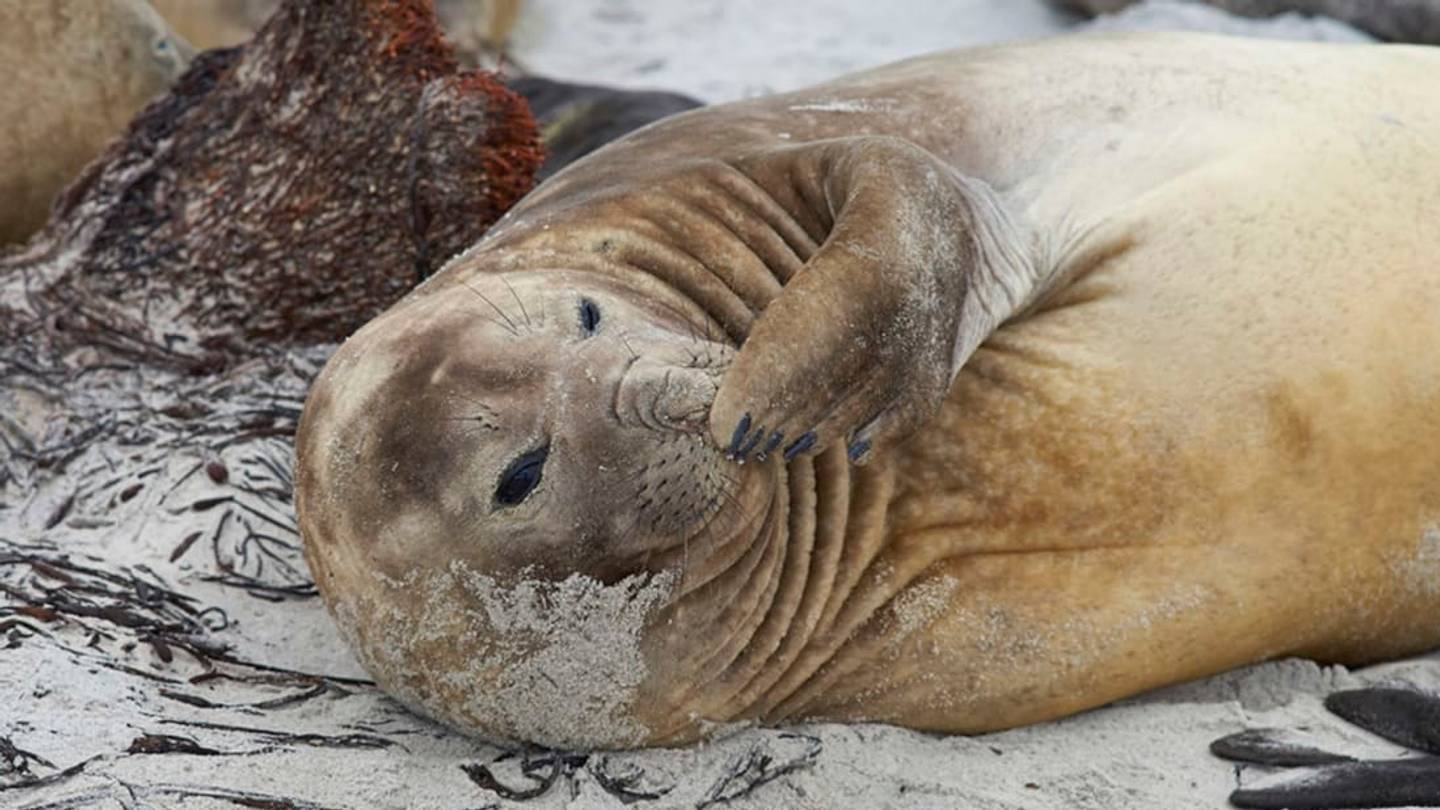
Extreme divers and polygamous lovers, these âelephants of the seaâ are some of the oddest marine mammals aliveâwhich is saying something.
Hit any beach from Alaska to Mexico and you just might spot a northern elephant seal ( Mirounga angustirostris ) colony. Of the two species , this oneâs smaller in overall sizeâthough males come with longer trunks. To spot southern elephant seals ( Mirounga leonina ), you'll have to travel below the equator.
Slaughtered en masse for their oil-producing blubber, the northern elephant seal was at one time close to extinction. By 1892, many assumed that this poor species had quietly disappeared forever.
However, a small breeding colony managed to endure. It was estimated that, in 1910, some 20 to 100 northern elephant seals were still alive. All of these survivors dwelled on or around Guadalupe Island off Mexicoâs Baja California coast. Things finally started to turn around for the species in 1922, when the island became a biological reserve , and the seals received government protection. Since then, the global population has ballooned up to 160,000âall of whom are descended from those Guadalupe Island holdouts.
Seals, sea lions, and walruses are collectively known as pinnipeds. Unlike most other ocean-going mammals (like whales and dugongs), these beasts arenât fully aquatic: They clamber out of the water to rest, molt, mate, and rear pups. There are 33 known pinniped species , and the absolute biggest is the southern elephant seal. From end to end, large individuals can grow to lengths of 20 feet and weigh up to 8800 pounds .
Next to a 4.5-ton bull, female southern elephant seals look puny. In general, males are seven or eight times heavier than females and can be twice as long. For northern elephant seals, the situation is similar, but less extreme. In this species, males max out at around 13 feet long and 4500 pounds , while the heftiest females are some 3000 pounds lighter and 3 feet shorter in length.
In 2012, marine biologists tracked a northern femaleâs progress as she descended to the amazing depth of 5788 feet under the surface. Elephant seals are great at holding their breath and can remain submerged for up to two hours straight.
What exactly do elephant seals do during those epic dives? Grab some calamari. By dissecting stomachs from dead specimens, scientists have learned that the mammals have a squid-based diet . Elephant seals also eat fish and crustaceans âalbeit less often.
A maleâs most conspicuous feature is, of course, something that females lackânamely, his bulbous nose, which comes with a sack-like appendage known as a proboscis . Expanding the proboscis enables an elephant seal to amplify snorts, grunts, and loud, drum-like bellows that can be heard several miles away.
The proboscisâs main function is to emit noises thatâideallyâward off rival males, stopping fights before they start. Over time, a masculine hierarchy is establishedâbut it looks like a bull canât climb very far up the ladder until heâs backed up a few threats.
For a four year period beginning in 2009, a team from the University of California Santa Cruz conducted an experiment with some nearby elephant seals. The scientists set up shop along the beaches of Año Nuevo State Park and recorded the warning calls made by individual males who frequented the area, then broadcasted them over a speaker later.
âWhat we were interested in is what type of information is contained in the vocalizations produced by males and how this information is used during the breeding season,â graduate student Caroline Casey says in the above video. âWe found that when we played back the call of an animalâs most familiar dominant rival, he actually moved away from the speaker.â Conversely, broadcasting grunts from a subordinate triggered the opposite reaction. In that situation, Casey says, the same male âattacked, or called at the speaker.â
But how would a bull from some completely different breeding colony react? To find out, Casey and her colleagues visited a cluster of elephant seals residing 300 miles south. By and large, the teamâs recordings had no effect there. âOnly three out of the 20 males that we did playbacks to moved at all,â Casey says.
The researchers concluded that a âback off!â cry means nothing if the listener doesnât recognize the voice in question. According to Casey, âThey only really know how to assess these calls if theyâve had previous interactions with [the callers].â
On dry land, elephant seals often go without drinking for extended periods. To avoid dehydration, their kidneys can produce concentrated urine that contains more waste and less actual water in every drop. After a few drinks, they switch back to excreting standard pee.
A colonyâs most dominant bull âalso known as a âharem masterâârounds up many of its females for himself. He then more or less maintains exclusive reproductive access to just about every single one of themâthat is, until a competitor dethrones him.
A massive elephant seal paternity test revealed just how prolific a harem master can be. Conducted in the Falkland Islands, this study examined one large colony over a two-year period. A whopping 90 percent of documented pups were fathered by dominant males, and harem masters produced as many as 125 offspring. On the other hand, 72 percent of subordinate males were never observed matingânot even once. Tough break.
When a mother elephant seal gives birth, the milk she secretes is around 12 percent fat. Two weeks later, that number increases to over 50 percent , giving the liquid a pudding-like consistency. By comparison, cow milk is only 3.5 percent fat .
Once the lactation process starts, these pups grow up fast : In just 30 days, an average pup will go from weighing 75 to 300 pounds.
In The Lord of the Rings: The Fellowship of the Ring , scrawny, cave-dwelling Moria orcs emit an eerie battle screech. When creating their cries, sound effects designer David Farmer found an oceanic source of inspiration.
â[The] major signature sound for them was ⦠elephant seal pups,â he said in 2010 . Farmer describes the unique noise as "a nice projecting call," lending itself nicely to reverberation. "The scene in the mines of Moria at the 'Drums in the deep' are all elephant seals distanced.â
These aren't the only pinniped noises in the trilogy. According to Farmer, the muscle-clad Uruk orcs were vocally based âon sea lions, especially for the pain reactions, with tigers and leopards for more aggressive attacks.â
All was peaceful in Gisborne, New Zealandâuntil Homer came along. Named after everyoneâs favorite Simpsons character, Homer was, according to the narrator of the above video, âa 14 foot-long, 4500-pound [southern] elephant seal who likes to turn parked cars into punching bags.â
His reign of terror began in May 2000. Seemingly without provocation, Homer rose from the depths and attacked at least three cars , multiple boat trailers , a pothutukawa tree, and a trash bin. In the process, he became something of a minor celebrity, appearing on news broadcasts all over the world. Later, Homer strolled over to an unsuspecting restaurant, struck the outside transformer, and singlehandedly knocked out the establishmentâs power .
Weird as it may sound, these all could have been crimes of passion. âHomer has got a bit of a problem,â Andy Bassett, a member of New Zealandâs Department of Conservation, told the BBC . âHeâs actually attracted to cars, and his two tonnes rubbing on a car makes a bit of a dent. We are hoping that he will take off and go back to the sub-Antarctic and try to look for lady friends down there.â
Soon enough, Homer did indeed bid Gisborne farewell, but itâs fair to say that the townspeople will never forget him.
All images courtesy of iStock
Loading recommendations... Please wait while we load personalized content recommendations