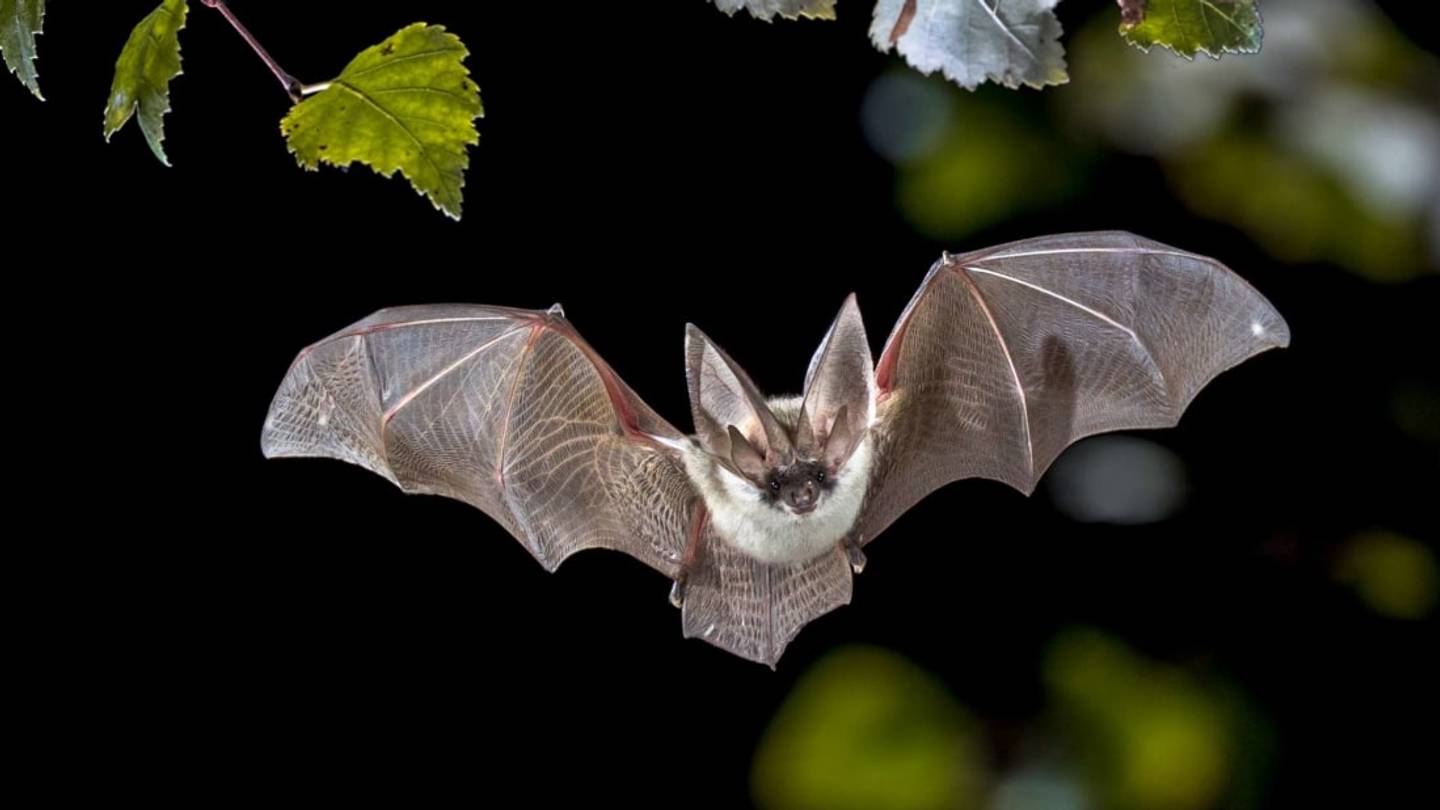
Roughly one in five mammal species is a bat. You may have heard of the famous vampire bats that feed on blood, but some lesser-known species use sonar to catch fish, scurry across the ground like mice, build their own tents, and even stick to sheer walls with suction cups. Letâs get face to face with some of the most bizarre bats in the world.
If you want to attach something to a smooth vertical surfaceâa car window, maybe, or a slippery shower wallâyou might use a suction cup. Disk-winged bats use them, too. They have special cups on their ankles and wrists that help them stick to smooth tropical leaves. This gives them a high, safe place to rest in the bustling tropical forest. Sucker-footed bats, meanwhile, hang on using wet adhesionâthey ooze a liquid that helps them cling to a surface.
When bats hunt insects at night, they find their prey with an amazing sonar-like ability called echolocation âthey make sounds that bounce off objects, then listen to the echoes for clues about whatâs ahead. But the greater bulldog bat, which is named for its dog-like face , uses this sonar to catch fish. Flying above the water, it senses telltale ripples caused by the underwater movements of its prey. It skims the surface with its large feet and swiftly snatches a slippery meal.Â
Kittiâs hog-nosed bat is the worldâs smallest batâand, in fact, itâs in the running for the worldâs smallest mammal. This animal is just a little over an inch (33 millimeters) long and weighs less than a penny. Itâs also unique: its ancestors split off from other bats more than 40 million years ago . Kittiâs hog-nosed bat is native to Burma and Thailand, where itâs vulnerable to habitat destruction.
If you take a backwoods survival class, youâll learn to build a shelter out of the natural material around you. And if youâre like most beginners, your first few shelters might fall down or let in too much rain. Shelter-building is a hard skill to masterâbut some bats have got it down . They gnaw the veins of a large tropical leaf, making it fold into a tent that protects them from rainfall and predators. One of these tent-making species is the Honduran white bat . A group of these animals snuggling under their tent looks like a pile of marshmallows .
When a New Zealand lesser short-tailed bat is hungry, it hits the ground. It folds its wings up tight and uses them as forelegs as it scurries, mouse-like, across the forest floor in search of a snack. This batâs diet is very diverseâit will eat nectar, pollen, berries, insects, and more.Â
Bats arenât just brown. The painted woolly bat of Southeast Asia is orange and black like a jack-o'-lantern . Indonesiaâs stripe-faced fruit bat is also ready for Halloween with some spooky makeup. Then thereâs the stunning pied bat ; an inhabitant of central and western Africa, it has striking white blotches that make it look like a badger or a panda. These are just a few of the worldâs many , many beautifully patterned bats.
Native to sub-Saharan Africa, Chapinâs free-tailed bat has a wicked hairstyle . Females sport a small tuft of fur that sticks up, but males have much larger crests that play a role in their courtship, and also just look cool.
Move over, nightingales. The males of several bat species woo their mates with tunes that are every bit as complex as those of songbirds. For instance, to construct a proper song, a Brazilian free-tailed bat needs to follow certain rules and patterns, but like a great improvisational musician, he also adds his own special style that marks him as unique.
How do bats learn these complicated songs? They pick them up from their parents. The greater sac-winged bat of Central and South America hones its singing skills as a baby. Like human kids, young sac-winged bats babble as they try to copy their dadsâ sounds.
Bats have some truly bizarre faces , but one of the all-time weirdest belongs to the male hammer-headed fruit bat of equatorial Africa. Females of this species have a relatively ordinary foxlike head. But males have heads that are almost three times as large as a femaleâs. Their faces look even weirder from the front. Why that giant face and protruding lips? They help this bat make a unique honking call .
The desert long-eared bat chows down on scorpionsâand doesnât mind being stung in the face as it pounces on its prey. Native to parts of Africa, the Middle East, and Asia, this bat catches scorpions by attacking their heads. The scorpions vigorously defend themselves by stinging the bat on its face and body. Unperturbed, the bat dispatches its meals and carries them back to a roost. There, it gulps down every bit of a scorpionâeven the stinger.
The desert long-eared bat isnât fussy about which scorpion species it hunts. Itâll even chow down on the deathstalker , one of the few scorpions in the world whose sting is potentially deadly to humans.
Bees are famous for pollinating crops, and they help us grow such familiar foods as apples, pumpkins, and macadamia nuts. But bats are pollinators, too. Those huge Saguaro cacti of the U.S. Southwest, for example, bloom in the evening to attract pollinating bats. And the agaves that give us tequila are also bat-pollinated; they make stinky flowers on tall stalks that open at night. Wild bananas rely on bats, too.
The tube-lipped nectar bat âs tongue is 1.5 times the length of its body. This bat uses its monstrous tongue to reach tasty nectar thatâs deep inside long-tubed flowers. When the tongueâs not in use, itâs stored in the batâs chest, next to its heart.
Certain fruit-eating bats have a wingspan of over 5 feet. One of the largest is the golden-capped fruit bat of the Philippines. Named for its shock of blond âhair,â it can weigh more than 2.5 pounds. It roosts in large numbers and dines on fruit such as figs. Deforestation and hunting, however, have put serious pressure on this batty behemoth.
Many insect-eating bats use echolocation to hunt down their flying prey. But some moths fight back. They rub their genitals together to make sounds that interfere with a batâs sonar. Confused, the hungry bats zero in on the wrong location and bite at empty air.
This acoustic warfare isnât just limited to bats vs. moths. Researchers have found that Mexican free-tailed bats seem to jam each otherâs signals when theyâre competing for prey.
Weâve established that bats have weird faces. Some bats have yellow tube-shaped nostrils . Some look like their faces collapsed inward . Some are mostly made of ears . But letâs end this list with one of the most extraordinary-looking species. Bourret's horseshoe bat, which lives in Southeast Asia, has a face that suggests an origami project gone wrong . Why the long nose? Itâs perfectly shaped to help focus the batâs sonar .
Loading recommendations... Please wait while we load personalized content recommendations