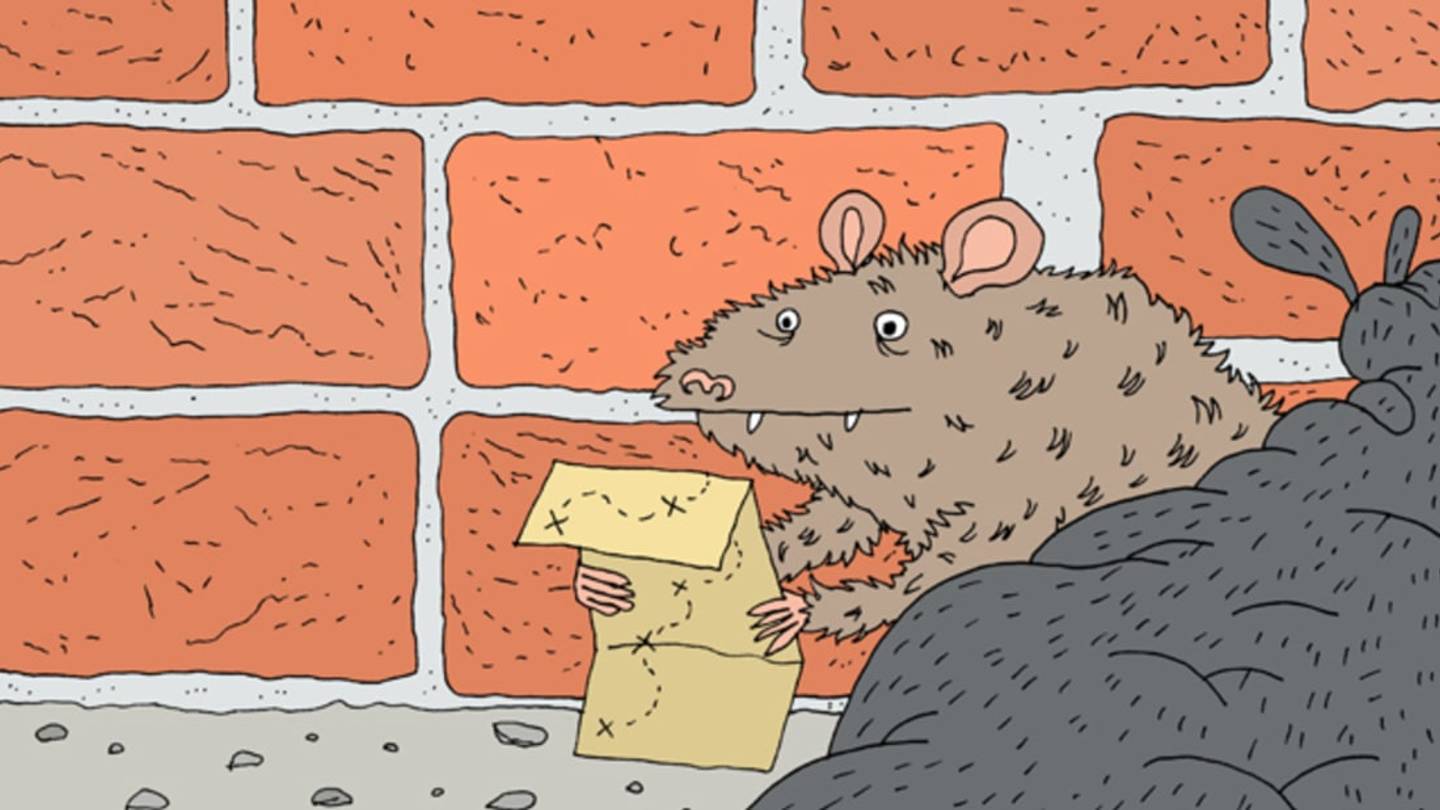
Most people think rats are gross. Filthy and unwanted, theyâre known for carrying diseases and sometimes giant pieces of pizza . But Robert Sullivan thinks differently: in 2004, Sullivan published a masterpiece on the critters, Rats: Observations on the History and Habitat of the Cityâs Most Unwanted Inhabitants . In it, Sullivan spends a year staking out alley rats, interviewing rat catchers, and digging through the crittersâ contribution to history from housing reform to entertainment. Here are seven short facts we canât stop thinking about from Sullivanâs incredible book.
Rats are thigmophilic (touch loving). As Sullivan points out, itâs why they feel most comfortable in corners, where they can feel up against a wall while scouting for an escape route. As they weave their way through trash-strewn alleyways, stumble through pipes, and flee across kitchen floors, rats âdevelop a muscle memoryâ of the spaces, and the best ways to get to their destination. Oddly enough, this knowledge is passed on when a rat dies: In Sullivanâs words, âDeep in their rat tendons, rats know history.â Younger rats follow the lead of older rats and learn these routes for themselves, preserving the pathways to food and safety for another rat generation.
According to Sullivan, subway workers in New York call the rats that live in stations and hop around the rails âtrack rabbits.â
Decked out in a top hat and sash decorated with cast-iron rats, Jack Black was an early pioneer of rat catching. Black dubbed himself the official rat catcher of Queen Victoria, even though he never had a royal decree from herâthough he did once sell her some rats. While Black spent most of his time catching the critters, he also collected them and sold them to Victorian women as pets. Queen Victoria was one of his clients, as was childrenâs book author (and scientist ) Beatrix Potter. Black was an equal-opportunity seller. Some of his rats went to rat pits (see below). Meanwhile, others became some of the earliest lab rats, including a specimen of albino rats he sold to scientists in France. As Sullivan theorizes: âI like to think that all the great scientific achievements that have been made in the modern scientific era as a result of work with laboratory rats are ultimately the result of the work of Jack Black, rat catcher.â
When rats were spotted on the southeastern border of Alberta, Canada, in 1950, the Canadian government sprung into action with an intensive rat-control program. The Alberta agricultural department told Sullivan the program has kept Alberta âan essentially rat-free province.â Still, there have been moments when the rats have made inroads, as Sullivan notes: âAlberta did have rats in its border areas for a brief period, and at that time, one Alberta mayor refused to believe it. He stated that he would eat any rats found in his town.â He had a change of heart, however, when âpresented with a bushel full of Rattus norvegicus .â
In the 1830s (well before The Bachelor was the cruelest spectacle the public could stomach), rat fighting was all the rage. Onlookers would bet how long it would take for a dog to kill a group of rats. One of New York Cityâs biggest pits was owned by Kit Burns, an Irish immigrant linked to the infamous Dead Rabbits Gang. Burns operated his pit out of Sportsmanâs Hall, located at 273 Water Street, where he had numerous dogs ready for the matches (âJackâ and âHunkyâ were two of his favorites). Occasionally, Burns even subbed in ferrets. But he never crossed one line that other pits did: putting men in the ring.
By the late 1860s, rat pits were under fire. The founder of the Society for the Prevention of Cruelty to Animals, Henry Bergh, was pushing for raids across the city, and Sportsmanâs Hall was one of the last operating rat pits. Before long, Kit started diversifying his income. He rented the bar out to prayer meetings in the morning, and then rented it out for three full years as The Kit Burns Mission, a home for âwayward women.â
But Burns didnât exactly give up rat fighting: 10 years later, he and the crowd at his new bar The Band-Box were busted for a rat fight on November 21, 1870. He died of a cold before he could be brought to trial. As for Bergh and others pushing back against animal cruelty, itâs thanks to their work that rat pit fights have faded both in popularity and from memory.
You know James Audubon for his iconic The Birds of North America . But did you know that the guy who traveled across the early United States documenting its avian wildlife also had a thing for rats? He made this lithograph of Black Rats snacking on eggs in a barn. He also used his downtime to chase after them. When he was living in New York in 1839 he got the city's mayor to let him âshoot Rats at the Battery early in the morning, so as not to expose the inhabitants in the vicinity to dangerâ¦â Turns out, in addition to being one of Americaâs foremost naturalists, Audubon was also considerate to his neighbors.
Sullivan speaks highly of Pest Control Technology magazine throughout Rats : He attends one of their âRat Management Summitsâ and reads columns in the magazine by rat control legend Bobby Corrigan, author of the industry standard Rodent Control: A Practical Guide for Pest Management Professionals . The magazineâs website features a regular podcast interviewing pest catching pros, and also, occasionally, poetry.
For more on Sullivanâs wonderful book, be sure to click here .
Loading recommendations... Please wait while we load personalized content recommendations