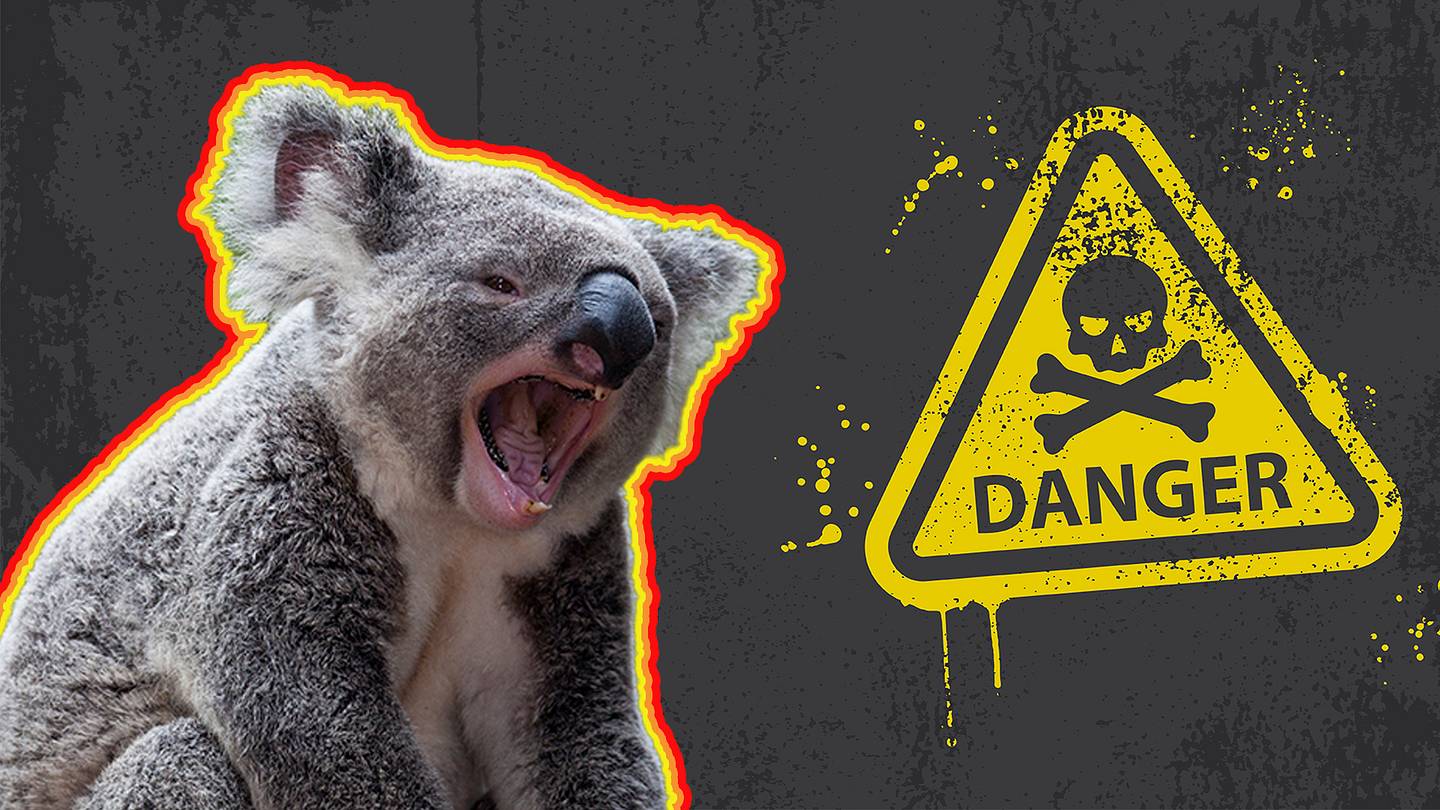
Theyâre cute. Theyâre cuddly. But beware: Theyâre dangerous.
It may seem hard to believe, but these seemingly cuddly creatures have a dark side. Most of the time, the tree-huggers keep to themselves, adhering to a strict schedule of snacking and snoozing (up to 22 hours a day!). But sometimes, a koala snaps. Koala-on-koala violence is generally pretty mild , but they have been known to go after dogs and even humans.
For example: In December 2014, Mary Anne Forster of South Australia found herself at the receiving end of a vicious bite after trying to protect her two dogs from an aggressive koala. The koala sank its teeth into Forsterâs leg and refused to let go, relenting only after she reached into its mouth and pried its jaws apart with her hands. Forster then walked her dogs more than a mile back to her house before going to the hospital for stitches.
Beavers have huge, razor-sharp teeth that never stop growing. Theyâre fiercely territorial. They build complex underwater lodges with architectural precision. And, most importantly, they can be bold. There was the fisherman in Belarus who died when a beaver bit through his femoral artery. At a lake in an Alaskan dog park , angry beavers sent a half-dozen dogs to the emergency vet for stitches, prompting park officials to post signs reading âWARNING AGGRESSIVE BEAVERS ARE LIVING IN UNIVERSITY LAKE!â
And those are just the healthy, well-adjusted ones. Rabid beavers have gone after swimmers in Canada and the U.S., including an 83-year-old woman in Lake Barcroft, Virginia. âThere is no way I will swim in that place again,â she said after the incident.
Not all cows have a mean streak. But some cowsâlike Heck cattleâdo, and theyâre terrifying.
In the 1920s and â30s, German zoologists (and brothers) Heinz and Lutz Heck each sought to recreate the extinct wild ox called the aurochs , which featured heavily in Teutonic mythology. Heinz Heck chose Spanish fighting cattle as a breeding strain for their prehistoric shape and aggression, and the Nazis used their fierce image in propaganda. Then, World War II happened. The Nazis fell, but the uber-cows survived.
Heck cattle still roam Bavaria to this day and are available for purchase. Farmer and photographer Derek Gow brought a herd of Heck cattle to his UK farm in 2009 and successfully bred them before realizing he was in over his head. âThey would try to kill anyone,â he told The Guardian of the dozen or so he had to put down because of the danger they posed. âDealing with that was not a lot of fun at all.â
It sounds outrageous, but itâs true: Dolphins can be pretty horrible.
Researchers have suspected as much since the 1990s, when the battered corpses of hundreds of porpoises and baby dolphins started washing up on both sides of the Atlantic. Eventually the researchers concluded that male dolphins were slaughtering other dolphins, including their own babies, just because they could [ PDF ].
This news was especially alarming to federal officials, who were concerned about human safety in the growing and unregulated industry of dolphin tourism. âItâs a time bomb waiting to go off,â said a spokeswoman for the National Marine Fisheries Service.
If that wasnât bad enough, dolphins have sexually assaulted divers and swimmers on numerous occasions , and have been known to play volleyball with helpless baby sharks.
Researchers say white-tailed prairie dogs routinely hunt and slaughter ground squirrels, with which they compete for resources. The prairie dogs are plant-eaters, so once theyâve bitten the squirrels to death, they just drop the carcasses and stroll away. The first time prairie dog expert John Hoogland saw it happen, he was shocked. âIt boggles the imagination that something like that was going on under our noses and we didnât notice,â he told New Scientist (whichâbe warnedâincludes Hooglandâs gruesome images of the carnage in its story).
The prairie dogs have a clear motivation: those that kill tend to have more babies than non-killers, and they and their offspring are more likely to survive.
âIt begs the question of whether itâs going on in other species,â Hoogland said.
When a slow loris feels threatened, it throws its arms over its head. This is adorable, but itâs also strategic: The little primate has venomous elbows, and that particular arm position gives it an opportunity to lick the toxin-producing glands in its upper arms and fill its mouth with venom. While the venom itself is only strong enough to kill smaller animals, loris bites have sent humansâincluding one researcherâto the hospital in anaphylactic shock.
Some scientists argue that the lorisâs elbow grease isnât venom at all , and that its ability to kill is purely incidental. But this is probably not much comfort to someone whoâs just been bitten.
Like most cows, most swans are fine. Sure, they get a bit territorial during breeding season. But the swans that are not fine are really, really not fine .
Take Hannibal , the swan who killed 15 other swans and injured dozens more on the grounds of Pembroke Castle in Wales. Hannibal bit his victims, beat them with his wings, broke their toes, and held their heads underwater until they drowned. After each brutal attack, Hannibal would parade in front of his kill, displaying the carnage for his wifeâMrs. Hannibalâand cygnet.
And then thereâs Mr. Asbo, the swan that terrorized rowers on the River Cam in Cambridge for years. Mr. Asbo (short for âAnti-Social Behaviour Ordersâ) regularly attacked and even capsized small boats before turning his aggression on larger vessels. Eventually, even the Royal Society for the Prevention of Cruelty to Animals (RSPCA) agreed that Mr. Asbo was âout of controlâ and got a license to relocate him and his mate to another county. One year later, a young male swan appeared in the same spot and started threatening people. Locals named the cocky newcomer Asboy , after his father.
Each year, the humble hippopotamus kills more people than lions, tigers, or bears. Or sharks , for that matter. Theyâre intensely aggressive, which is a dangerous quality in an animal that can reach 17 feet long and 10,000 pounds. Theyâre not slow, either: They can reach speeds of up to 30 miles per hour on land, outpacing even Olympian Usain Bolt. They go after each other, after humans, after crocodiles, and even after boats and cars, flipping the crafts and attacking the inhabitants. From time to time, someone will try to tame a hippo and keep it as a pet. This does not end well . Do not try this.
A version of this story first ran in 2015; it has been updated for 2023.
Loading recommendations... Please wait while we load personalized content recommendations