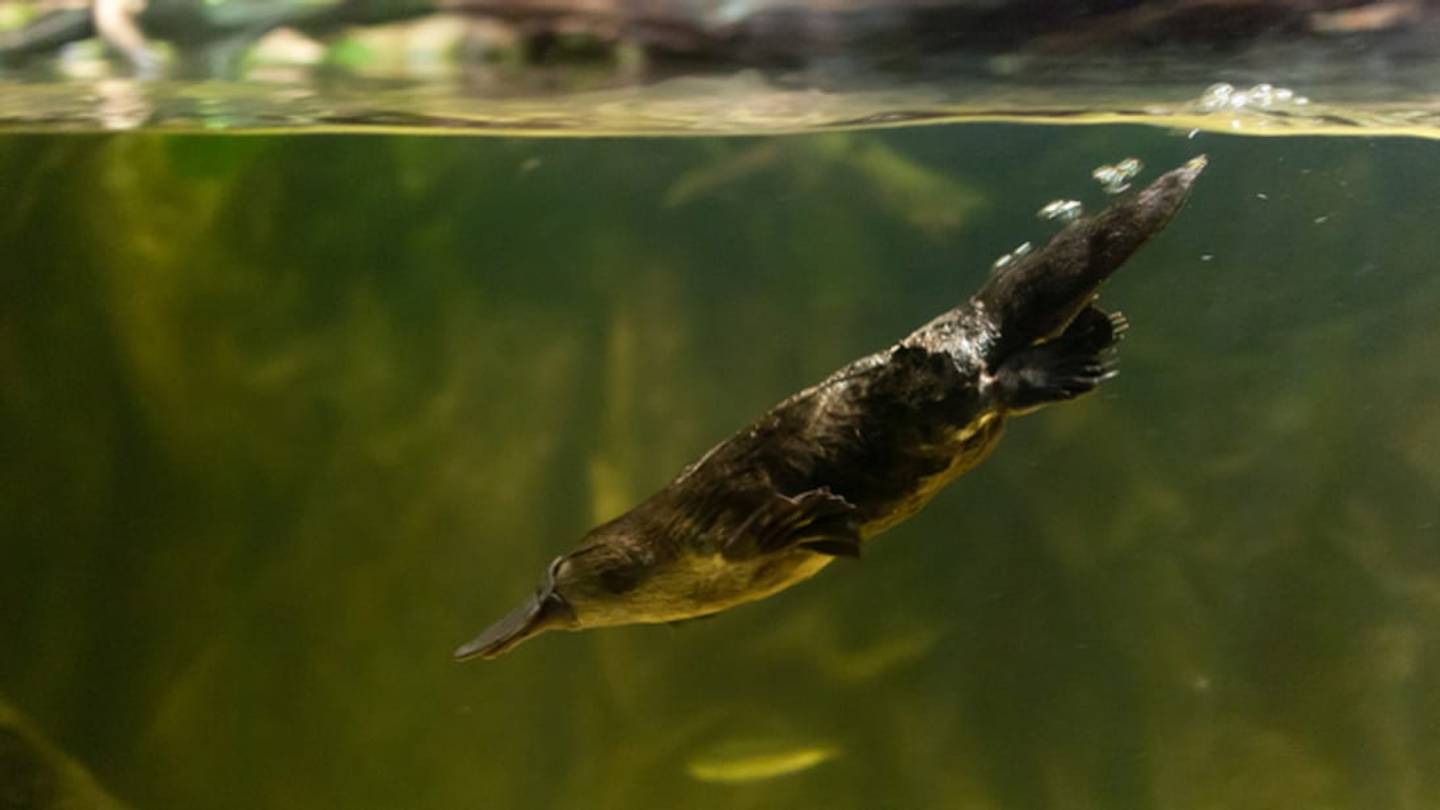
Youâve heard the joke: âAfter God finished making all the animals, He took the leftover parts and made the platypus.â While the platypus does not, in fact, have an actual beaverâs tail nor a duckâs bill, genetic analysis proves that the platypus is confounding well beyond its external mismatched/mish-mashed characteristics.
Mammals are hairy by definition, and platypuses are hairier than most. They waterproof their dense fur by preening it free of oil and schmutz, and the clean fur acts as a sort of dry suit, trapping pockets of air to keep platypuses warm underwater. (Yes, sadly, âplatypusesâ is the official plural for platypus, though âplatypiâ is used in the Latin names for some insects. Or maybe you prefer platypodes? )
Like all mammals, platypuses nurse their young on milk produced by mammary glands. Thanks to 2008âs Platypus Genome Project , we know that platypus genes that are responsible for milk production read a lot like the milk-making genes in other mammals, humans included. Scientists now think that mammals have been producing milk for over 166 million years, which would mean milk production has been an instrumental evolutionary rudder in the development of modern mammals. Haha: udder rudder. Except ...
The platypus doesnât have teats. Instead, it oozes milk from mammary âpatches,â which are kind of like areolae without the nipples. Other animals that nurse via mammary patches? Oh, just the four species of echidna (spiny anteaters), which, together with the platypus, make up the entire order Monotremata , also known as âegg-laying mammals.â
Platypuses lay leathery, reptile-like eggs, but their genes tell us that their egg-making genes are more mammalianâin some ways. Other egg-related gene characteristics are shared with birds, amphibians and fish, while still others are only shared with birds and fish, and those genetic traits only partially shared.
Much like marsupials (kangaroos, possums, and other pocketed animals), platypus young are born (i.e. hatch from their leathery eggs) in a semi-fetal state, and continue developing throughout the nursing process. In fact, echidnas keep their young in a pouch after hatching; platypuses instead dig deep, complex burrows in which to safely build their nests. How?
...With their clawed feet, which are also webbed for swimming. Who says working moms canât have it all?
The platypusâ eyes alone have been the subject of much publication, possessing (again) a mosaic of characteristics found in disparate animal orders. For instance, they have a rod/cone balance that most closely resembles that of other mammals, but also have a âdouble coneâ thing going on, a feature not found in eutherian mammals (mammals that give birth to fully developed young) or marsupials. Meanwhile, their eyeballs are enclosed by a type of cartilage more like that seen in birds, reptiles, amphibians, sharks, rays, and lungfish.
Male platypuses have pretty mean built-in weapons: spurs on their hind legs that are loaded with a venom potent enough to kill a dog and debilitate a human for days. While there are a few other types of venomous mammal out there, this type of venomous sting could be considered a more reptilian-like trait; that is, the venom itself is made up of organic material similar to the venom in reptiles. However, according to the platypus genome, that organic material gets made via variations in different genes than in reptiles. Reptilian result, uniquely platypusal cause.
The sex of the platypus is determined by a set of ten chromosomes, which, according to platypus geneticist Jennifer Graves, âare absolutely, completely different from all other mammals. We had not expected that.â Each platypus sperm contains either all X or all Y chromosomes. And the platypus X chromosome looks more like the Z sex chromosome that shows up in birds.
In case you werenât yet convinced that the platypus is âspecialâ: It hunts via a system called electroreception, which is exactly as rad as it sounds. The skin in its bill is highly sensitive, and its combination of touch receptors and electroreceptors (comparable to those found in electric fish) pick up on movements and low-frequency electrical signals in its prey. Thatâs why, even hunting underwater, at night, the platypus can still bring home the bacon. Itâs like, guysâleave some cool stuff for the rest of us, maybe.
Primary image via Flickr user The Eggplant . Â
Loading recommendations... Please wait while we load personalized content recommendations