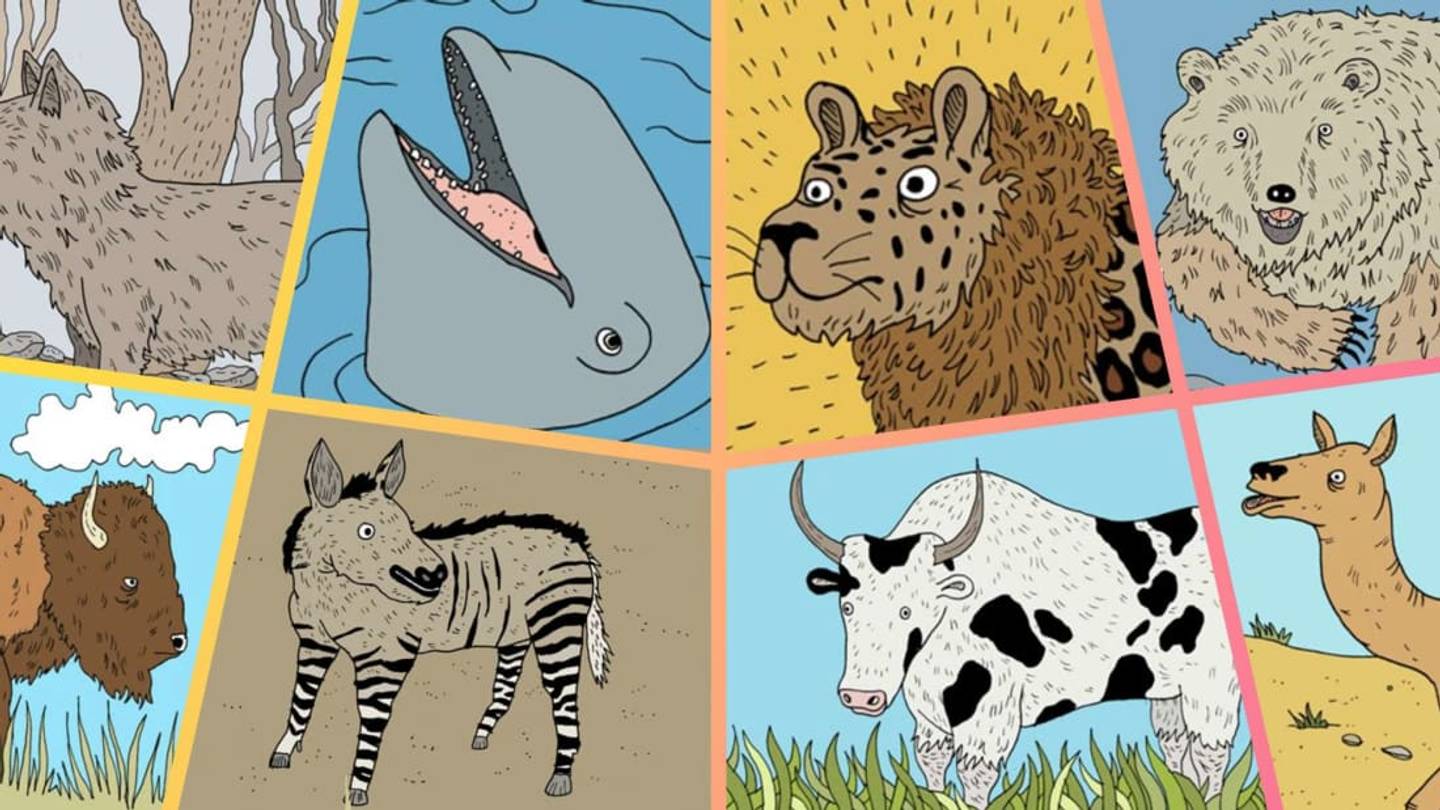
The most famous hybrid animal is the liger âbut there are more than a few crossed creatures you probably didn't know about.
Although there are frequent unconfirmed reports of them in the wild, only one pure wholphin is currently confirmed to exist. Her name is Kekaimalu âwhich means "from the peaceful ocean"âand she's a resident of Sea Life Park, Hawaii. Her parents were quite the odd couple: When staffers placed a 2000-pound false killer whale and a 400-pound Atlantic bottlenose dolphin in the same tank, nobody expected them to mate. Kekaimalu's surprise birth on May 15, 1985 made international headlines.
Another wholphin had previously been bred at Sea World Tokyo in 1981, but that animal lived just 200 days. Kekaimalu, however, is still going strong. At almost 11 feet in length, sheâs more lightly colored than a false killer whale, but darker than a bottlenose. Though her first calf died young, a second calf lived for nine years, and in 2005, Kekaimalu had a healthy daughter, named Kawili âKai, by a male dolphin.
In 1999, Dr. Lulu Skidmore and her team at Dubaiâs Camel Reproduction Center set out to create an animal that was part Old World camel and part New World llama. The goal was utilitarian: âThe main aim was to see if we could get the best of both species,â she said . âWe thought [that] the long coat of a llama and the strength of a camel would make for a very useful animal.â
It was soon discovered that their male llamas couldnât impregnate female camels, and the reverse approach proved anatomically impossible. In the end, Skidmore and her team used artificial insemination to impregnate a female camel. The result was a male cama they dubbed Rama. Since Rama's birth, a few other camas been been born using the same strategy.
Over the past 200 years, various ranchers have crossed American bison and domestic cows. Among them was Charles Jesse âBuffaloâ Jones , a Kansas resident who, in the late 19th century, saw that cattle were ill-equipped for the harsh winters of the Great Plains. Hybrids, he figured, would be more resilient.
Jones started cross-breeding the two species in 1906 on a patch of land that lies near present-day Grand Canyon National Parkâwhere so-called cattalo became a menace . (Don't confuse them with beefalo : Cattalo are hybrids that have a predominately bison appearance, while beefalo are those that are only three-eighths bison .) As park superintendent Dave Uberuaga told the Associated Press, âThe massive animals have reduced vegetation in meadows to nubs, traveled into Mexican spotted owl habitat, knocked over walls at American Indian cliff dwellings below the North Rim, defecated in lakes, and left ruts in wetlands.âÂ
In Africa, leopards and lions cross paths quite frequently, so a wild-born hybrid is possibleâbut so far, all documented leopons have been produced in captivity , and the last known leopon specimen died in 1985. The brown-spotted, reddish-yellow creatures were larger than your average leopardâin fact, they were almost as big as lionessesâand had tufted tails. Males, like their leonine ancestors, had beards and manes.
If you live in eastern North America , you may have spotted one of these canines. Sometimes called woyotes, theyâre a western coyote/eastern grey wolf mix. The hybrid's beginnings trace back to when European settlers first arrived on the continent. The settlers, who viewed the eastern grey wolves as a nuisance, hunted the animals to near-extinction. As the wolf population dwindled, coyotes began moving in from the west to exploit the vacancy. Eventually, they entered one of the wolvesâ final strongholds: southern Ontario.
Sometime between the 1950s  and the '70s, that area became the coywolfâs probable birthplace. These new creatures have longer legs, bigger paws, stronger snouts, and bushier tails than normal coyotes do. Like wolves, theyâre capable of hunting in packs . But while wolves arenât cut out for cities or suburbs, coywolves have proven quite adaptable and embrace metropolitan lifestyles.
Donkey/zebra hybrids are nothing new; Charles Darwin even wrote about them in the 1859 edition of On the Origin of Species . As with mules, zonkeys are born sterileâat least for the most part. Darwin did report on a zonkey that had successfully mated with a mare, thus combining the genes of three equine species. However, nobody has since been able to breed one with anything else (including other zonkeys). At one point, captive zonkeys could be found at zoos in Mexico and Italy .
Another bovine hybrid, yakows (a.k.a. dzo and dzomos) are a common sight in Nepal. Larger and stronger than both yaks and cows, the beasts of burden also produce significantly more milk. At high altitudes , yakows are the ideal livestock: They combine a yakâs thin air tolerance with a cowâs relative agility. Farmers have learned that while males cannot successfully reproduce, females can.
AÂ 2013 study on brown bears living on Alaska's Admiralty, Baranof, and Chichagof Islands revealed that all of the animals had some DNA from polar bearsâa remnant of their interbreeding around the time of the last Ice Age.
Now, thanks to climate change, the native ranges of grizzly and polar bears are increasingly overlapping. The result? An influx of muscular, sand-colored grolar bears . According to Brendan Kelly , a University of Alaska marine biologist, free-roaming specimens are a fairly new phenomenon. âWeâve known for decades that, in captivity, grizzly bears and polar bears will hybridize,â he told PSMag . But there were no confirmed wild grolar sightings until a hunter gunned one down in 2006. Subsequent DNA testing revealed the abnormal heritage of his curious prize.
Grolars tend to have both a grizzlyâs hump and a polar bearâs elongated neck. Zoo keepers have noted that captives usually behave more like the great white ursids. When presented with a new toy, theyâll stamp on it with both of their front pawsâthe same technique that polar bears use to break open seal dens.
A version of this story ran in 2015; it has been updated for 2022.
Loading recommendations... Please wait while we load personalized content recommendations