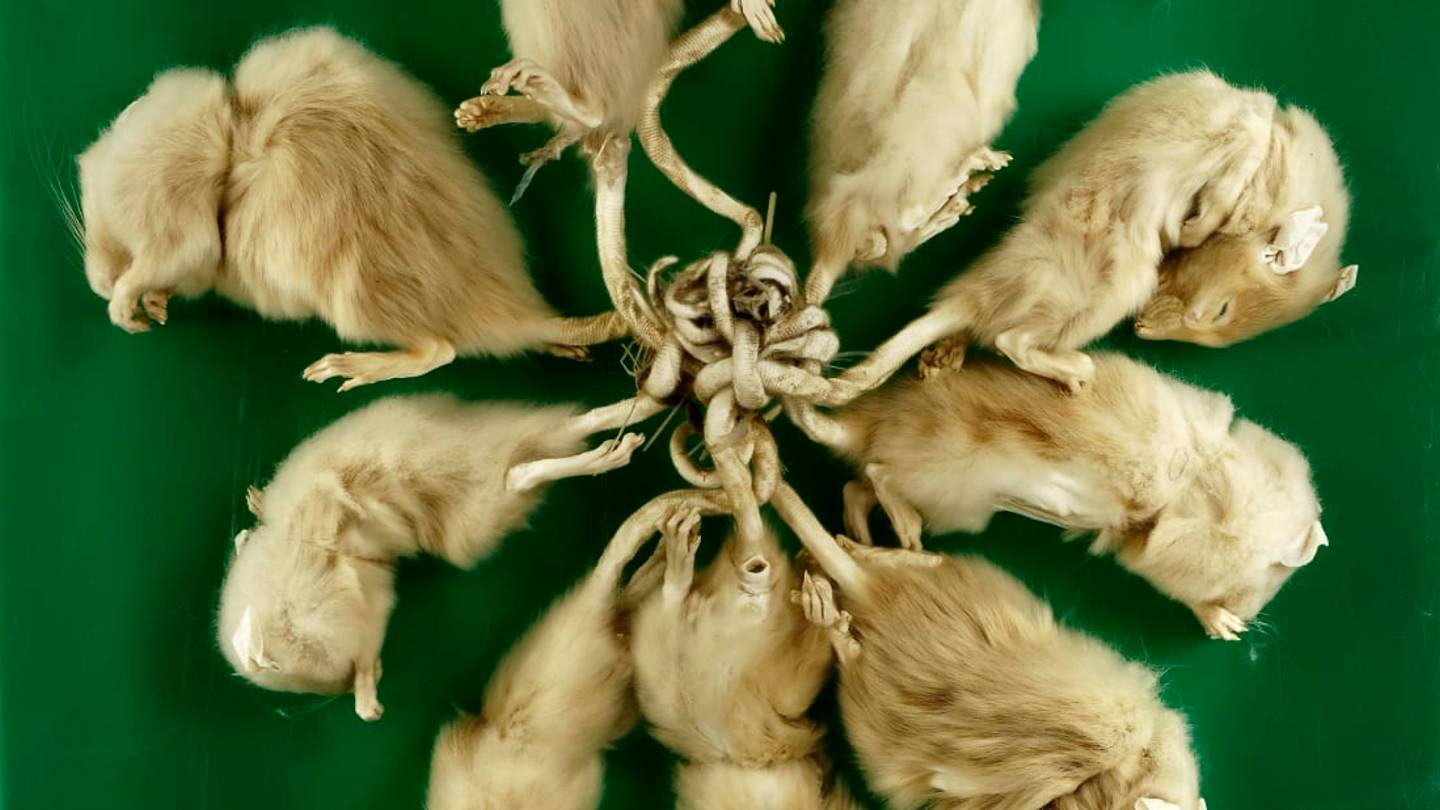
Behold the rat king!
A ball of furry fury, a rat king occurs when the tails of rodents become twisted, wrapped, and warped into a knot so impossible that not even the world's most loyal Boy Scout could untangle it. Rat kings have been reported since the mid-16th century (almost entirely within Germany), and everything about themâfrom their name, to their cause, to their very existenceâremains suspended in mystery.
To start, the origin of the term rat king is hazy. It may be a mistaken translation of the French rouet de rats , a "wheel of rats" (rat king in French is roi-de-rats ). But this is an unlikely etymology. More likely, rat king harkens to the German Rattenkönig âan insult for the pope, but also a term used to describe elderly rats. (It was believed that senior rats would sit on the tails of younger rats to make their nests, and that, if the tails tangled, the elder rat would survive by having its meals delivered by the rodent world's proletariat. As the New York Tribune described in 1857, a rat king, âlike so many kings, princes, and democratic officer holders, [depended] upon the labouring classes for support.â)
The rat king's existence is debatable; while there are several preserved specimens, they might be fakes perpetrated by hoaxers who wanted to make a quick buck. (Don't put it past our ancestors: âIn medieval times, some sleazy European merchants glued bat wings to lizards and sold them as âdragons,ââ notes Quail Bell magazine .) Owing to a lack of solid contemporary evidence, zoologists remain skeptical of rat kingsâbut open to the possibility that they are freak accidents.
Other rodents, after all, do get tied up in each otherâs business. In 1951, a "squirrel king" appeared in a South Carolina zoo. In 2013, six more tangled squirrels were saved by veterinarians in Canada. And just this year in Maine, four baby squirrels were recorded on video with their tails linked like "a giant dreadlock," according to the man who discovered them.
If real, how do rat kings occur? Some theories are more crackpot than others: In the 17th and 18th centuries, naturalists suggested the tails had been woven during birth, glued by the afterbirth. Others suggested that healthy rats deliberately tangled the tails of weaker rodents to make a nest. Both theories are unlikely.
The most plausible explanation is that black ratsâwhich have long, supple tails and reside in close quarters during winterâmay come in contact with a sticky or frozen substance such as sebum (secreted from the crittersâ skin), sap, food, feces, frozen urine, or frozen blood. The bonding agent may solidify as the animals slumber. Once the rodents realize their tails are glued, they might create a tighter knot as they attempt to wriggle free.
This explanation has a ring of truth: Most rat kings were discovered during the winter or a frosty shoulder season, and theyâre usually found in a tight shelter.
Over the past five centuries, there have been 30 to 60 recorded rat king sightings. In 1973, the biologist and writer Maarten ât Hart tracked down all of them. Using Hartâs delightful book Rats as our primary guide, we now present a timeline of nearly every recorded rat king sighting since the 16th century.
(Note: We excluded approximately a dozen sightings that Hart argued were dubious, and we're certain that more instances exist. But, to be frank, after seeing the photographs below, you might understand why this timeline is the sort weâd prefer to never have to update.)
1576: Johannes Sambucus, a Hungarian historian, releases the fourth edition of his popular Emblemata âessentially a 16th century picture bookâcalled Emblemata cum aliquot nummis antiqui operis. In it, Sambucus describes how servants in Antwerp, Belgium discovered seven rats with knotted tails. (The same volume contains stories involving unicorns, so take that for what itâs worth.)
July 1683: In Strasbourg, France, a man named Würtzen discovers in his cellar six âstrikingly large rats with their tails so intertwined and fused that they could not be separated without injury,â a contemporary report states. The varmints are exhibited at the town hall, and an illustrated print of the braided bunch is published in the Mercure Galant .
1690: After hearing his floorboards squeak for all the wrong reasons, a bigwig in Kiel, Germany, orders boiling water poured down a rathole. Four rodents scamper out, but when the squealing continues, the homeowner decides to remove the floor tiles. He discovers 14 tangled rats, which are promptly dumped in a privy.
1694: In Krossen, Germany, 15 fused rats are found at a mill. They are killed with boiling water and strung from an oak tree, giving passersby a chance to gawk.
1705: A lump of snarled rats is discovered in Keula, Germany. Itâs pickled in alcohol and later disappears.
July 1719: A rodent tumbleweedâpopulation nineâappears in RoÃla, Germany. (The naturalist Johann Heinrich Linck supposedly makes engravings of the monster.)
1722: Residents in the village of Dieskau, Germany, find another reason to avoid eating their vegetables when 12 tangled critters are found rooting through a barrel of peas. Euthanized by a cascade of boiling water, the rats are taken to Dresdenâs Royal Natural History Collection. In 1849, this ratty rosette is presumed lost in a fire.
1722: A writhing cluster of rats (number unknown) grips Leipzig, Germany. The gnarled specimen is killed, pickled in a jar of alcohol, and paraded through the city. Itâs later mummified in a private museum. Like any good mummy, it mysteriously goes missing.
1725: Eleven rats of various sizesâsaid to be a momma-rat and its youngâare found entangled in Dorndorf, Germany.
1727: In a banner year for rat kings, naturalist Johann Linck reports that a whopping four rat kings are sighted in Germany. Hart, however, claims that only one of these is mildly credible: the rat king of the quaint mountainside town of Wernigerode, which is said to be preserved by a local count.
1748: German zoologist Johann Goeze reports that a gross ball of 18 rats has turned up in the town of Gross-Baullhausen, Germany.
1748: A lump of 10 plump male rats appears at a monastery in the spa town of Bad Langensalza, Germany. The sanctity of life apparently does not extend to rat kings: Itâs killed, dunked in alcohol, and, like the other specimens, later goes M.I.A.
1759: A tinsmith in Arnstadt, Germany, is startled to find a buffet of six snagged vermin near the town market. The discovery becomes the subject of five oil paintings, four of which were lost during World War II. (According to Hart, the only surviving artwork is hung in Arnstadtâs Castle Museum.)
1772: Twelve twist-tied rats are discovered in Erfurt, Germany; the specimen is later illustrated by J. J. Bellerman in his 1820 book Ueber das Bisher Bezweifelte Dasein des Rattenkönigs , or On the Hitherto Doubted Existence of Rat Kings . (For those curious, the book does not sell very well.)
December 1774: Christian Kaiser, a millerâs assistant, finds 16 snarled rats in Lindenau, Germany, and drags them to an artist named Johan Adam Fassauer, requesting a painting. Instead, Fassauer begins exhibiting the rats to the public for a fee. When Kaiser realizes that the painter is profiting off his discovery, he demands for the specimenâs return. (According to Hart, âthe end of the story is unknown,â but other reports suggest the dispute led to one of the strangest custody battles a courtroom has ever witnessed.)
1793: A Gordian knot of 10 rats appears in a stable in Wundersleben, Germany.
1793: In Brunswick, Germany, seven entangled rodents make a surprise visit to a local privy.
1810: Brunswick celebrates back-to-back rats! After days of interminable squeaking, a well-to-do citizen tears up his floorboards only to find a tangled jumble of seven rodents. âAll of their tails had been joined together so firmly and so inextricably that they could not be pulled apart,â writes Hart.
December 1822: A thresher in Döllstädt finds two gobs of ratsâone consisting of 28 rodents, the other 14âinside the main beam of a barn. âAll 42 seemed to be very hungry, and squeaked continuously but looked perfectly healthy,â reported zoologist Alfred Brehm. âAll were of equal and moreover of such considerable size that they must have been born during the last spring.â The rats are paraded through town before being thrown unceremoniously onto a dungheap.
May 1828: Doing spring cleaning, Miller Steinbruck of Thuringia, Germany, finds a scorched clump of 32 rodents in his chimney. The terrifying rat king is today held at the Mauritianum Museum in Altenburg, Germany.
May 1829: An artist gets creative with a coil of eight rats discovered in Flein, Germany. âThe individuals constituting this king were not arranged in the usual circle but looked like a bunch of flowers with the tails representing the knotted stems,â Hart writes. Today itâs preserved at the Stuttgart Natural History Museum .
1837: A dirty dozen appears in Zaisenhausen, Germany, prompting the discoverer to call upon a pastor. The holy man gives the sample to a local museum director, but when the director dies, he brings any knowledge of the rat king's whereabouts to his grave.
1841: Half a dozen knotted rats appear in Bonn, Germany. They are preserved for more than a century at the University Zoological Institute, but it becomes one of many museum casualties during World War II.
March 1844: A smorgasbord of seven rats surfaces in the small Bavarian town of Leutershuasen, Germany.
1870: In Keula, Germany, a rat king of unknown number is discovered and preserved, but it, too, disappears during World War II.
February 1880: After hearing unusual squeaks from high up a wall, a postman in Düsseldorf, Germany uncovers a skein of eight rats, which is photographed and preserved, but (you guessed it!) is lost during World War II.
1883: In an attempt to determine if rat kings are a hoax, German zoologist Hermann Landois ties the tails of 10 dead brown rats together. According to Hart, the results must have been disappointing. âAnyone who ties up the tails of dead rats (I have tried it several times) will obtain something that in no way resembles the kings found in nature: the knots are too neat.â But Hart does not discount that there may be frauds out there: â[It was] lucrative to own a king, and so people began tying tails together. Kusthardt (1915) reports that many such sham kings were exhibited at fairs and similar gatherings.â
April 1883: After loud squeals emerge from underneath a merchantâs toilet in Lüneburg, Germany, a motley knot of eight rats is discovered. Like many others, it is purportedly preserved but lost during the Second World War.
1889: A young rat king numbering five or six turns up in Obermodern-Zutzendorf, Germany. Reports of the discovery make it to England, where the The Newcastle Weekly Courant spreads the myth that, like royalty, the rats were sustained by the charitable contributions of lowlier rodents: âThe rats were in the very best conditionsâconclusive that astonishingly good care had been bestowed upon them by their more fortunate rat brethren.â
April 1894: A frozen ratcicle containing 10 rodentsâmany of which are pocked with teeth marks and gnawed legsâis found under a hay-bale in Dellfeld, Germany. You can visit the specimen at the Strasbourg Zoological Museum .
November 1899: A ratpack of seven crosses the border and visits Courtalain, France. Itâs currently kept at the Musee de Chateaudun , a two-hour train ride from Paris.
May 1905: Seven young rodents are reported in Hamburg, Germany, now preserved in the cityâs Natural History Museum. (The next year, a lucky seven strikes again in le Vernet, France.)
January 1907: A potpourri of 10 black rats appears in Rudersdorf. It is preserved.
October 1914: An adolescent rat king is discovered (alive) in Moers, Germany. It is preserved (not so alive) and later disappears.
March 1918: The rat king takes a vacation to Bogor, Java! Not only is this weave of 10 rats one of the few reported outside of Central Europe, itâs the only report not to involve black rats.
1930s : In New Zealand, a cluster of eight contorted rats drops from the rafters of a shipping office. Clerks beat it generously with a pitchfork and then, also generously, donate it to the Otago Museum, where it now resides. (The tails, the museum discovered, were tangled with horsehair.)
October 1937: Hark! A farmerâs servant discovers nine gnarled rats in a starlingâs nest in Büngern, Germany.
1940: In whatâs believed to be the Lictenplatte district of Offenbach, Germany, a king of five young rats is found squirming in a pigsty.
June 1949: In Berlin, Germany, three separate rats are tossed into a bucket on the evening of June 2. The next morning, the three rats have mysteriously tangled into a knot. Herr Otto Janack, an official with the local rodent extermination department, disentangles the rodents and comes away thinking that itâs all a bad jokeâor one of natureâs weird, twisted miracles.
1951: A rat king of four adults is discovered in Châlons-sur-Marne, France (now renamed Châlons-en-Champagne).
1955: The Natural History Museum of Maastricht picks up a crowd-pleasing specimen: a seven-strong rat king found in Limburg, Netherlands.
1961: According to a Russian-language journal article about hollow-dwelling birds, a rat king of unknown size appears in Lithuania.
February 1963: A Dutch farmer in Rucphen, Netherlands, hears a loud squeal and follows the noise to a pile of bean sticks in his barn. When he notices a rat, he kills it and attempts to pull it from the pile. It refuses to budgeâuntil the farmer realizes that six more rodents are connected to the original rat. These, too, are exterminated and the specimen is later X-rayed.
1966: A man by the name of Wierts attempts to make his own rat king by gluing the tails of six live albino lab rats. When the animals attempted to wriggle free, their tails became entangled in a knot. Wierts then anesthetized the rats and removed the glue to see if they remained knotted like a pretzel ... and they did.
1986 : A roi-de-rats of nine turns up in Vendée, France. Today you can see it in the Natural History Museum in Nantes .
2005: In Saru, Estonia, a farmer discovers a cluster of 16 ratsânine of which are aliveâin a shed, their tails tangled by frozen sand. It is taken to the Natural History Museum at the University of Tartu , where it is preserved in alcohol. (Itâs reported that two other rat kings were discovered in Estonia in the 20th century, one of which contained 18 live rats [ PDF ]!)
Loading recommendations... Please wait while we load personalized content recommendations