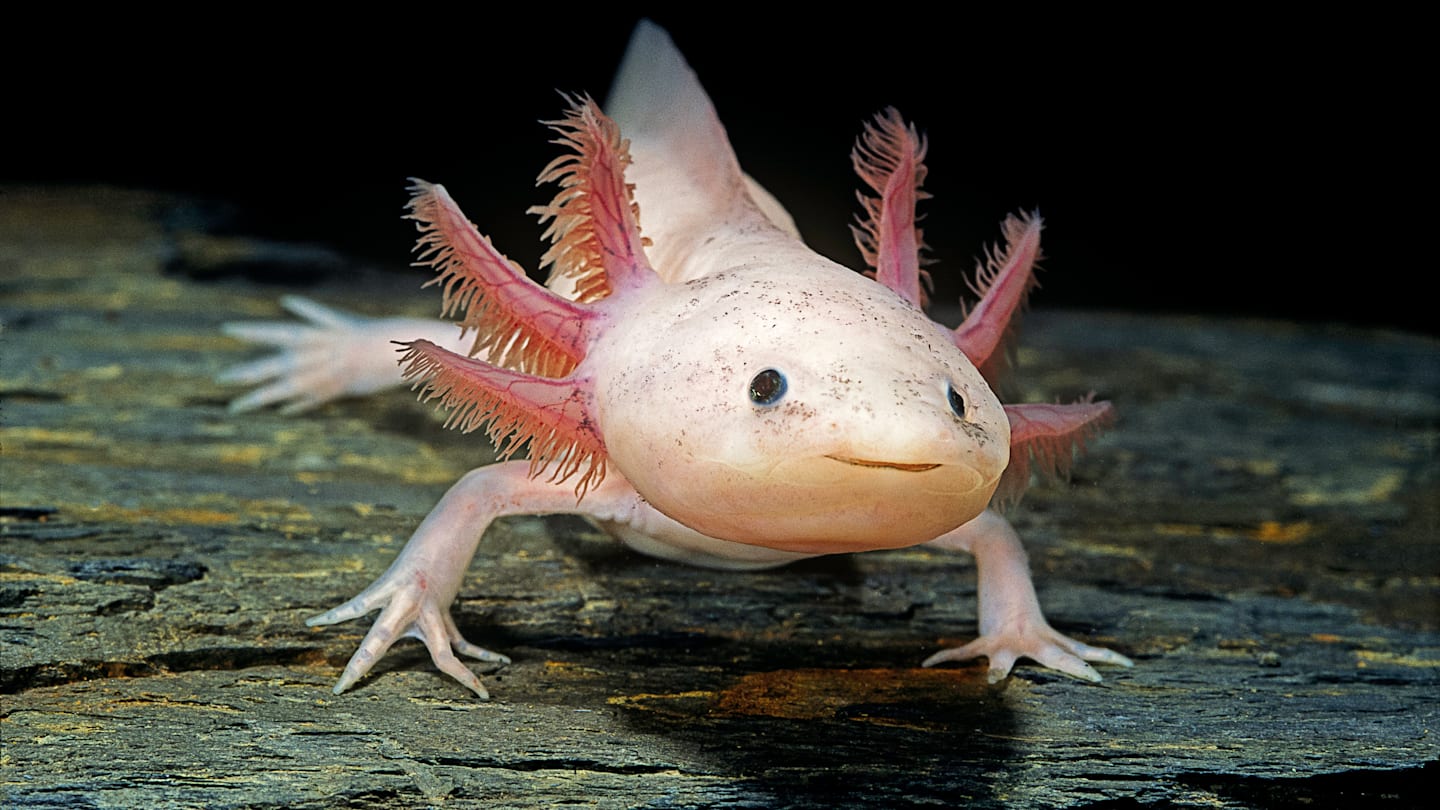
With big branch-like gills, lizard-like limbs, and a cute perma-smile, itâs hard not to fall in love with the axolotl. Also known as Mexican walking fish (although theyâre not actually fish ), these aquatic-dwelling amphibians are famous for their ability to regrow limbs and organs, including parts of their brains âbut thatâs not the only reason theyâre so fascinating. Discover more interesting facts about these adorable salamanders down below.
Stumped over how to pronounce axolotl ? It sounds like âACK-suh-LAH-tuhl.â The name has an interesting history, too. Atl comes from Nahuatl , the Uto-Aztec language thatâs still widely spoken in Mexico, and means âwater,â while xolotl is associated with dogs. Because of that, axolotl is sometimes translated as â water dog .â
Xolotl also relates to the Aztec god of the same name. In Aztec mythology, the dog-headed deity was believed to rule over fire and lightning, and led the souls of the dead to the underworld. As with all mythology, there are a lot of mixed accounts about what happened next, but some believe that Xolotl was fearful of being sacrificed and transformed into an axolotl to hide. The salamander is trapped in the streams around Xochimilco, unable to transform and walk on land.
While you might see plenty of white or pink axolotls in captivity, the animal is normally dark brown or black in the wild. White and pink axolotls are known as âleucisticâ and descend from a mutant male that was shipped to Paris in 1863. They were then specially bred to have black eyes (different from albinos, which generally have red eyes).
While you can find axolotls in aquariums and laboratories all over the world, itâs much harder to spot them in the wild. The animals can only be found in the lakes and canals of Xochimilco, Mexico, a borough of Mexico City. The axolotl eats small fish, worms, and anything else it can find that will fit in its mouth âeven other salamanders.
The impossibly silly branches that grow from the axolotlâs head might not seem practical, but theyâre actually the salamanderâs gills. The filaments attached to the long gills help them breathe underwater.
Neoteny means that a creature can reach maturity without going through metamorphosis. In less extreme cases, itâs simply exhibiting juvenile traits after reaching adulthood. Axolotls are a great example of neoteny because as they grow bigger, they never mature. Unlike tadpoles or similar animals, axolotls hold on to their gills and stay in the water, despite actually growing lungs.
âThe one thing that neotenic species have as an advantage is that if you donât undergo this metamorphosis, youâre more likely to reproduce sooner. Youâre already one step ahead,â biologist Randal Voss told WIRED in 2014.
Sometimes as a result of a mutation, or a shot of iodine from a scientist, axolotls can be forced out of their safe watery home. The shot gives the animal a rush of hormones that leads to a sudden maturation. The axolotls become strikingly similar to their close relative, the tiger salamander, but they continue to only breed with their own kind.
Transforming your aquatic friend into a land-dweller might seem cool, but leave it to the professionals. Experts strongly urge owners to never interfere with the biology of their pets, because it will likely be fatal.
Thanks to TikTok and Minecraft, axolotls are more popular than ever online. Some reports claim there are as many as 1 million in captivity worldwide. Not only that, but theyâre among the most in-demand pets in the U.S. (although they are illegal to own in multiple states, including California). Despite all this, axolotls are actually considered critically endangered in the wild and are on the verge of extinction, all as a result of habitat loss, pollution, and the introduction of invasive species like tilapia and carp.
In an attempt to revive the species , researchers have built âsheltersâ made from reeds and rocks to filter the water and create a more desirable living space. Unfortunately, the numbers continue to decline. There were about 6000 wild axolotls documented in a 1998 study, but by 2008, there were only about 100. For a brief amount of time in 2014, biologists failed to find a single water dog, and feared the salamanders had gone extinct in the wild. Luckily, some have since been found roaming the water. Still, in 2017, Scientific American reported that there were fewer than 35 of these amphibians per square kilometer in their native Mexico City.Â
Before the axolotl was an endangered species, Xochimilco natives would chow down on the salamanders. Axolotl tamales were a favorite, served whole with cornmeal and corn leaves. In 1787, Francesco Clavigero wrote that âthe axolotl is wholesome to eat, and is of much the same taste with an eel. It is thought to be particularly useful in cases of consumption.â
Today, you can still taste one of these creaturesâbut you might have to travel to Japan to do it. When deep-fried, they apparently taste like white fish meat, but with a crunch.
The city held an official emoji contest back in 2017, asking residents to come up with 20 small symbols that best represented the megalopolis. The winning package was from designer Itzel Oropeza Castillo and featured axolotl, which speaks to how iconic these little salamanders truly are within Mexico City.
Itâs not unusual for amphibians to be able to regenerate, but axolotls take it to the next level. On top of being able to regenerate limbs, the animal can also rebuild their jaws, spines, and even brains without any scarring. Professor Stephane Roy of University of Montreal broke it down to Scientific American in 2011:
âYou can cut the spinal cord, crush it, remove a segment, and it will regenerate. You can cut the limbs at any levelâthe wrist, the elbow, the upper armâand it will regenerate, and itâs perfect. There is nothing missing, thereâs no scarring on the skin at the site of amputation, every tissue is replaced. They can regenerate the same limb 50, 60, 100 times. And every time: perfect.â
Scientists have even transplanted organs from one axolotl to another successfully.
Thanks to their unique biology and regenerative abilities, axolotls have been studied for a long time. In the 20th century, they helped scientists uncover the causes of spina bifida in humans, and were also used in embryonic cell and cancer research (the axolotl is highly resistant to cancer, more so than mammals).
Given all this, the amphibians are still a focal point in scientific research to this day. Various studiesâincluding two released in 2012 by the Salk Institute for Biological Studies and another headed by Voss in 2015 , among othersâhave sought to better understand the axolotl genome which controls regeneration, with the hope that we can eventually recreate the phenomenon in human beings.
Unfortunately, results so far have shown that the process might be even more complicated than expected. But still, the little salamander remains enormously important in the field of regenerative medicine.
A version of this article was published in 2015; it has been updated for 2023.
Loading recommendations... Please wait while we load personalized content recommendations