J.R.R. Tolkien has no shortage of fans in the science world. Dozens (at least) of organisms have been named after Lord of the Rings lore: creatures, locations, Elvish words, and more. Here are 10 extant species whose taxonomies pay tribute to Middle-earthâs most famous characters.
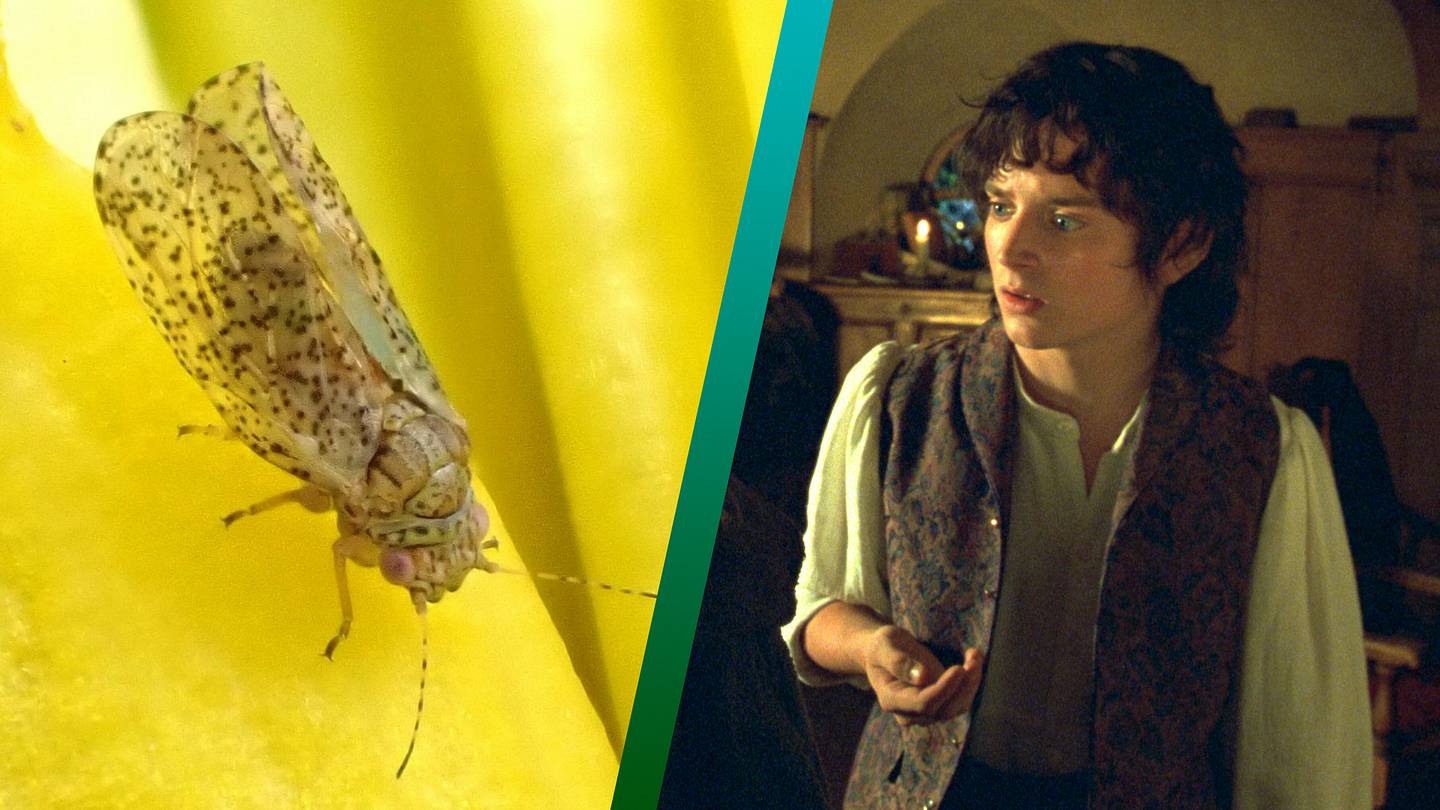
Psyllids , a.k.a. jumping plant lice, are a family of true bugs (Hemiptera) that feed off plant juice; each kind of psyllid typically lives off a particular kind of plant. In 2019, researchers published a paper supporting the theory that the psyllids endemic to New Zealandâs kÅwhai trees arenât all Psylla apicalis . They named the newly identified species Psylla frodobagginsi after Frodo Baggins for two reasons: one, because these bugs are smaller than apicalis , like Hobbits are smaller than humans; and two, because Peter Jacksonâs Lord of the Rings movies were filmed in New Zealand. Psylla frodobagginsi is casually known as the Hobbit psyllid .
New Zealand as the Lord of the Rings filming location also inspired the name Gandalfus for a genus of blind crabs first found in the underwater volcanoes around New Zealandâs Kermadec Islands [ PDF ]. That inaugural species was christened Gandalfus puia in 2007; puia is MÄori for âvolcanoâ or âgeothermal spring.â Gandalfus puia has little in common with its eponymous wizard, though Redditors have pointed out that it lives near hot deep-sea ventsâand Gandalf is no stranger to a deep, fiery crevasse.
Myloplus sauron , on the other hand, does bear some resemblance to its namesake, Sauron, the evil maker of the One Ring. Itâs a species of pacuâa relative of piranhasâthat lives in Brazilâs Xingu River basin and flaunts one vertical black stripe along its flank. The stripeâs similarity to the Eye of Sauron is pretty uncanny, but itâs not the most off-putting thing about this fish: It has blunt, eerily human-looking teeth .
Spaeleoleptes gimli is another native Brazilian: Itâs a species of daddy longlegs, a.k.a. harvestmen, discovered in a subterranean cave in the state of Bahia. Researchers named it after the dwarf Gimli due to dwarvesâ affinity for mining and caves. âParticularly,â researchers wrote in a 2024 paper , âGimli explicitly expresses his fascination for the Glittering Caves of Aglarond with their extensive series of spectacular speleothems, and after the defeat of Sauron, he was given the lordship over this marvelous cave.â
Bahia is also home to freshwater snails named for two of Tolkienâs bravest and most beloved secondary heroes. Thereâs Idiopyrgus eowynae in honor of Ãowyn, a woman warrior who âexemplifies courage, resilience, and resistance against darkness, both internal and external, standing against GrÃma Wormtongue and the Witch-king of Angmar,â researchers explained in a 2024 paper . And then there are Idiopyrgus meriadoci after Meriadoc âMerryâ Brandybuck, a Hobbit who, in addition to âstanding with Ãowyn against the Witch-king in the Battle of the Pelennor Fields,â serves as âan example of the fight for nature conservation in Middle-earth, pushing the Ents into action and ultimately ending Sarumanâs threat to Fangorn Forest.â
The Entsâtree-like humanoids that protect regular treesâof Fangorn Forest have earned their own taxonomical shout-out in the form of Uroplatus fangorn , a species of gecko found in the forests of Madagascar. Itâs a special tribute to the oldest Ent, Treebeard, also known as Fangorn ( Fangorn means âTreebeardâ in the Elvish language Sindarin). Researchers chose the epithet in part because the geckos hail from âa deep, dark woodlandâ not unlike Fangorn Forest and because they, too, look like a kind of living tree.
Real Tolkien fans know that Galadriel, the Elf queen of Lothlórien, wields one of the Elvesâ three Rings of Power; hers is Nenya, the Water Ring. The researchers who discovered Pseudophallus galadrielae in and around Guatemalaâs Lago Izabal knew that, tooâbecause itâs why they chose to name their newfound freshwater pipefish species after her. They explained in a 2020 paper that the moniker is a nod to âthe additional bony rings diagnostic of the new species and its association with freshwater habitats.â
In 1953, an unknown species of shark was found in New Zealand waters and named Triakis attenuata : Triakis is a genus of houndsharks, and attenuata refers to this oneâs attenuated (i.e., long and slender) body. Twenty years later, shark expert Leonard Compagno reclassified them into a new genus, Gollum , because âthis shark bears some resemblance in form and habitsâ to the mutant Hobbit of the same name. Gollum attenuatus âa.k.a. the slender smooth-hound or gollumshark âand Tolkienâs Gollum are both extremely thin, brownish-gray, skulking bottom-feeders.
Smaug giganteus âa.k.a. the giant girdled lizard or the sungazerâwas also reclassified from a different genus ( Cordylus ) into its own. Researchers chose Smaug as the genus name because The Hobbit âs antagonistic dragon âlived underground and was heavily armored,â much like Smaug giganteus . They also mentioned that Tolkien was born in South Africaâs Free State province, which is the sungazerâs âcore area of distribution.â
All the main Hobbits and Tolkien himself have wasp alter egos. Shireplitis (after the Shire) is a wasp genus native to New Zealand whose species include Shireplitis bilboi (Bilbo Baggins), Shireplitis frodoi (Frodo), Shireplitis meriadoci (Meriadoc), Shireplitis peregrini (Peregrin âPippinâ Took), Shireplitis samwisei (Samwise âSamâ Gamgee), and Shireplitis tolkieni (Tolkien). Itâs unclear whether the scientists tried to match the wasps to each character by appearance or just assigned names at randomâbut itâs worth pointing out that Shireplitis meriadoci is lighter-colored and slightly longer than S. peregrini (just as Merry is blonder and slightly taller than Pippin).
Learn More About Animal Names: