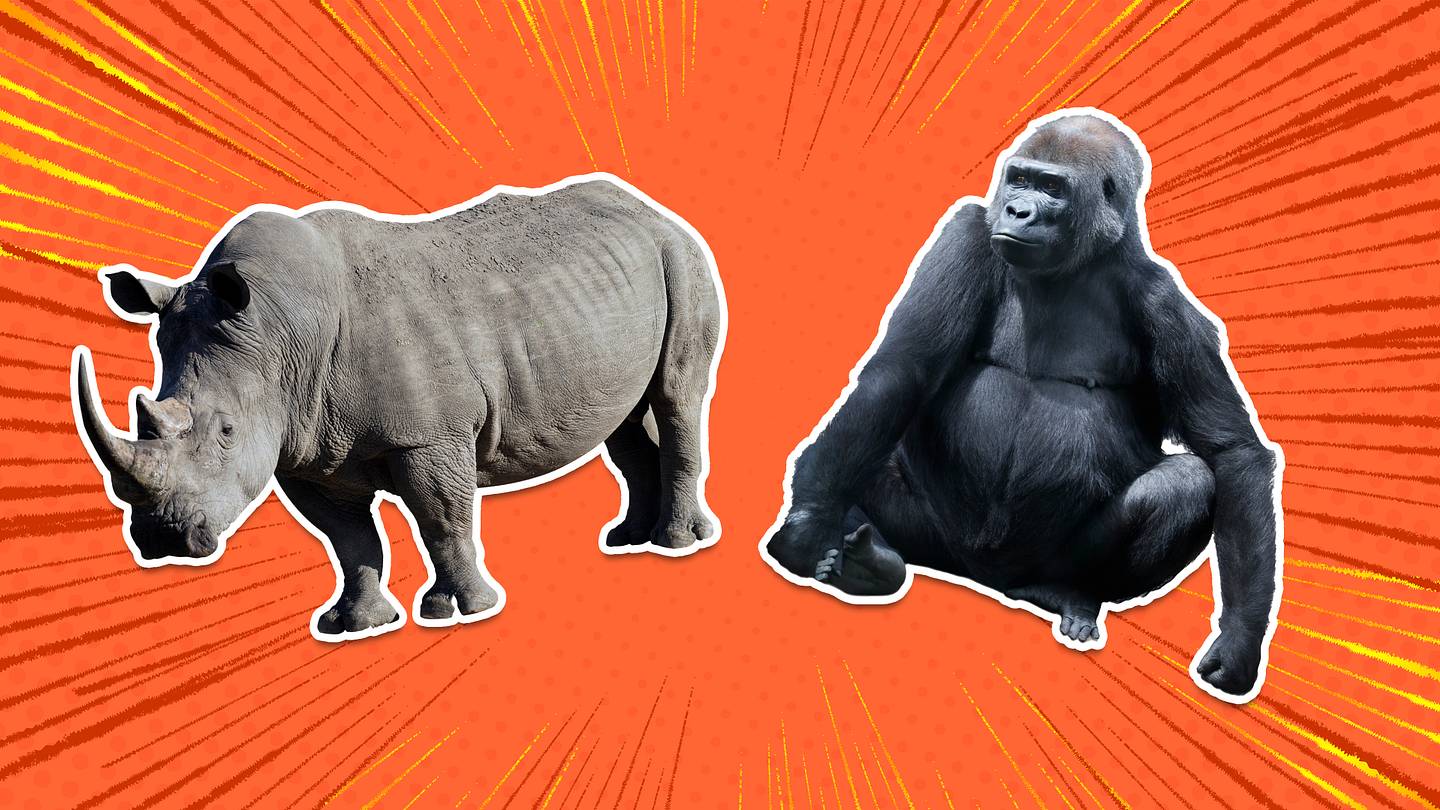
The animal kingdom is a pretty wild place, and history is full of stories of creatures that western scientists didnât believe actually existed until evidence finally proved them wrongâincluding the animals below. Could Bigfoot, the chupacabra, or the Loch Ness monster be next? (Probably not.)
In 1859 , French-American explorer Paul du Chaillu returned from Central Africa with wild tales of humanoid monsters so massive and strong they could bend the barrel of a gun with ease. The creatures had giant skulls but could walk on two legs; they also had the ability to sound eerily like people.Â
While bones of this creature had made their way to the west in previous decades, it was still unknown to many people. And the stories of this animal du Chaillu brought back with him practically got him laughed out of the scientific community.
Du Chailluâs reputation was restored the following year when renowned English anatomist Richard Owen invited him to present his stories, skins, and skulls to Londonâs elite. They were enthralled, and his bestselling book of dubious accuracy brought this creature to the attention of the entire Western World. The mysterious animal? The gorilla.
Most people in the Middle Ages didnât know about narwhals. They did, however, believe in unicorns. The narwhal, a type of whale that lives in the Arctic Ocean, has one long tooth that protrudes from its head and looks a lot like the horn of a certain mythical beast. When Arctic traders realized they could make ungodly amounts of money off of their European clients by claiming the narwhal tooth was actually a unicorn horn ... well, they did .Â
Because these supposed unicorn horns were so rare and valuable, gifts made from them became the must-have gift for European nobility. The Hapsburgs had a unicorn horn scepter ; Queen Elizabeth I drank out of a unicorn horn goblet believing it would explode if poison was in her cup. The Kings of Denmark had an entire throne made out of unicorn horns. Even churches put ground unicorn horn in the holy water in hopes of offering miracle cures to parishioners.Â
The worldwide belief in unicorns waned in the 18th century as more of the world was explored and no hard evidence of horned horses appeared. On the flip side, narwhals gained more prominence, even garnering mentions in Herman Melvilleâs Moby Dick and Jules Verne âs 20,000 Leagues Under the Sea. Between the literary nods and just our expansion of knowledge about oceanic creatures in general, the narwhal quickly went from myth to fact in the scientific community.Â
For centuries, sailors told horrible tales of giant sea monsters rising from the deep to pull ships beneath the waves. In the 1750s, Danish bishop Erik Pontoppidan described the kraken as âround, flat, and full of arms or branches,â and said that fishermen âunanimously affirm, and without the least variation in their accounts,â that the creature exists some number of miles offshore.
Despite other similar reports from around the world, including one of a 60-foot creature with a mouth full of jagged teeth off the coast of Africa in 1848 , not many believed that the monster actually existed. Theories on the creatureâs origins included everything from a water-loving boa constrictor to a âvery large seal.â
It wasnât until 1857 that we would get our first theory resembling the truth. Danish zoologist Japetus Steenstruptook all of these sea monster descriptions from over time and hypothesized that there were probably some very largeâsome might even say âgiantââsquid floating around in the ocean. Up until this point, only smaller squid had been firmly discovered, along with one extremely large squid beak that had washed ashore solo.Â
Over the next couple of decades, Steenstrup was proven right when a handful of giant squid were discovered near the Canary Islands and Newfoundlandâbut they were dead. Because it lives so deep in the ocean, the so-called âkrakenâ has remained elusive even in modern times. The first photo of a living giant squid in its natural habitat wasnât captured until 2004. The first video took almost another decade, when it was recorded 2000 feet below the surface of the Pacific Ocean.Â
Now, thatâs not to say that giant squids were sinking ships back in the day; itâs more likely that sailors were prone to a little story embellishment. But with their long tentacles and legendary size, itâs easy to see why the giant squid may have been blamed for destroying some boats.Â
We can all agree that the platypus looks like it was put together by a mad scientist. First of all, itâs a mammal that lays eggs, which is nearly unheard ofâthe only other mammal to lay is are the echidna (also known as the spiny anteater). Then you tack on the beak that looks like that of a duck, the tail of a beaver, and then make it venomous.
So when British scientists were first presented with the body of this odd animal in the 18th century, itâs easy to see why they thought it was a joke. âIt naturally excites the idea of some deceptive preparation by artificial means,â George Shaw, the keeper of the natural collections at what is now the British History Museum, wrote in 1799. You canât blame him for being skepticalââdeceptive preparationâ of strange creatures was perfectly in vogue at the time. In the 1800s, P.T. Barnum displayed an unholy mashup of monkey bones, fish parts, and papier mâché and charged people to see âThe Feejee Mermaid.â And Cabinets of Curiosities were filled with objects of natural history, often with more emphasis on curiosity than accuracy.
Unlike mermaids, Shaw did eventually determine the platypus was real, not a taxidermied nightmare, and was the first to name it the P latypus anatinus , meaning âthe flat-footed duck.â To add to the weirdness of the platypus, hereâs another fun fact: Itâs not officially called a âplatypus.â After Shaw deemed it Platypus anatinus, it was discovered that Platypus was already being used for the genus of a type of beetle, so it had to be renamed. Coincidentally, another scientist had gotten a platypus and gave it the name Ornithorhynchus paradoxus , or âparadoxical bird-snout.â Ultimately an animal that was thought to be a mashup would get another mashup, and today it goes by Ornithorhynchus anatinus , which is something like âduck like bird snout.â But we still call it a âplatypus.â Sorry, beetle.
Far from being a common warning on old maps, the phrase here be dragons âor at least the Latin version of sameâonly really appears on a couple globes from the 1500s. And there are some serious researchers who think that rather than being a warning itâs entirely descriptive, because the phrase appears near where the Komodo dragon lives.Â
Whether you think thatâs fanciful or not, the modern era of Western Komodo dragon recognition dates only to around 1910, when Lieutenant J.K.H. van Steyn van Hensbroek decided to investigate whether rumors he was hearing about a giant lizard were true. His expedition didnât take longâafter a â brief survey â of the islands, he found what he was looking for, even managing to kill one 7-foot-long specimen. He sent the skin to a zoo director in Java. Still, it would take another decade and a half for the Komodo dragon to become more widely known.
In 1926 , explorer W. Douglas Burden decided to venture to the East Indies to record footage and bring specimens back to the United States. Burden succeeded, bringing two live Komodo Dragons to the Bronx Zoo, where thousands of people flocked to see the ancient beasts. The American Museum of Natural History also benefited from the expedition, of courseâseveral of the specimens collected by Burden are still on display at the museum.
The museum isnât the only place youâll find Burdenâs influence today. Back in the U.S., Burdenâs adventures fascinated folks, including his good friend Merian C. Cooper. Cooper, a screenwriter, took the details of Burdenâs tripâa dashing explorer, an island with a mysterious monster, bringing the beast back to civilizationâand turned it into one of the most iconic movies of all time: King Kong.Â
The ultimate myth-turned-real creature has to be the okapi, which looks like a zebra and a deer had a baby (but its closest relative is actually the giraffe). The only place in the world the okapi can be found in the wild is in the Democratic Republic of Congo, and theyâre famously solitary creatures.Â
So, you can imagine that sightings were few and far between. Europeans dubbed the creature âthe African Unicorn,â and the descriptions of them were so fantastical that most people didnât quite believe they were true. Things started looking up for the okapi when Dr. Henry Stanleyâyou know, the one who said, âDr. Livingston, I presume?ââmade note of its existence during a trip in 1887 . Even then, zoologists thought it was some type of equine and classified it as such for quite some time.
In 1901 , British official Sir Henry Johnston sent a piece of okapi hide to the British Museum, which is when modern science finally considered the okapi âdiscovered.â
Okapi sightings are still rare. Although they can be seen in many zoos these days, finding the okapi in its natural habitat is nearly impossible. The first-ever photo was just taken in 2008 âand that was the first sighting in more than 50 years.Â
âA unicorn by any other name...â OK, thatâs not how the Shakespeare quote goes, but with as many false unicorn sightings as weâve had over the centuries, maybe it should. Thirteenth century Venetian explorer Marco Polo, for example, reported that he had come face-to-face with a unicorn, and it was not a gorgeous alabaster horse.Â
Polo noted, âTheir hair is like that of a buffalo, and their feet like those of an elephant. In the middle of the forehead they have a very large black hornâ¦. Their head is like that of a wild boar, and is always carried bent to the ground. ... It is a hideous beast to look at.â We now know that what he saw was probably a Sumatran rhinoceros.
But even once Post-Classical Europe knew the rhinoceros was real, the depictions were still rather mythical. In 1515, German artist Albrecht Dürer created a woodcut of a rhino that would go on to be the defining image of the beast for the next 200 years. The problem? Dürer had never actually seen a rhinoceros. Using a sketch from another artist and a description from a letter, Dürer made this print depicting the animal with armored plates and a tiny, superfluous back horn.Â
The rhino in the drawing had been a gift to King Manuel I of Portugal, who apparently wanted to see if it could beat an elephant in a fight. Donât worryâthe fight never happened. Before the animals could harm each other, the elephant got spooked by the crowd and fled.
But back to Dürer. Even though more accurate images existed, Dürerâs became the example because of the medium he chose. The woodcut meant the image was easily reproduced, so it was widely used. Other artists based their work on Dürerâs, spreading the inaccuracy. Public perception didnât really change until the mid-1700s, when a rhinoceros named Miss Clara was exhibited across Europe, providing access to the masses and showing them what a rhino actually looked like.
Despite the fanciful name, the King of Saxony Bird of Paradise isnât particularly strikingâexcept for one not-so-little detail. Attached to the side of the maleâs head are two plumes, described by Britannica as âlong head-streamers composed of about 40 squarish lobes with an enameled appearance.â They can flow downward like ribbons, but also stand to form a v-shape around the eyes. The plumes are so strange and unmatched in nature that when pictures first reached ornithologist Richard Bowdler Sharpe in the 1890s, he thought it was a fake, saying , âI could not help exclaiming that it was impossible that such a bird could exist in nature!â Heâs almost right, since there is only one place it can be found in the entire world: New Guinea.Â
Even nearly 100 years later, the birdâs singularly unique plumes continued to fascinate experts: âThereâs nothing else remotely like those plumes in the whole of the bird world,â Sir David Attenborough said when he described the birdâs mating ritual in the 1990s.
To top it all off, the King of Saxony Bird of Paradise sounds as strange as it looks, making noises that sound like screeching, static and rattles.
This story was adapted from an episode of The List Show on YouTube. Subscribe for new videos every week.
Read More Fascinating Facts About Animals: