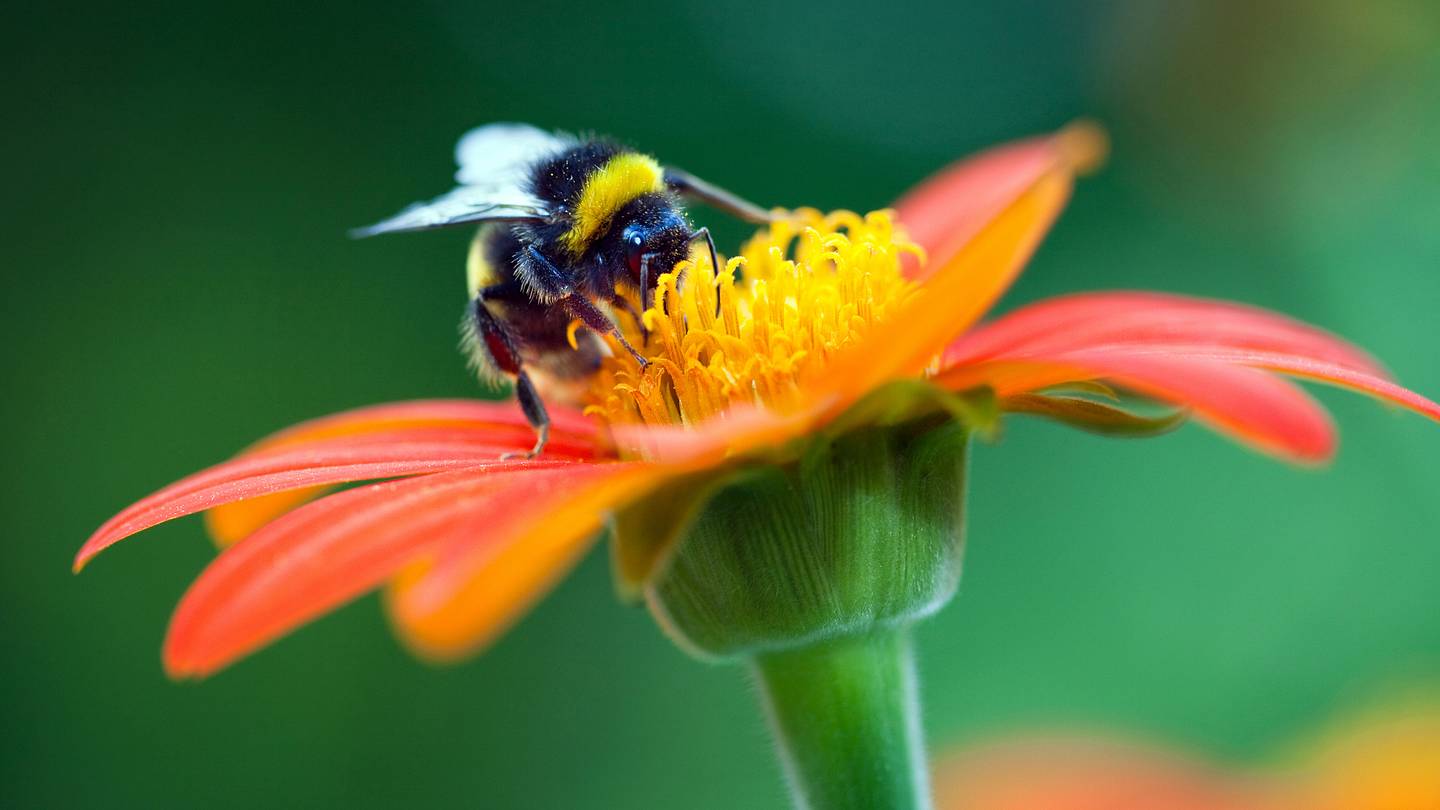
Scientifically speaking, insects are absolutely not fish . But under California law, they sometimes areâand that legal quirk is helping save the stateâs bees .
It all started in 1969, when California updated the definition of fish in its Fish and Game Code to include invertebrates and amphibians [ PDF ]. Before that, it had only covered âwild fish, mollusks, [and] crustaceans." The following year, the state legislature passed the California Endangered Species Act (CESA), which gave the California Fish and Game Commission the power to classify âbirds, mammals, fish, amphibia, or reptilesâ as endangered or rareâessentially protecting them from being killed or otherwise interfered with.
The act was replaced in 1984 with a new version that added plants to the list and also changed rare to threatened (among other revisions); further edits were made in the late 1990s. But what hasnât changed is section 45 of the code, which the commission uses to make decisions about which living things are legally fishâand therefore qualify for protection under CESA. And because all insects are invertebrates, theyâre covered under this umbrella of âfish,â too ⦠in theory.
In practice, however, not everyone has agreed with such a biologically absurd conclusion. In 2018, the Xerces Society for Invertebrate Conservation, the Center for Food Safety, and Defenders of Wildlife asked the commission to list the following four bumble bee species as endangered in order to grant them CESA protection: Crotchâs bumble bee, Franklinâs bumble bee, the western bumble bee, and the Suckley cuckoo bumble bee. The commission started the process, prompting a lawsuit from the Almond Alliance of California and a number of other agricultural organizations on the grounds that invertebrates were outside CESAâs purview. The Sacramento County Superior Court ruled in favor of those organizations, so the conservation groups joined forces with the commission to appeal the decision.
This time, as The Sacramento Bee reports , the court has sided with the conservationists. One key factor in the decision was the precedent set by the Trinity bristle snail, which was first designated a rare animal in California back in 1980 and confirmed as a CESA-protected threatened species when the act was overhauled later that decade. The Trinity bristle snail is a mollusk and an invertebrateâso by confirming its protection under CESA, Californiaâs legislature tacitly confirmed that mollusks and invertebrates, as âfishâ according to section 45, are indeed covered by CESA.
Because it lives on land, the Trinity bristle snail also helped poke a hole in another argument made by the Almond Alliance of California et al.: That section 45âs definition of fish was only meant to refer to aquatic invertebrates, mollusks, etc.Â
âAlthough the term fish is colloquially and commonly understood to refer to aquatic species, the term of art employed by the legislature in the definition of fish in section 45 is not so limited,â Ronald Robie, associate justice for the third appellate district of the California Court of Appeals, wrote in the court ruling [ PDF ]. A term of art is one that âhas a specialized meaning in a particular field or profession,â per Merriam-Webster .
Not only will the ruling help protect the four bumble bee species, but it also paves the way for the protection of other endangered and threatened terrestrial invertebrates in California.
âIt is a great day for Californiaâs bumble bees. Todayâs decision confirms that California Endangered Species Act protections apply to all of our stateâs imperiled native species and is critical to protecting our stateâs renown biodiversity,â Pamela Flick, a California program director for Defenders of Wildlife, said in a press release . âBees and other pollinators are integral to healthy ecosystems and the crucial pollination services they provide serve all of us, making this decision exponentially more consequential.â
[h/t The Sacramento Bee ]
Loading recommendations... Please wait while we load personalized content recommendations