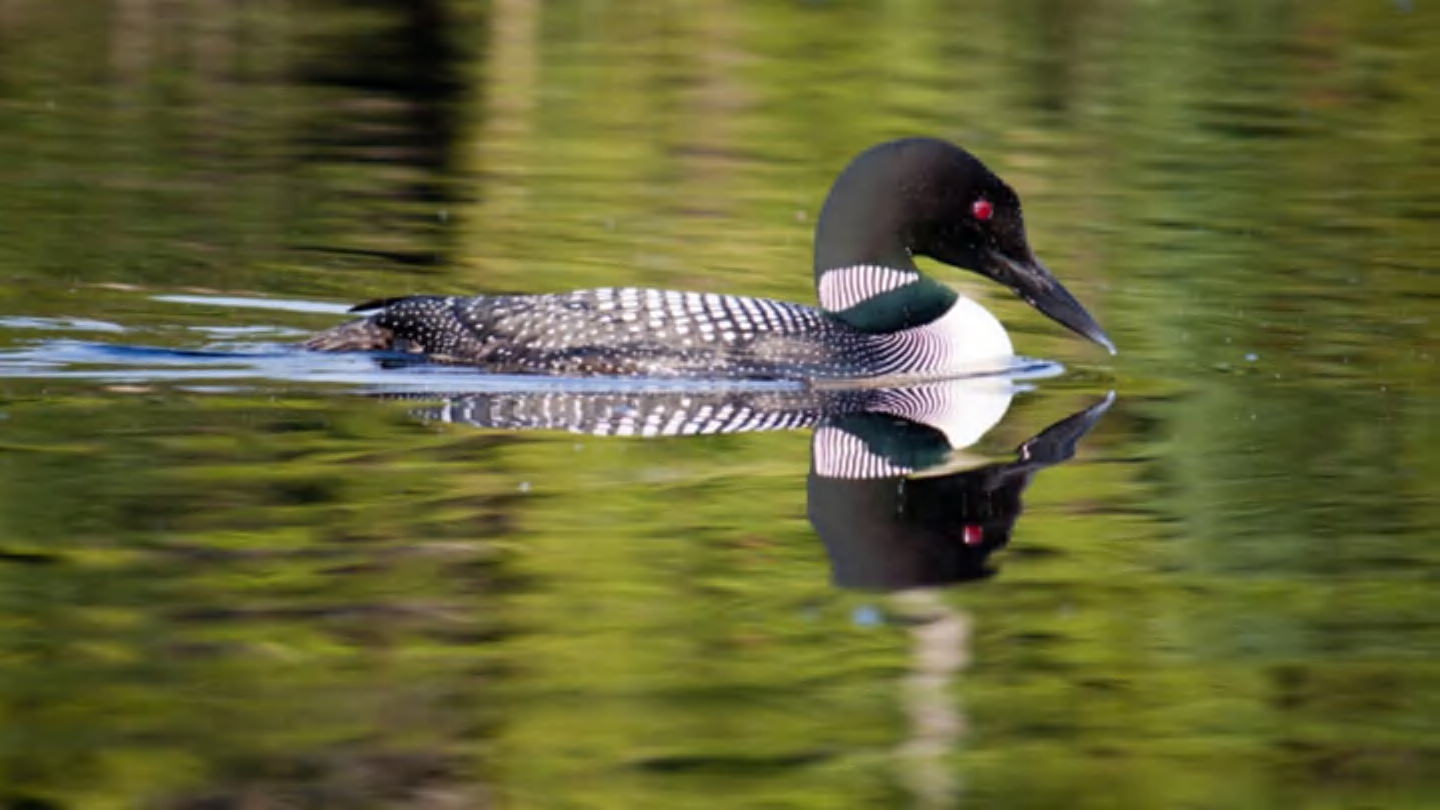
There are five species of loon, all living above the equator. There's the Arctic loon , a hardy tundra-dweller that roosts in northern Eurasia and North America; the Pacific loon, flocks of which descend upon California, Oregon, and Washington state every autumn; the red-throated loon , a small, narrow-headed bird that tends to point its beak upwards while swimming rather than straight ahead like its relatives; and the yellow-billed loon , the largest member of the loon family, which can weigh much as 13.2 pounds.
But when most people think of loons, itâs the common loon ( Gavia immer ) that comes to mind. Here are a few things you might not have known about the most iconic bird in this group.
In pursuit of fish, a common loon can plunge over 200 feet below the waterâs surface [ PDF ]. How is this possible? Part of the secret is in the bird's skeleton: Most avians have hollow, lightweight bones, but a loonâs are solid. This makes the diving birds a good deal less buoyant than, say, ducks. Once submerged, common loons can hold their breath for as long as eight minutes . Thanks to these talents, the birds are sometimes referred to as âgreat northern divers.â
After the bald eagle, the common loon is arguably the most celebrated bird in North America. In 1961, it was adopted as the state bird of Minnesota , and up in the Great White North, Canadian wallets are stuffed with âlooniesââdollar coins that have a portrait of the common loon on their reverse sides.
How the fowl came to grace this unit of currency is an interesting story. In 1986, the Royal Canadian mint was gearing up to release a new dollar coin. The design had already been selected: Queen Elizabethâs face would be slapped onto the front and two voyagers in a canoe were to decorate the tails side. But when making a two-sided coin, each of the images that will be included must be engraved into a metallic stamp called a die. Unfortunately, the canoe dies went missing before Canadaâs new one-dollar coins could be mass-produced. As a last-minute replacement, the mint decided to slap on a picture of a loon instead. Today, the coins are beloved in Canada. Many peopleâ particularly hockey players âconsider them to be lucky, but thatâs a story for another time.
Evolution is sometimes a matter of trade-offs. Over millions of years, loon legs were pushed towards the rear of their bodies. This helped the birds become more graceful swimmers, both underwater and at the surfaceâbut because they more or less jut out behind the animalâs body, they're not that great for walking. On land, loons stumble around and push themselves along on their belliesâso they try to avoid walking whenever possible. In egg-laying season, mated pairs will look for a nesting site thatâs close to the waterâs edge. Islands are considered prime real estate because terrestrial predators are less likely to attack the clutch or chicks there. You know what they say: location, location, location.
Despite being fairly heavyset birds, loons are strong fliers: They can reach speeds of about 70 miles per hour . But getting airborne is no easy task. Due to their size and leg anatomy, four of the five loon species physically cannot take off on dry land (the red-throated loon is the one exception ). Instead, they must run over the surface of some lake, ocean, or waterway, flapping their wings all the while. Only after zipping along in this fashion for 100 feet to a quarter-mile (depending on the wind) can the heavier loons gain liftoff and travel skywards.
Each sound is suited to a different situation: The wail , a long, haunting bellow that sounds like the howl of a wolf, is used to signal their whereabouts to faraway mates or rivals. An undulating, repetitive shriek called the yodel , which means âstay out of my territory,â is only made by males; no two specimens share the exact same yodel. The tremolo is a cackle that loons let loose when they either feel threatened or territorial. Finally, thereâs the onomatopoeic â hoot ,â which is used by members of the same family (mates, parents and chicks, etc.) who âhootâ every so often to keep in touch over short distances.
In the colder months, the birdsâ eyes are a dull gray. But in the spring and summer, they turn a vibrant shade of crimson. Scientists donât know why this happens, although it may have something to do with attracting mates or helping with underwater vision.
Like all birds, loons lack teeth. This forces them to either swallow their meals whole or in sizable chunks. To ease the digestion process, loons will seek out and devour small pebbles . Once inside their stomachs, the tiny stones mash up newly-eaten food, which can then be processed more efficiently.
At first glance, loons might bear a passing resemblance to these better-known birds, but looks can be deceiving. Molecular testing indicates that loons are more closely related to penguins and albatrosses than they are to ducks or geese.Â
Out in the field, itâs easy to tell loons and ducks apartâeven from a considerable distance away. Because of their heavy skeletons, loons ride low in the water while swimming. Conversely, youâll see a larger percentage of a duckâs body floating above the surface.
Hereâs another difference between loons and ducks. After mating, male ducks generally donât stick around to help the females incubate eggs or raise chicks. However, a pair of loons will take turns sitting on their clutch. When these eggs hatch, mom and dad both tend to the babies. A newborn loon will spend about 65 percent  of its first week riding around on a parentâs back. Apart from keeping them warm, hitching a ride helps keep the young safe from large fish and other aquatic predators like snapping turtles. Chicks will stay close to their guardians for two to three months. At the end of this period, most youngsters are capable of flying on their own and looking after themselves.  Â
This cozy town in the Badger State has a large concentration of loons, which frequent the surrounding lakes. In Mercer, the Great Northern Diver is treated like royalty. A 16-foot, 2000-pound talking loon statue named Claire dâLoon sits outside the chamber of commerce building. Moreover, residents throw a âLoon Festivalâ each summer. Here, you can pose next to locals who dress like the birds, get your face painted, and enjoy a bake sale. Then thereâs the loon calling contest , wherein contestants of all ages show off their yodels, wails, and tremolos. By the way, the 2016 festival will commence on August 3. That should give you plenty of time to practice. Now get yodeling!
Loading recommendations... Please wait while we load personalized content recommendations