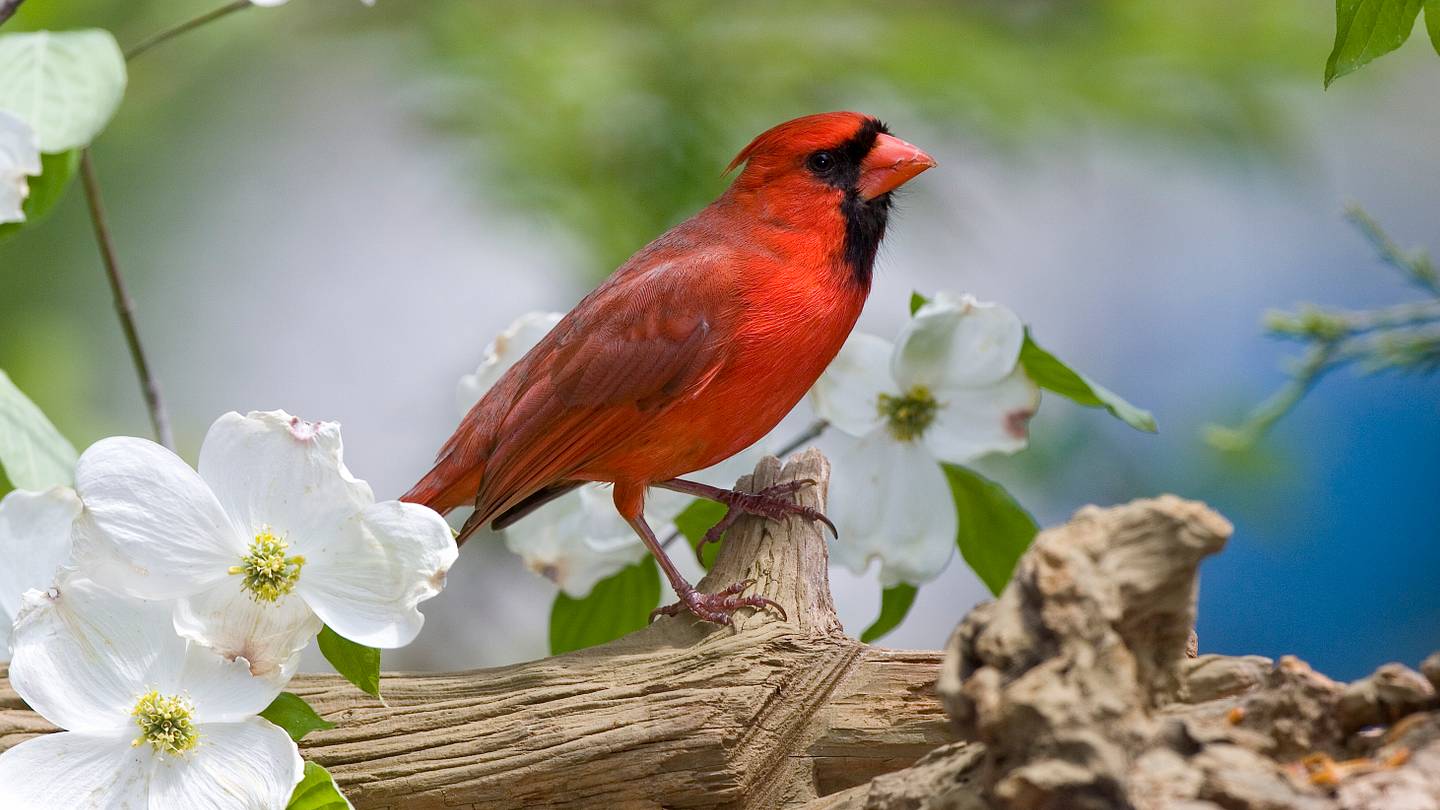
These crested songbirds add a welcome dash of color to yards throughout much of the United States. Letâs get a little better acquainted with our rosy, non-migratory neighbors.
For the remainder of this article, weâll be focusing on the northern cardinal , the most famous species in the United States. But the genus to which it belongs, Cardinalis , does contain two lesser-known members: The desert cardinal (also known as pyrrhuloxia ), which can be found in Mexico and the American southwest and has a distinctive scarlet and gray coat, and the radiant vermillion cardinal , which can be found in Venezuela and Colombia. There are also several closely related members of the Cardinalidae family, such as buntings, grosbeaks, and dickcissels, which are often referred to as cardinals.
American colonists named the birds cardinals as a nod to the red-gowned religious figures (either directly or after the word cardinal  had become a term for a particular shade of red). Over the past 400 years, people have also called them crested redbirds, Virginia nightingales, andâparadoxicallyâred blue jays. The term cardinal ultimately derives from cardo , a Latin word meaning âhinge.â In Vatican City, several important jobsâlike electing popesâdo, in fact, hinge upon the cardinals (hence the name).
Northern cardinals, like flamingoes, use foodâsuch as grapes or dogwood berriesâto keep up appearances. During the digestive process, pigments from the fruit enter the bloodstream and make their way to feather follicles and crystallize. If a cardinal canât find berries to snack on, its hue will gradually start fading.
Itâs appropriately called â anting â and over 200 species of bird, from the wild turkey to the Baltimore oriole, do it. Why? Experts arenât sure . Maybe the formic acids that these insects release help ward off lice. Or perhaps the chemicals make molting easier. At any rate, cardinals go about anting in two different ways: Sometimes, the birds mash up the insects and smear them around like sunscreen. On other occasions, theyâll simply drop live ants into their plumage.
Kentucky, Indiana, Illinois, Ohio, North Carolina, Virginia, and West Virginia chose the colorful cardinal as its state bird, making this species the most popular state bird in America.
Once upon a time, the northern cardinal was mainly a southern bird . In the 1880s, people rarely spotted them north of the Ohio River. Obviously, this is no longer the case. In 1896, the first northern cardinal was reported in Ontario. By 1910, theyâd become common throughout the Canadian province. The rise of suburbs can help explain this trend, since shrubs and small treesâwhich these neighborhoods have in abundanceâare a cardinalâs favorite haunts. On a related note, the avians were deliberately introduced to Hawaii and and became firmly entrenched in southern California during the 1920s.
Lady cardinals use this custom to evaluate potential suitors. Any candidate who can fetch top-quality seeds likely has good foraging skills, a sizable territory, or, ideally, both. When the incubation process starts, a femaleâs partner bears total responsibility for satisfying her dietary needsâso locating good chow will be a critical part of his job description.Â
In the warmer months, cardinal pairs aggressively defend a plot of land sized between two and 10 acresâso you might think that they get especially territorial in winter, when food gets much scarcer than usual. Instead, cardinal pairs will often join forces in the quest for sustenance. As temperatures drop, temporary flocks consisting of five or more couples band together. Loose confederacies like this also make individual birds less vulnerable to cardinal-eating predators, which are spotted more readily by large groups. At the end of the day, thereâs safety in numbers. Fun fact: a group of cardinals is called a âvaticanâ or a âconclave.âÂ
Naked-headed cardinals donât make for a pleasant sight. Wild specimens that suffer from a near-total lack of feathers on their heads and necks are documented every year. Many experts blame parasites, though someâlike Eastern Kentucky University ornithologist Gary Ritchisonâhave their doubts. Ritchison has personally handled âthousandsâ of cardinals, including several baldies. Among those afflicted birds, he says that âNone ⦠had severe lice or mite problems.â Alternative explanations include abnormal molting patterns and cranial injuries.
In northern cardinals, males and females look noticeably different. The former are a vibrant shade of crimson, the latter a drab olive with a few red highlights on the wings, crest, and beak. Imagine, then, the confusion that Larry Ammann must have felt one January morning in 2011. Perched upon the Texanâs bird feeder was an eye-catching cardinal whose right side was olive and whose left side was red.
A statistics professor and wildlife photographer, Ammann snapped a few shots of his guest. Intrigued, he decided to conduct a little online researchâwhich is when things got weird. âIn just a few hours, I learned ⦠that this bird is an extremely rare bilateral gynandromorphy cardinal,â the statistician said. What does that mean? Basically, Ammann put it, âa genetic mistake occurred during the first cell division of the fertilized ovum, causing one of the cells produced by this division to be male and the other to be female. As this egg developed, the entire right side remained female and the left side remained male.â
Gynandromorphy is more commonly observed in crustaceans and insects. Still, every so often, split-sexed vertebrates turn up. In 2003, for example, a gynandromorph zebra finch made international headlines. Amazingly, biologists learned that the masculine and feminine sides of this cardinalâs brain behaved in two different waysâbut it chirped out exclusively male calls and copulated with a female finch.
Read More About Birds:
A version of this story originally ran in 2016; it has been updated for 2025.