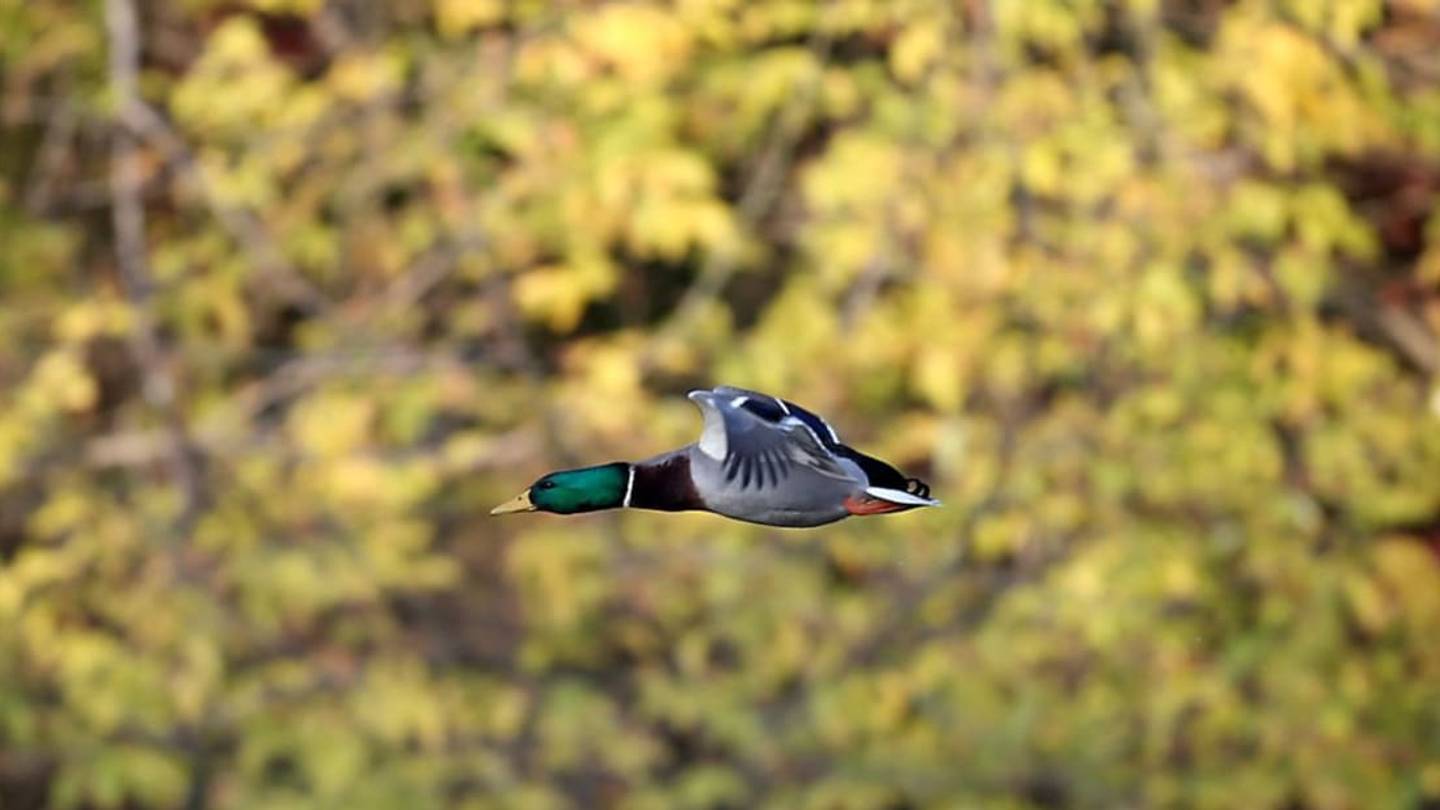
Mallard ducks: It seems like theyâre everywhere (spoiler alert: they pretty much are), and theyâre familiar to most of us. But what do you know about them beyond âtheyâre the ones with the green headsâ? If it isnât much, here are 15 facts about them.
Only the male mallards have the iridescent green head feathers, white âcollarâ on the neck and dark brown breast. The females are comparatively drab, with mottled brown and tan plumage all over. Both sexes, though, have a dark blue-black band of feathers, bordered by white, on their wings.
Male mallards donât sound much like what we think ducks sound like. They donât quack, and instead produce deeper, raspier one- and two-note calls. They can also make rattling sounds by rubbing their bills against their flight feathers. The females make the stereotypical quack, and often produce whatâs called a âdecrescendo callââa series of 2â10 quacks that start loud and get softer and shorter.
Christof Stache/AFP/Getty Images
Mallards can live in nearly any wetland habitat, natural or artificial. Theyâll make themselves at home in and around lakes, ponds, rivers, marshes, estuaries and coastlines, as well parks and backyards. That versatility (and a little help from humans, who likely introduced them in various locations) has allowed them to span across the globe, and they can be found across North America, Eurasia and New Zealand, and in parts of Central and South America, the Caribbean, Africa, the Arabian Peninsula, Japan and Australia.
Only two species of wild duckâthe mallard and the Muscovy Duckâhave been domesticated by humans. The vast majority of domestic duck breeds descend from mallards and were developed by selectively breeding different domestic birds (and sometimes domestic and wild individuals) for desired traits like plumage, growth speed, and high egg production.
Mallards are âdabbling ducks,â a cute term that means they feed by floating on the water and tipping themselves forward, butts in the air, to graze on underwater plants or grab insects. Theyâre as cosmopolitan in their diet as they are in their habitat choices, and will eat plants, worms, snails, other insects and their larvae, and shrimp. On land, theyâll also eat agricultural grains and seeds, especially during migration. And, of course, theyâre happy to take bread and other handouts from people in parks (though this isnât always good for them). Their diet is generally two-thirds plant matter and one-third animal protein.
The mallardâs wide range puts them in contact with plenty of other duck species, and theyâll readily mate with them, producing a number of hybrids like the Mallard X American Black Duck and the Mallard X Northern Pintail.
Mallards form pairs in the fall, court throughout the winter, and then breed in the spring. These pairs are generally monogamous, but âextra-pair copulationsâ can still happen because both paired and unpaired males sometimes mate with paired females whose partners arenât keeping an eye on things, leading to broods with multiple fathers.
Marco Bertorello/AFP/Getty Images
Migrating mallards have been clocked flying at 55 miles per hour, slightly faster than the average waterfowl. While they usually cruise at an altitude of less than 10,000 feet, they can get much higher. In 1962, a mallard was struck by a commercial airliner at 21,000 feetâa record altitude for a bird-aircraft collision at the time.
When a mallard was shot by a hunter in 2008, a band on its leg revealed that it had been tagged by biologists in 1981, making it at least 27 years old and the oldest known mallard on record. That bird was a lucky duck, thoughâthe average lifespan is just 3â5 years in the wild and about a decade in captivity.Â
The mallard was given its scientific description and species name, Anas platyrhynchos , back in 1758 by Carl Linnaeus, the âfather of modern taxonomy.â He derived the name from the Latin word for "duck" and an ancient Greek term for "broad-billed."
Mallards are among the most abundant ducks in the world, and in the U.S. alone, the mallard population is estimated to be 11.6 million birds. Thatâs good, because theyâre also one of the most heavily hunted ducks, and account for one out of every three ducks shot in North America.
In 1933, the general manager of The Peabody Hotel in Memphis, Tennessee came back from a hunting trip and thought it would be funny to place some of his live decoy ducks in the hotelâs fountain. The stunt was a hit with the guests, and since then, â The Peabody Ducks ââa group of one male and four female mallards, borrowed from a local farm and retired after three months to live wild againâhave lived in the âRoyal Duck Palaceâ on the hotel's rooftop and are brought down daily for a swim in the lobby. The hotel Duckmaster looks after them during their stay.Â
In 1995, Kees Moeliker, a curator at Rotterdamâs Natuurhistorisch Museum, documented the first case of homosexual necrophilia in mallards after he found one male mallard attempting to mate with another that had died after flying into a museum window. As Moeliker wrote in a paper about the incidentâwhich won an Ig Nobel Prize in 2003âthe mallard âmounted the corpse and started to copulate, with great force, almost continuously picking the side of the headâ for nearly an hour and a half before Moeliker intervened.
The dead mallard that Moeliker discovered has been commemorated every year since with a holiday called, obviously, Dead Duck Day . On June 5, the anniversary of the duckâs death, Moeliker holds a brief ceremony outside the building that the duck struck (usually holding the unlucky duck, which the Natuurhistorisch Museum had stuffed), talks about animal behavior, and discusses ways to prevent bird-window collisions. The museum also has a âsplatâ-shaped memorial plaque designating the spot where the duck hit the glass.
Evolutionary biologists think that mallards and other ducks have yellow or orange bills and legs to show off for the opposite sex. The bright colors suggest that a duck has been eating right and has a strong immune system, making them attractive mates.
Loading recommendations... Please wait while we load personalized content recommendations