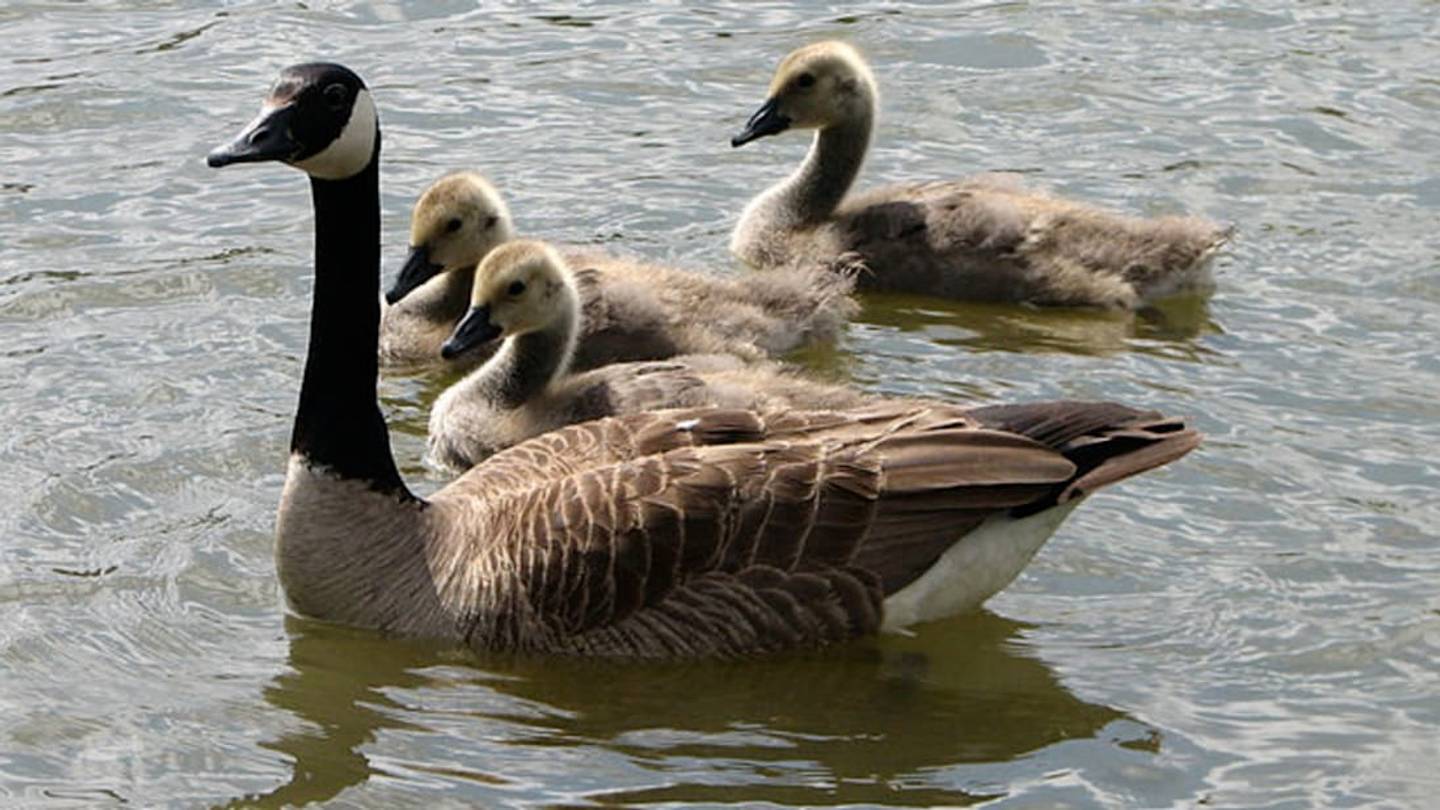
If you live in North America, you're probably familiar withâand perhaps annoyed byâthe Canada goose  ( Branta canadensis ). But how much do you know about the birds besides the fact that they're everywhere and honk a lot? Here are a few tidbits to get you better acquainted with the big, loud birds.Â
Canada geese look for a few things in a place to live and breed: grass to eat, water to drink, and unobstructed views to scan for danger. Part of the reason the geese are so common and so successful is that people have created a lot of spaces that fill those needs in the form of lawns, parks, golf courses, agricultural fields, and airports. After decades of decline due to hunting and habitat loss, all of that safe, reliable habitat has allowed the number of Canada geese in North America to grow rapidly, from less than 500,000 in the 1980s to more than 5 million today.
The increase in goose numbers and their concentration around humans has led to the goose getting branded as a nuisance or pest for eating grass and crops, fouling lawns and water with their waste, making a racket, and sometimes attacking people while defending their territory. Around airports, the geese also pose a serious danger to aircraft in the form of bird strikes . While geese and other waterfowl donât account for very many bird-aircraft collisions, Canada geese are among the species that can cause the most damage to planes because of their size and the large flocks they fly in. Government agencies and private landowners have tried plenty of ways of deterring the geese, including audio repellents that play goose alarm calls or the calls of birds of prey; swapping out shorter grasses for taller ones that geese donât eat; scaring them with pyrotechnics; and relocating or culling the birds.
Where populations are dense, Canada geese commonly form âgang broods,â groups of 20-100 goslings from different parents that move around and feed together accompanied by a few adults. This is sometimes cooperative, with families joining up so that some adults can watch the babies while the others forage for food. Sometimes, though, joining a gang brood isnât voluntary, and dominant pairs of geese have been known to attack and kill other adults and absorb their broods into their own. Either way, itâs good for the goslings, since larger families can more easily control the best foraging spots.
Canada geese find mates when theyâre around two years old, and pairs stay together for the rest of their lives (24 years on average). The birds usually pick partners that are similar to their own body size, a pattern known as âassortative mating.â
Canada geese usually fly in a large V-shaped formation, with one bird in the lead and the others trailing behind it in two diverging lines. There are two reasons for this. First, the V shape makes the flock more energetically efficient, with vortices of air created by each gooseâs flapping giving some lift to the birds behind it. Second, the formation makes it easier for the geese to maintain visual contact with each other and communicate, which helps navigation and flock cohesion.
Canada has more than 450 resident bird species and its fair share of national emblems  but no official national bird. The Royal Canadian Geographic Society aims to fix that by next year, the nationâs 150th birthday. Theyâve picked 40 candidates from the birds that call the country home and asked the public to vote for their favorite. The society will then lobby the government to give the winning bird official designation. As of this writing, the Canada goose is in a distant fourth place, with 2703 votes to the common loonâs 9209. At least it's slightly ahead of the black-capped chickadee (2530 votes).
Loading recommendations... Please wait while we load personalized content recommendations