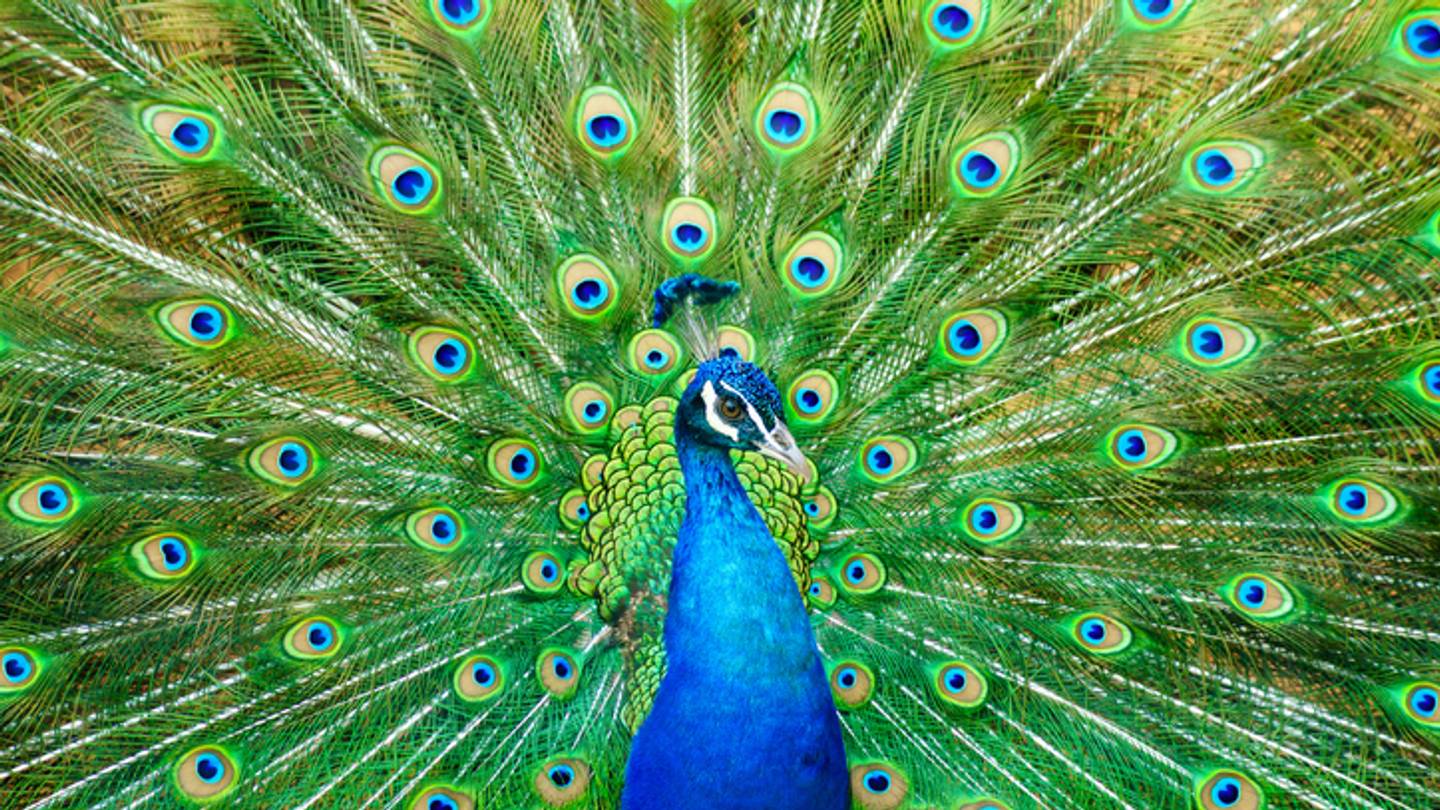
With their massive tails and iridescent colors, peacocks have long fascinated their human observersâand weâre still learning their secrets.
For example, a study in The British Journal of Animal Behaviour suggests that when a peacock fans its dazzling train for the ladies during mating season, its quivering feathers emit and amplify a low-frequency sound inaudible to human ears. Depending on whether they want to attract females from far away or up close, they can change the sound by shaking different parts of their feathers.
Here are a few other interesting facts about these impressive birds .
The collective name for birds in the genus Pavo is âpeafowl.â There are two species of peafowl: the Indian peafowl ( Pavo cristatus ) and the Congo peafowl ( Pavo muticus ). The males of both species are called peacocks, females are peahens, and the babies are peachicks.
A group of the birds is also sometimes called an ostentation , a muster , or even a party.
The male peachicks donât start growing their showy trains until about age 3. In fact, itâs hard to tell the sex of a peachick because theyâre nearly identical to their mothers. At around 6 months old, the males will begin to change color.
Luckily, the peacocks shed their train every year after mating season, so the feathers can be gathered and sold without the birds coming to any harm. The average lifespan of a peacock in the wild is about 20 years.
A peacockâs tail feathers can reach up to six feet long and make up about 60 percent of its body length. Despite these odd proportions, the bird flies just fine, if not very far at a time.
Thanks to selective breeding, itâs common for captive peafowl to have only white feathers. This is called leucism, and itâs due to a genetic mutation that causes loss of pigmentation in some of the birdsâ pigment-producing cells. These peafowl are often mistaken for being albino, but instead of having red eyes, leucistic animals retain their normal eye color .
The birds were plucked, roasted, and then re-dressed in their feathers for the dinner table. The birds may have looked beautiful, but they reportedly tasted terrible. The meat âwas tough and coarse, and was criticized by physicians for being difficult to digest and for generating bad humors,â writes Melitta Weiss Adamson in her book Food in Medieval Times .
These birds arenât just nice to look atâtheyâre also clever, according to a review in the journal The American Naturalist .
When peacocks mate with peahens, they give out a loud âcopulatory call.â Canadian researchers Roslyn Dakin and Robert Montgomerie discovered that the birds can âfakeâ this call to attract more females. By doing so, he may be signaling to females that heâs more sexually experiencedâand thus more genetically fit âthan other peacocks in the neighborhood. Dakin and Montgomerie found that a third of the calls were fake, and the birds that made them scored more hookups. Sneaky.
What makes the some of the peacockâs feathers so brilliant? Microscopic structures that reflect different wavelengths of light depending on how theyâre spaced, resulting in bright fluorescent colors. Hummingbirds and shimmering butterflies demonstrate a similar visual effect on their own wings.
A female peacock has special sensors in her crest that allow her to feel the vibrations of mate who may be located far away. The feathers are âtuned to vibrate at the exact same frequencies at which a displaying peacock rattles his tail,â according to The Atlantic . Whenever a male peacock fans his tail, he shakes it at a rate of 26 times a second, creating a pressure-wave that literally rattles the femaleâs head for attention.Â
A version of this story ran in 2016; it has been updated for 2023.
Loading recommendations... Please wait while we load personalized content recommendations