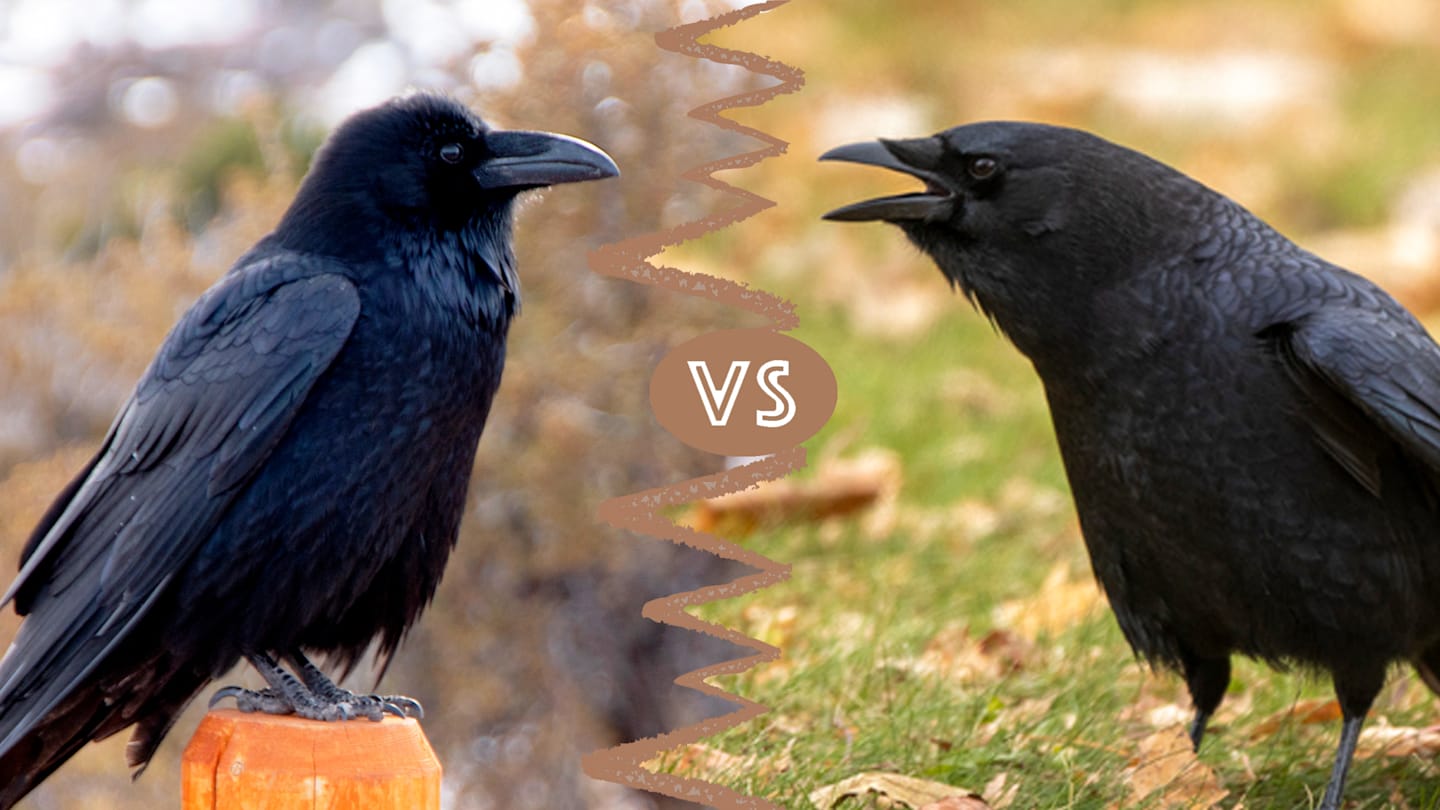
Ravens and crows have, bar none, the coolest group names in the animal biz. A collection of crows is, of course, a murder, and a gathering of ravens is called a âconspiracy.â
And if you canât tell these two types of big songbirds apart, you may think youâre uncovering a minor conspiracy when youâre actually witnessing a murder.
Itâs easy to confuse crows and ravens because both are solid black and as goth as the night is longâbut a few characteristics give their identities away. Here are some tips on how to differentiate the common raven ( Corvus corax ) and the American crow ( Corvus brachyrhynchos ).
That raspy â Caw! caw! caw! â tone of movie graveyards , haunted houses, and Halloween sound effect collections? Thatâs a crow. Their caw is a territorial call, and youâll hear them making this sound alone, with family or friends, or sometimes in roosts among hundreds of other crows.
Itâs not the only vocalization by these brainy birds. Crows emit whatâs called a rattle, which sounds like cackling, and a whole library of calls to communicate different things to their peers. Semi-captive crows can also mimic human speech .
Ravensâ typical calls are more gurgly and croaky and can sound eerily human. They âtalkâ on their own, with others, or in response to another ravenâs call. Scientists have documented 33 types of common raven vocalizations, including predatory alarms , comfort sounds, and chase calls, which can take the forms of chuckling, knocking, shrieking, and more. They can imitate other birds and learn to imitate us.
If theyâre not talking enough to tell you their identities, the difference in size between crows and ravens can give them away.
American crows are significantly smaller than ravens. They weigh less than a pound, measure 17 to 21 inches from beak to tail, and have a wingspan of 34 to 39 inches , roughly the length of a baseball bat. Crows look huge when compared to most backyard birds like sparrows, wrens, or chickadees, but theyâre dwarfed by their corvid cousin.
The common raven is as big as a hawk . They can reach 21 to 27 inches in body length and sport a wingspan of 46 inches , about the size of the longest professional golf club . They weigh 1.5 to nearly 4 pounds , which makes them the largest songbird in North America.
Because youâll rarely get close enough to either bird to size them up with a yardstick, other physical clues can point to their identities. The bill of a crow is smooth, slightly hooked down on the end, and half-covered in flat black bristles. Itâs almost delicate compared to the ravenâs bill, which is quite a bit larger and sometimes referred to as â Roman ,â similar to a human âRomanâ or aquiline nose , which features a prominent bridge and sloping profile. ( Aquiline derives from the Latin term for âeagle-like,â referring to its hooked bill.)
Ravens have shaggier feathers around their bill and on their neck, which can puff out when the bird vocalizes. The feathers around a crowâs head are smooth and neat.
In flight, the birds have different tail feather silhouettes. Crow tail feathers are all the same length and will spread out like a fan. A ravenâs tail feathers are longer in the center and, when the bird is in flight, take on a wedge or diamond shape.
Ravens are widespread across the Northern Hemisphere. They range throughout Eurasia from northern Scandinavia and Russia as far south as the Himalayas and northernmost Africa. They also inhabit the southern borders of Greenland and all of Canada and the western U.S., including Alaska, down into Central America.
American crows are literally less worldly, confining their travels to within North America . Their year-round range extends throughout the United States, the Canadian Maritimes, and coastal British Columbia and Alaska. Crows are short-distance migrants and spend the breeding season in Canada, as far north as the Northwest Territory.
Ravens can live just about anywhere and adapt to a huge variety of environments . They can be found in broadleaf and conifer forests, shrublands, grasslands, steppes, coastal areas, cliffs, mountains, deserts, and towns. They mostly avoid major cities, but in less-populated areas, ravens will readily nest on human-made structures like oil rigs, utility poles, and radio towers.
Crows make their homes in forests, shrublands, prairies, and agricultural lands as well as big cities. Crows, more than ravens, seem to adapt to highly developed metropolitan areas. Cities like Poughkeepsie , New York; Rockville , Maryland, and Portland , Oregon, play host to wintertime roosts of thousands of crows at a time.
Read More Stories About Animals: