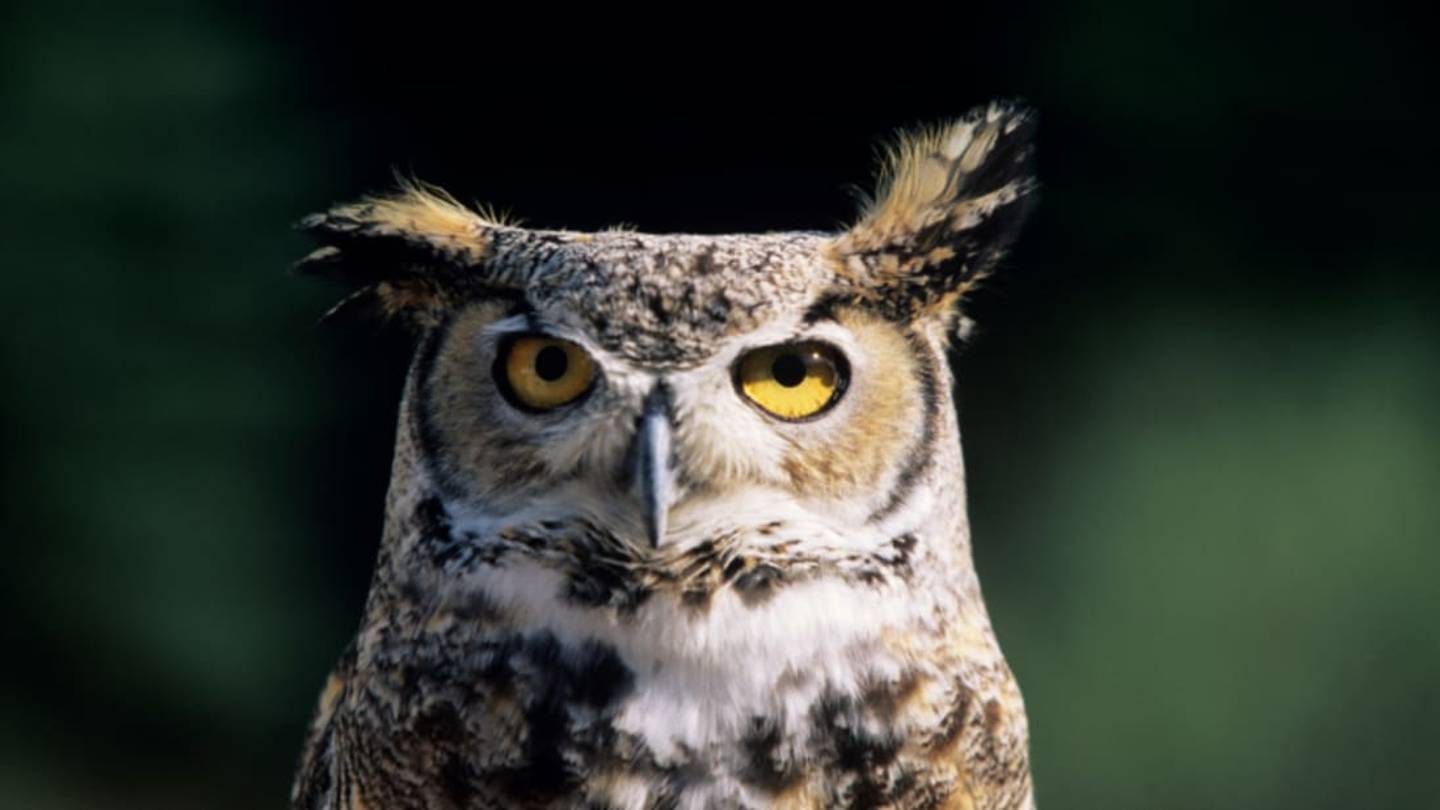
For humans, sudden gyrations of the head and neckâwhether theyâre from car accidents, rollercoaster rides, or chiropracty gone awryâcan tear blood vessel linings in the neck, leading to clots that can cause stroke. Not so in owls, which can quickly rotate their heads 270 degrees in either direction without damaging blood vessels or cutting off blood flow to the brain. How do they do it?
To solve the mystery, scientists at Johns Hopkinsâled by medical illustrator Fabian de Kok-Mercado and neuroradiologist Philippe Gailloudâused angiography and CT scans to examine the anatomy of a dozen snowy, barred, and great horned owls that died from natural causes. They discovered that the birds are equipped with four biological adaptations that prevent injury from rapid rotational movement; their study appears in the latest issue of Science .
âUntil now, brain imaging specialists like me who deal with human injuries caused by trauma to arteries in the head and neck have always been puzzled as to why rapid, twisting head movements did not leave thousands of owls lying dead on the forest floor from stroke," Gailloud said in a press release announcing the results of the study. "The carotid and vertebral arteries in the neck of most animalsâincluding owls and humansâare very fragile and highly susceptible to even minor tears of the vessel lining.â
After x-raying, dissecting and analyzing blood vessels from the dead birdsâ necks, the researchers injected dye into the dead owlsâ arteries to mimic blood flow and manually turned their heads. What they found was surprising: Unlike in humans, whose arteries shrink as the head turns, the blood vessels just under the jaw at the base of the owlsâ heads got increasingly larger as more of the dye entered, but before the fluid pooled into reservoirs. These contractile reservoirs, scientists say, are what allow owls to turn their heads so radically while still having enough blood to feed the eyes and the brain. What's more, a complex supporting vasular network minimizes interruptions in blood flow; the scientists discovered that owls have small vessel connections between the carotid and vertebral arteries that allow blood to flow between the two vesselsâso even if one route is blocked by an extreme neck rotation, another can provide an uninterrupted blood flow to the brain.
Bones in owlsâ necks also have adaptations designed to facilitate extreme rotation. One of the major arteries feeding the birds' brains passes through holes in the vertebrae, called transverse foramine; the team found that these holes were 10 times larger in diameter than the artery. This extra space creates air pockets that allow the artery to move around when twisted; 12 of the vertebrae in the owlsâ necks had this adaptation. "In humans, the vertebral artery really hugs the hollow cavities in the neck. But this is not the case in owls, whose structures are specially adapted to allow for greater arterial flexibility and movement," said de Kok-Mercado. Plus, the owlsâ vertebral artery enters the neck higher than it does in other birdsââgoing in at the 12th cervical vertebrae, rather than the 14thâallowing for more slack.
"Our new study results show precisely what morphological adaptations are needed to handle such head gyrations and why humans are so vulnerable to osteopathic injury from chiropractic therapy," Gailloud said. "Extreme manipulations of the human head are really dangerous because we lack so many of the vessel-protecting features seen in owls." The team created a poster (above) that details their findings, and next plans to study hawk anatomy to see if those birds have similar adaptations for head rotation.
Loading recommendations... Please wait while we load personalized content recommendations