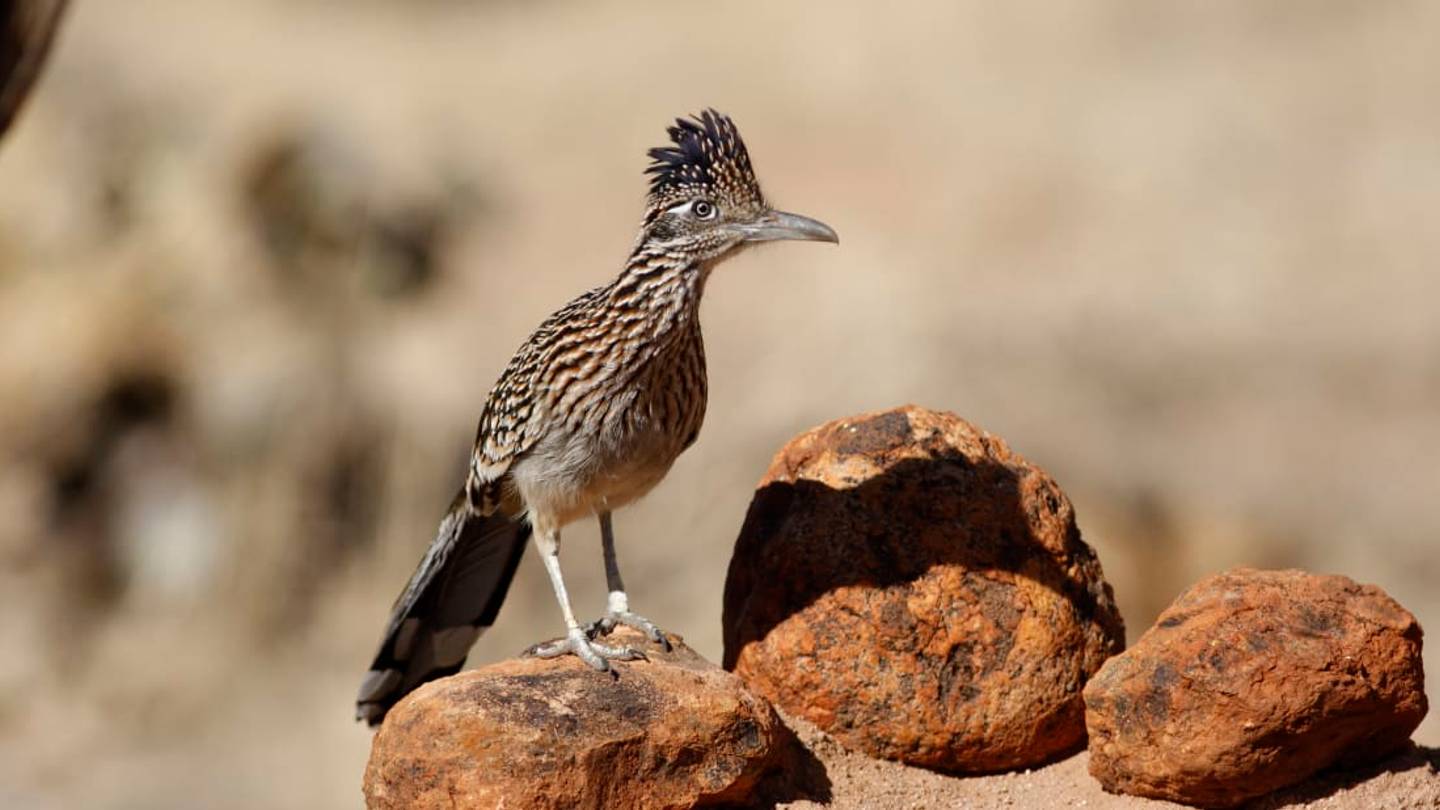
Anyone who was raised on Looney Tunes cartoons might be surprised to find out that roadrunners arenât long-necked or purple-crestedâbut roadrunners and coyotes do occasionally engage in chases. Here are a few fast facts about these unusual desert birds.
Found in deserts, grasslands, and forests, the greater roadrunner ( Geococcyx californianus ) cruises through the southwestern U.S. and northern Mexico. Its slightly smaller relative, the lesser roadrunner ( Geococcyx velox ), is generally found further south. Both birds belong to the cuckoo family, Cuculidae , which also includes anis and malkohas. All the members of the family have zygodactyl feet, with two forward-facing and two backward-facing toes. The arrangement gives roadrunners X-shaped footprints.
According to The Real Roadrunner by Martha Anne Maxon, scientists have clocked the speedy birds running at 15 to 20 miles per hour. Coyotes can run twice as fast as even the fastest roadrunners, but luckily for the birds, coyotes would just as well dine on small rodents, plants, and lizards instead of birds.
Most of the time, roadrunners get around on foot, but taking flight is an option too. Roadrunners will sometimes glide down to Earth from tree branches or canyon rims, but theyâre limited to short-distance powered flights because their wings are weak and their muscular legs weigh them down. To get airborne, they usually need a running start.
Opportunistic and omnivorous , roadrunners will eat seeds, cactus fruit, snails, snakes, lizards, insects, arachnids, and rodents. Smaller birds are fair game, too. Roadrunners will sometimes lurk around birdfeeders and, with a great leap, snatch songbirds in midair. Wildlife photographer Roy Dunn recently filmed a roadrunner capturing a hummingbird at his backyard feeder.
Roadrunners have no fear of venomous rattlesnakesâin fact, they find them delicious. But hunting one takes patience. When the two beasts face off, the roadrunner will fan its wings, which makes the bird look bigger and more threatening. As the snake strikes, the roadrunner nimbly leaps out of the way. This happens over and over until the bird, having learned the snakeâs routine, grabs it by the back of the head in mid-strike. Then the roadrunner bashes the snake against the ground until itâs subdued or dead. Since they donât have talons and their beaks arenât equipped to rip through flesh, roadrunners swallow snakes whole.
Roadrunners are viewed as protective entities among Puebloan peoples in the southwest U.S. Members of these tribes scratched X-shaped symbols designed to look like the birdsâ tracks into the earth around dead bodies. The Xs were believed to secure them from evil spirits: malevolent beings would get confused because they couldnât tell which way the roadrunner who left the âfootprintsâ had been headed. Likewise, roadrunner feathers were placed over cradles to protect the babies inside.
Male roadrunners emit cooing noises while courting females and defending territories. Both sexes also use barks and growls to communicateâand for unknown reasons, roadrunners like to produce a long series of clicks by snapping their beaks. The clicks might be a message about oneâs territory or a signal to broadcast oneâs location to others.
Considered monogamous, greater roadrunners sometimes pair for life. To help maintain the relationship, males periodically dance for their partners. Theyâll also offer food and materials that can be used during nest construction. Both parents take turns incubating their eggs, which are laid in clutches of two to six, and they share chick-raising duties later on. Defending the home turf is another task they perform together. A single pair of roadrunners may occupy a huge territory encompassing up to 250 acres .
Roadrunners donât migrate. On cold nights, the birds reduce their own body temperatures by as much as 15°F , which allows them to burn less energy. To help warm themselves back up, the birds like to sunbathe in the early morning [ PDF ]. They even raise their feathers to expose their skin directly to the sunâs warming rays.
The greater roadrunner was formally chosen to be the Land of Enchantmentâs state bird on March 16, 1949. Since then, the anti-littering organization Keep New Mexico Beautiful, Inc. has adopted an anthropomorphic roadrunner named Dusty as its mascot.
Loading recommendations... Please wait while we load personalized content recommendations