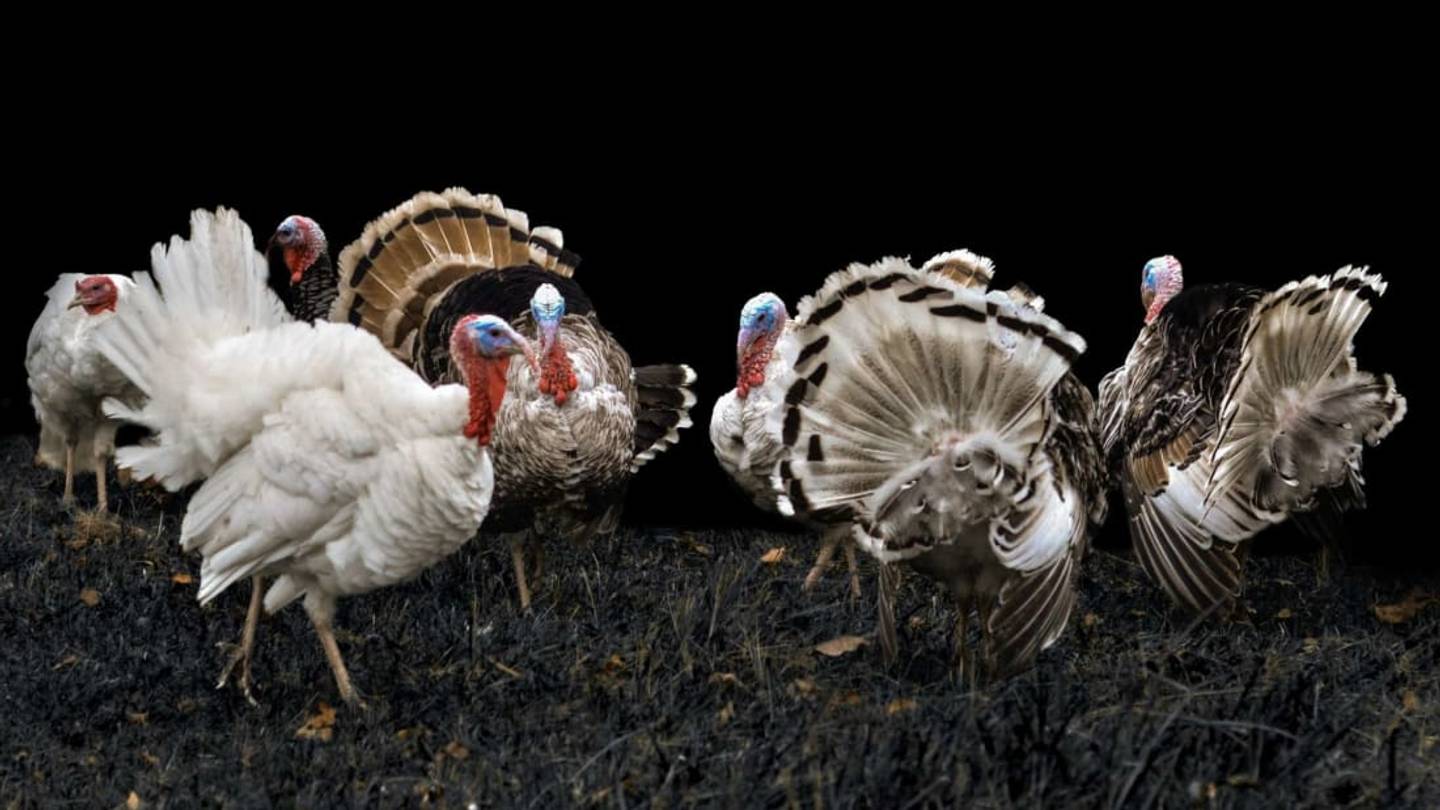
Most of us probably associate turkey with a sumptuous Thanksgiving spread, but thereâs a lot more to the big bird than how delicious it is alongside your grandmaâs famous cranberry sauce . Here are a few bits of knowledge you can drop over the dinner tableâwhen youâre not fighting with your family, that is.
Wild turkeys once roamed the continent en masse, but by the early 20th century, the entire U.S. population had been whittled down to a mere 30,000 due to hunting and the destruction of their woodland habitats. In the 1940s, many of the remaining birds were relocated to parts of the U.S. with recovering woodlands so the turkeys could repopulate. Despite these efforts, by 1973, there were still just 1.5 million wild turkeys in North America. Today, that number is up to about 6 million.
The dangly appendage that hangs from the turkeyâs forehead to the beak is called a snood . The piece that hangs from the chin is the wattle . These fleshy flaps can change color according to the turkeyâs physical and mental healthâwhen a male turkey (called a tom, of course) is trying to attract a mate, the snood and wattle turn bright red. If the turkey is scared, the appendages take on a blue tint. And if the turkey is ailing, they become very pale.
Well, domestic turkeys that are bred to be your Thanksgiving centerpiece canât. Theyâre too heavy. But wild turkeys can, reportedly at speeds up to 55 mph. Though they donât go very farâusually less than 100 yardsâwild turkeys are among the five largest flying birds in the world. Theyâre in good company: Others on the list include the swan and the albatross.
Turkeys donât swim often, it seems, but they can , by tucking their wings in, spreading their tails, and kicking. In 1831, John James Audubon wrote , âI have been told by a friend that a person residing in Philadelphia had a hearty laugh on hearing that I had described the Wild Turkey as swimming for some distance, when it had accidentally fallen into the water. But be assured, kind reader, almost every species of land-bird is capable of swimming on such occasions, and you may easily satisfy yourself as to the accuracy of my statement by throwing a Turkey, a Common Fowl, or any other bird into the water.â
The next time you happen across turkey poop âwhich happens all the time, we knowâtake a closer look at it. If the droppings are shaped like a âJ,â they were left there by a male turkey. Spiral-shaped poo? The culprit is female.
The citizens of Pilot Rock, Oregon, probably donât much care about the shape of the stuff, but more about the quantity of it. In 2017 , Pilot Rock turned to the Oregon Department of Fish and Wildlife (ODFW) for help combating a flock of 50 to 70 wild turkeys that would periodically invade the town, destroy gardens, perch in trees, and poop on pickup trucks. The ODFW offered several solutions, but as far as we know the turkeys still rule the roost at Pilot Rock.
Thanks to historical records , we know for sure that the Wampanoag brought deer, and the English brought fowlâlikely ducks and geese.
You may have heard that at least one of our Founding Fathers lobbied hard to make the turkey our national symbol instead of the noble bald eagle . Thatâs not quite true, but in a letter to his daughter, he did expound on the character of each, which may be where the rumor got started:
Yep, A. Ham liked turkey. In fact, he thought eating turkey was practically a god-given right, and once remarked that "No citizen of the U.S. shall refrain from turkey on Thanksgiving Day."
Olâ TR may have been accustomed to hunting big game, but wild turkeys held a special place in his heart. He believed they were every bit as challenging to hunt as deer. In his 1893 book Hunting Trips of a Ranchman and the Wilderness Hunter , he wrote , âThe wild turkey really deserves a place beside the deer; to kill a wary old gobbler with the small-bore rifle, by fair still-hunting, is a triumph for the best sportsman.â
Their fantastic vision is probably one reason Teddy Roosevelt found turkeys such a challenge to hunt. They can detect motion from many yards away, have vision three times greater than 20/20, and have peripheral vision of about 270 degrees . Ours, comparatively, is only 180. And although turkeys canât see in 3D, they can see UVA light, which helps them better identify predators, prey, mates, and food.
You may know Minnesota for producing Prince , the Mall of America , and Target . But we also have the Land of 10,000 Lakes to thank for our Thanksgiving turkeys. According to the Minnesota Turkey Growers Association, approximately 46 to 48 million turkeys are produced in Minnesota every year. In fact, itâs where the turkey that receives a presidential pardon hails from every year. Speaking of which â¦
Officially, the tradition of the sitting president of the United States pardoning his Thanksgiving turkey dates back to John F. Kennedy , who decided to let his gift from the National Turkey Federation off the hook. But he wasn't the first president to let a turkey go free: When Lincoln âs son Tad befriended one of the birds intended for Christmas dinner in 1863, kind-hearted Abe granted it a stay of execution.
In 1953, Swanson ended up with 10 train cars full of frozen turkeysâ 260 tons of themâwhen an overzealous buyer ordered too many turkeys for the holidays. Salesman Gerry Thomas solved the problem by ordering 5000 aluminum trays and setting up an assembly line of workers to scoop dressing, peas, and sweet potatoes into the compartments. Slices of turkey rounded out the meal, which Swanson sold for 98 cents. The idea was a hit: The following year, 10 million turkey TV dinners were sold.
Everyone eats turkey in November and December, so thereâs not a lot of need for extra poultry promotion during those months. If you want to celebrate National Turkey Loversâ Month , youâll have to do it in June with some turkey brats and burgers on the grill.
Thatâs how long it typically takes the birds to grow to maturity, which is when theyâre usually slaughtered.
At one point, Disney thought 1995's Pocahontas needed a little comic relief, so they hired John Candy to voice a wisecracking woodland fowl named Red Feather. Sadly, Candy passed away while the logistics were being worked out, so animators dropped the turkey entirely and opted for a clever raccoon named Meeko.
If you hear a turkey making the distinctive noise we all associate with them, then youâre hearing a male communicating with his lady friends up to a mile away. Females make a clicking sound instead of a gobble.
According to the National Turkey Federation, 88 percent of Americans eat turkey at Thanksgiving.
When KFC opened its first stores in Japan in the 1970s, the company was surprised to find that sales soared during the holidays. The phenomenon stymied executives since most of Japan celebrates neither Thanksgiving nor Christmas. It was later discovered that foreigners craving holiday turkey had decided that KFC âs chicken was the next best thing. After the company figured this out, they played up the association with their âKurisumasu ni wa kentakkii!â campaignââKentucky for Christmas.â It worked on tourists and locals alike, and today, Christmas Eve is still the highest-selling day for KFC Japan.
You probably know that a group of turkeys is a flock , but they can also properly be called a rafter . And should you want to call baby turkeys something a little more precise, you can call them poults .
Archaeologists have found vases dating from 250-800 CE that have turkeys depicted on them. According to University of Wisconsin-Milwaukee art historian Andrea Stone, "turkeys were quintessential animals for feasting and for sacrificial offerings." The Maya even crafted tamales shaped like the birds.
Even when she was at peak popularity, the famous chef refused to remove her phone number from public listings. According to friends, complete strangers would call Child on Thanksgiving to ask for advice on cooking the perfect turkey . Child always answered the phone, and typically told callers whatever they needed to hear to get them to relax and enjoy the holiday. She even told some amateur cooks that turkey was best served cold anyway.
Well, according to Sesame Street , heâs actually a canaryâbut his plumage makes him a turkey. The good people at American Plume & Fancy Feather provide Sesame Street with several thousand turkey feathers per costume to make sure Big Bird looks soft and fluffy.
But the whole thing was a mistake . Centuries ago, the English began to import a rather tasty bird, now known as a helmeted guinea fowl, from Madagascar. But they didnât know it was from Africa. Because it was imported to Europe from merchants in Turkey, the English believed the birds were also Turkish.
Later, when the Spanish arrived in the New World, they discovered Meleagris gallopavo âthe wild turkey. It was delicious, so they started importing it back to Europe. Europeans thought it tasted like the âturkeyâ guinea fowl they had been enjoying, so they called it the same thing.
Itâs just a different type of muscle than white meat. White meat is the result of glycogen, which doesn't need much oxygen from the blood because the muscles it fuels only require short bursts of energy. Dark meat, however, is found on wings, thighs, and drumsticksâmuscles that are used for long periods of time and require more sustainable energy. Itâs made dark by the proteins that convert fat into energy.
Like all birds, turkeys donât have teeth , so theyâve got to enlist some extra help to break down their food. Each swallowed mouthful goes first into a chamber called a proventriculus , which uses stomach acid to start softening the food. From there, food travels to the gizzard, where specialized muscles smash it into smaller pieces.
Turkey meat does contain the amino acid tryptophan, and tryptophan can have a calming effect. However, youâd have to eat a whole lot of turkeyâand nothing elseâto notice any effect. The sleepy feeling that you feel after the big meal is more likely caused by carbs, alcohol, and generally eating to excess.
Due to their aforementioned deliciousness, turkeys have a lot of natural predators. As the sun goes down, the turkeys go upâ into the trees . They start by flying onto a low branch, then clumsily hop their way upward, branch by branch, until they reach a safe height.
The wattle is the red dangly bit under the turkeyâs chin. The red thing on top of the beak is called a snood . Both sexes have those, too, but theyâre more functional in male turkeys. Studies have shown that female turkeys prefer mates with longer snoods, which may indicate health and good genes.
You probably wouldnât guess it by looking at them, but turkeys can really book it when they need to. We already know theyâre fast in the air; on land, a running turkey can reach up to 25 mph âas fast as a charging elephant.
Turkeys can recognize each other by sound, and they can visualize a map of their territory. They can also plan ahead and recognize patterns. In other ways, theyâre very, very simple animals. Male turkeys will attack anything that looks remotely like a threat, including their own reflections in windows and car doors.
Baby turkeys, or poults , are precocial. This means that theyâve already got downy feathers when theyâre born, and they can walk, run, and get their own food. Turkey moms defend their poults from predators, but thatâs about all they need to do. The fluffy chicks are pretty self-sufficient.
Loading recommendations... Please wait while we load personalized content recommendations