Your mom always told you to be nice to the custodianâand speaking of clean-up specialists, have you thanked a vulture today? The scavenging birds do our environment a world of good. If youâre not a fan already, we hope these astonishing facts will help you learn to love them.
With the exception of Australia and Antarctica, every continent has a resident vulture population. Ornithologists split the 23 living species into Old World vultures and the New World vultures (condors belong to the latter). Genetic evidence tells us that these birds arenât close relatives; they independently evolved similar-looking physiques in response to environmental forces, a rare case of convergent evolution .
Old World vultures, native to Europe, Africa, and Asia, have strongly curved, eagle-like beaks and they can easily grasp things with their hooked talons. By comparison, the beaks on New World vultures, which live in the Americas, are weakerâand these birds arenât as adept at using their feet to manipulate objects [ PDF ].
Most vultures, in both hemispheres, have little to no plumage on their necks and heads. Historically, naturalists believed baldness was a sanitary measure, assuming that if vultures had facial feathers, theyâd get drenched in blood and gore at mealtime. But it turns out their bald heads may offer another advantage.
Researchers at the University of Glasgow compared photos of griffon vultures in different poses depending on the temperature of their environment. They found that on hot days, the vultures tended to stick their necks out, and in cold weather, they tucked their heads underneath their wings. The scientists concluded that the birdsâ bare skin helped them regulate their body temperatures because the skin rapidly loses heat. The trick may come in handy since many vultures have to deal with extreme daily temperature variation in their habitats.
Much like their bald heads, their unfeathered feet and legs can also help vultures get rid of excess body heat. To aid that process, some species will literally poop on their legs and allow the viscous liquid to evaporate, cooling their skin. The waste serves an additional purpose: Thanks to their diet, vulture poop is highly acidic and acts as a disinfectant for their feet, slaying harmful bacteria they pick up while hopping around animal carcasses.
In 1826, John James Audubon challenged the prevailing belief that all vultures had an extraordinary sense of smell . Audubonâs field experiments with birds he believed to be turkey vultures convinced him that the birds used sight to track down their food. Divided over this issue, ornithologists broke off into rival factions: âNosariansâ still believed that vultures were scent-driven animals while âanti-nosariansâ agreed with Audubonâs thesis. Both sides were partially right. Most Old World vultures are indeed guided by visionâas is the North American black vulture, which is probably the species that Audubon looked at in his experiments. But the turkey vulture has a phenomenal sense of smell , allowing it to zero in on carcasses from thousands of feet overheadâa nice compliment to the animalâs keen eyesight .
The nasal septum, a wall of bone and cartilage in the nose, separates the left and right nasal passages. Turkey vultures lack this structure, which is also absent in yellow-headed vultures. If you look at them from the side, itâs possible to see clear through their bills.
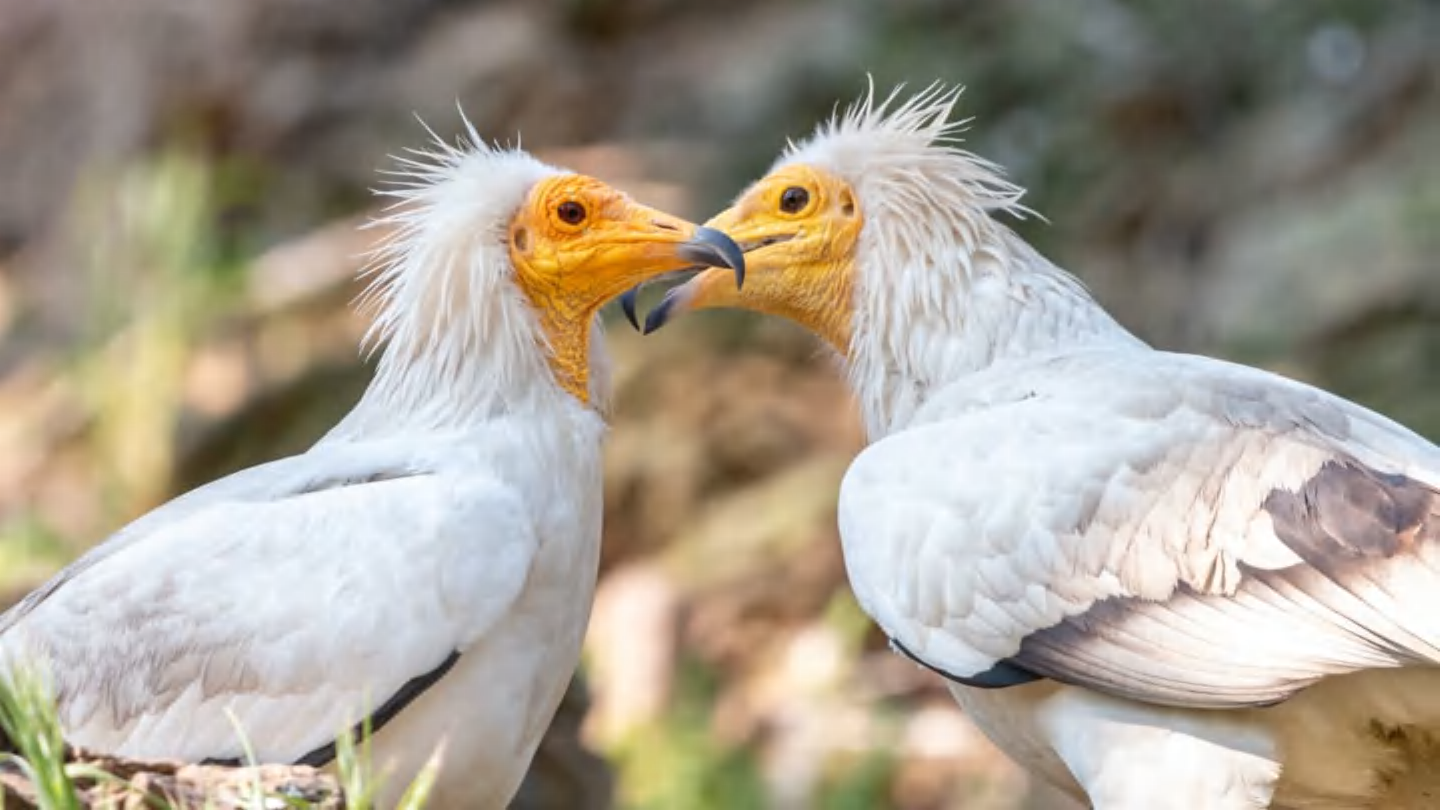
With round-edged stones, the Egyptian vulture ( Neophron percnopterus ) hammers away at ostrich eggs until they crack open. Once the hard work has been done, though, ravens will sometimes swoop down, chase the vultures off, and steal the exposed yolks. Thatâs life for you.
Old World vultures keep a close eye on their neighbors. When one of the birds locates a carcass, another individual may watch its descent and infer that the first bird is headed towards a dead animal. In short order, a whole bunch of observant vultures can gather around a carcass, simply by following other members of their species. Likewise, some African vultures track steppe and tawny eagles over long distances in the hope that these raptors will lead them to a nice meal of carrion.
Given their reputation as scavengers, people often think of vultures as disgusting or unsavory birds. But some cultures admire vultures and their scavenging ways. In ancient Egypt, vultures were thought to be especially devoted mothers , so they were commonly associated with maternity and compassion. Also, since the birds soar at great heights with an all-seeing gaze, the ancient Egyptians viewed them as living embodiments of their rulers.
From tip to tip, the wingspan of an Andean condor can measure 10.5 feet across. Although some albatrosses and pelicans can reach longer maximum wingspans, their wings are a lot skinnier than vulturesâ. The Andean Condor beats them in terms of total surface area .
Using powerful digestive acids, the stomach of a bearded vultureânative to Eurasia and Africaâcan break down solid bones within 24 hours. Bones and bone marrow account for 85 percent of the bearded vultureâs diet. To break larger bones into bite-sized fragments, the birds will drop them from heights of 164 to almost 500 feet.
A widespread denizen of central and southern Africa, this black and white vulture does consume small animals and carrion. But itâs mostly a vegetarian. The palm-nut vultureâs primary food sources are fruits, grains, and plant husks.
Researchers have estimated that in the Serengeti ecosystem of eastern Africa, vultures devour more animal flesh than all of the regionâs carnivorous mammals put together. As natureâs clean-up crew, vultures slow the spread of diseasesâincluding those affecting livestock. And the birds help sustain plants by returning nutrients to the environment.
When vulture populations decline, other scavenging animals wonât always pick up the slack. In 2018, a research team deposited two sets of rabbit carcasses in rural South Carolina, with one set accessible to turkey vultures and the other inaccessible. They waited seven days, and guess what happened? In the vulture-free group, 80 percent of the rabbits were untouched by vertebrate carnivores, showing that coyotes, opossums, and alligators didnât scavenge more carrion when not competing with vultures. In other words, when vultures vanish, a lot of rotting roadkill goes uneaten.
Lead poisoning, pesticides, and active persecution have put vultures at serious risk. No fewer than 16 species are classified as endangered, threatened, or vulnerable. Around the world, captive breeding programs are trying to throw the birds a lifeline. Similar efforts have done wonders in the past. In 1982, the global population of California condors consisted of just 23 birds . Now, there are over 400 documented individuals, with more than half of those flying free out in the wild. Although their long-term survival as a species is by no means guaranteed, captive breedingâand increased public interestâhelped reverse the condorsâ fortunes.
Vultures have developed ironclad stomachs to be able to consume tough flesh and bones. Their extremely acidic digestive fluids not only break down rotting meat; they also kill pathogens like anthrax, botulinum toxins, and the rabies virus that would otherwise make them sick. Those fluids can also be a handy, highly corrosive weapon against predators. When turkey vultures and other species feel threatened, they upchuck a mess of semi-digested offal and acid toward their attackers and escape. This defensive vomiting may also rid their stomachs of a heavy meal so they can take flight quickly.
Loading recommendations... Please wait while we load personalized content recommendations