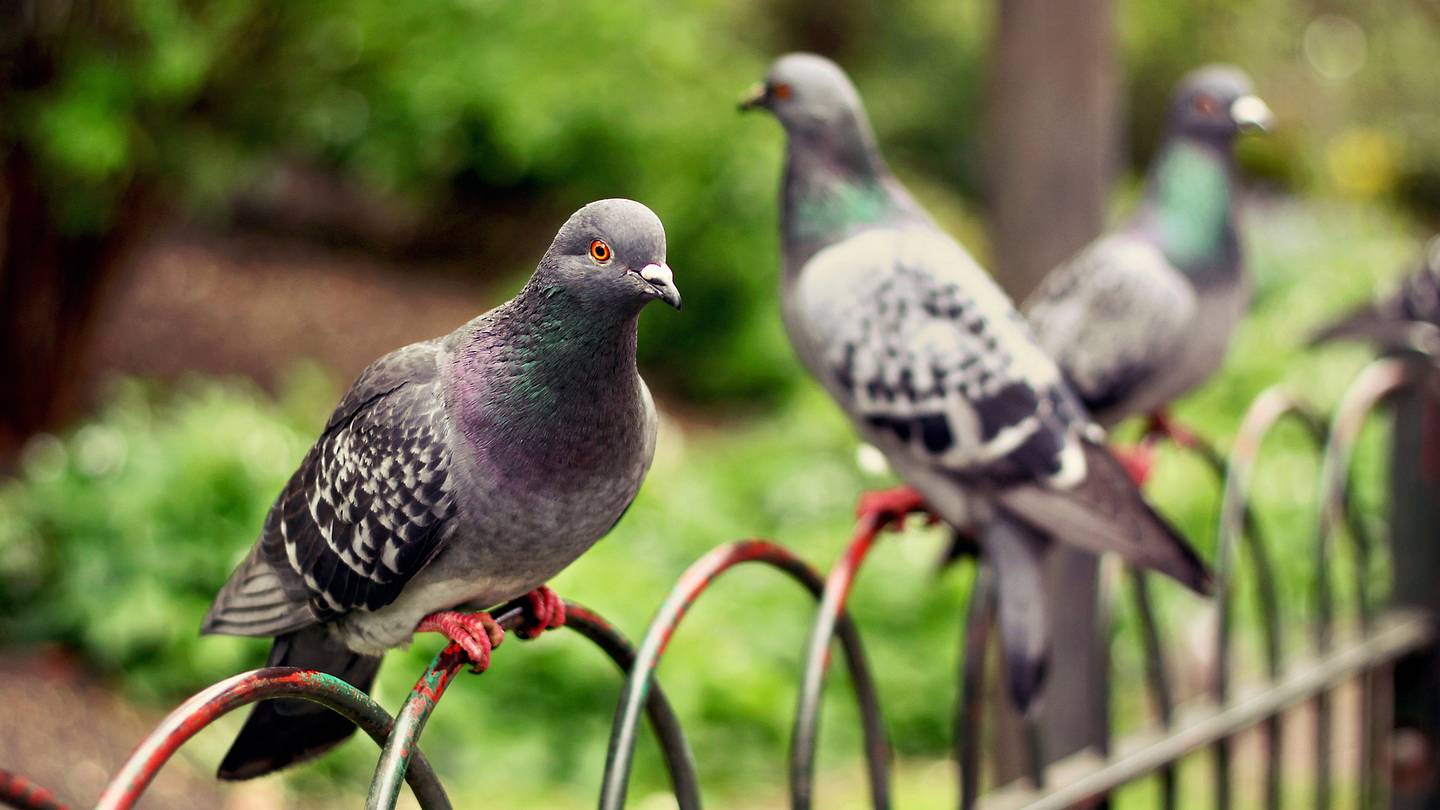
To city dwellers, it might seem that pigeons multiply magically: All the birds swooping down at us, or scurrying out of the way when we walk, are fully grown. How come we never see baby pigeons anywhere?
Rest assured, baby pigeons, or squabs, do existâand thereâs a good reason youâre not seeing them. Itâs partially due to where the birds nest: Pigeons, also known as Rock Doves, build their nests in places that mimic the caves and cliffs that their ancestors used in the Mediterranean. âIn New York City, theyâre building their nests anywhere they can find, any opening on window sills, on roof tops, under bridgesâpreferably somewhat protected places,â Charles Walcott , then Professor Emeritus at Cornell University and former executive director of the Lab of Ornithology , told Mental Floss in 2014. âThere are lots of nice artificial cliffs that people have erected in New York.â
The other reason why squabs are rarely seen is because of how long they stay in the nestâfor about a month to six weeks, âuntil they are effectively an adult size,â Walcott says. City dwellers typically think of pigeons as rats of the sky, but it turns out that the birds are usually pretty good parents. âBoth males and females tend the young and feed them,â Walcott says. âIf one of the parents dies, it becomes tougher for the remaining one to raise the young. But often the young will survive.â Baby pigeons survive on a diet of pigeon milkâdigested epithelial (or skin) cells made in their parents' cropsâuntil theyâre old enough to eat some solid food. âThe parents regurgitate charming things like corn kernels and so on,â Walcott says. Pigeons are mostly grain-eaters, by the way (their ancestors foraged grain from fields), though according to Walcott, âMcDonaldâs French fries will do just fine, thank you.â
More Articles About Pigeons:
Once a squab leaves the nest, it ignores its parents, begins to feed itself for the first time, and joins a flock, which is âcomposed of the same birds day after day that hang out in a particular area and that will be distinct from what goes on a couple blocks away,â Walcott said. âCity pigeons are fairly territorial. They have their own area where they hang out and if you take them away, they do return, although theyâre in no great rush to do so.â
Itâs probably for the best we donât see baby pigeons. They are, according to Walcott, ârevolting. They are naked. They have little pink feathers and theyâre sort of semi-transparent.â (You can see a rare squab on the streets of Brooklyn here . Itâs not pretty.) Still, you might have seen a juvenile pigeon and just not been aware of it. âYou can often recognize a young pigeon because it will have a few little downy feathers poking out from the back of its head,â Walcott said. âThatâs probably a young pigeon.â
A version of this story ran in 2014; it has been updated for 2023.
Loading recommendations... Please wait while we load personalized content recommendations