In the 1950s, it was believed we knew more about the surface of the moon than the deep seas on Earth. Since then, humans have landed on the moonâs surface and have dived nearly seven miles in a submersible to the oceanâs deepest point.
Scientists continue to make discoveries about both extreme environments, but so far, only one has been found to support animal lifeâand those creatures will haunt your dreams.
From a ginormous relative of the garden pillbug to fish with translucent heads, these organisms are adapted to the dark, cold, pressurized environment of the deep sea.
The giant larvacean ( Bathochordaeus stygius) is one of the strangest critters of the deep: It has a tadpole-shaped body only an inch or two long. You may be wondering why itâs called a giant larvacean, and it comes down to its unique way of eating. This gelatinous tunicate âa type of marine invertebrateâenvelops itself in a coating of mucus, also known as a â snot palace ,â that can measure more than three feet in diameter, and it uses this snot net to catch drifting food particles. The mucus can snag carbon-rich marine snow as well as microplastics , and when it gets too clogged with inedible stuff, the giant larvacean discards it. The blob then falls to the ocean floor where other animals eat it, and a new mucus house is grown.
As revolting as this picture may be, you should thank a giant larvacean. They actually help fight climate change by collecting and sequestering a ton of carbon from the ocean in their mucus. According to a 2017 study by scientists at the Monterey Bay Aquarium Research Institute, published in the journal Science Advances , giant larvaceans can capture more carbon than any other filter-feeding zooplankton.
The common fangtooth , a tiny fish with a formidable bite, is found worldwide in tropical and temperate waters between 1600 and 6500 feet below the oceanâs surface. Itâs also been spotted at a depth of 16,000 feet. Thatâs as deep as a stack of 52 Statues of Liberty, including the pedestals.
But its signature feature is its mouthful of dental daggers. The fangtooth ( Anoplogaster cornuta ) has the largest teeth of any marine species relative to body size. Theyâre so big that the fish canât even close its mouth properly. Instead, it has evolved two sockets on either side of its brain where the bottom teeth slide in when its jaws shut.
So why does this little guy need such big teeth? Scientists think that they might be an adaptation to living in darkness in a food-scarce environment. The giant chompers allow the 6-inch fish to grab on to anything unlucky enough to pass by, even prey much larger than itself. The same explanation may apply to deep-sea creatures like viperfish, dragonfish, and anglerfish.
Add Mental Floss as a preferred news source !
In biology, Bergmannâs Rule states that smaller species tend to live in warmer climates, and larger species in colder environments. Case in point: the giant isopod ( Bathynomus giganteus ), a marine arthropod related to the much smaller, friendlier garden pillbug or roly-poly. These benthic beasts can grow over a foot long and are commonly found 7000 feet below sea level, where they hunt smaller creatures and scavenge whale falls and other foods drifting down to the seafloor.
Scientists donât really know why theyâre so big; their relative hugeness could be an adaptation to their cold, highly pressurized habitatâa theory called abyssal gigantism, which also falls in line with Bergmannâs Rule.Â
Another weird fact: Though giant isopods are found in most regions of the worldâs oceans, all individuals are physically identical, which suggests a lack of evolution âeven though theyâve been around for about 160 million years. This characteristic might be a product of their low-light environment.Â
The gulper eel ( Saccopharynx lavenbergi) , also called a pelican eel, is roughly a meter of tail and mouth. This unusual fish, the only species in the genus Eurypharynx , slinks through the water as delicately as a rhythm gymnastâs ribbon. But its streamlined profile and uniform coloring disguise its main feature: an absolutely gigantic mouth. Â
The eelâs teeny eyes arenât much help with hunting in the pitch-dark sea, so the gulper eel relies on a bioluminescent organ at the tip of its tail to attract prey. When it locates a small fish or crustacean , all bets are off. The eelâs massive jaws swing forward and its mouth opens to a diameter many times that of the rest of its body to literally gulp its prey. The skin of its âcheeksâ and throat is so flexible that its entire head can blow up like a balloon , giving the gulper eel the shape of a lollipop, and allowing it to engulf prey much larger than the eel itself.Â
Because they live at depths between 900 and 7000 feet and donât often come closer to the surface, gulper eels are rarely encountered in the wild, but they occasionally get swept up in commercial fishing nets.Â
Scientists werenât aware of the existence of deep-sea hydrothermal vents until 1977, when researchers discovered an area of the super-hot, mineral-rich springs bursting from the seafloor near the Galapagos Islands. Even more exciting? Encountering bizarre animals, like the giant tubeworm, thriving in what was thought to be an uninhabitable environment.
There were colonies of giant tubeworms ( Riftia pachyptila ) crowding the vents. The 6-foot invertebrates are the heaviest worms and one of the fastest-growing species on Earth. They lack mouths and digestive systemsâso, instead of eating, the worms harbor symbiotic bacteria in their bodies that transform the ventsâ hydrogen sulfide emissions into energy. If the worms feel threatened, they can retract their red, feather-like gills inside the protective white tubes surrounding their bodies. Thanks to their incredible adaptations, these extremophiles and the ecosystems they support may give us insight on how life could exist on other planets .Â
Imagine being a salp , a type of marine invertebrate thatâs basically a handful of transparent goo with a brain. One minute youâre minding your own business, efficiently using jet propulsion to move about the water column, and the next minute youâre getting eaten alive by a barrel amphipod.Â
Salps are no match for these inch-long, shrimp-like crustaceans . Barrel amphipods ( Phronima sedentaria ) depend on salps for food and shelter in a deep-sea environment with few places to hide. First, the amphipod snags a passing salp with its sharp claws. It eviscerates the salp and eats its guts, then climbs inside the hollowed-out invertebrate, ensconcing itself in its new abode, a.k.a. barrel. But they donât settle down; the creatures take their barrels with them wherever they go. These amphipods can even remodel their âhomesâ by secreting chemicals that strengthen the gelatinous structures. Because when you live more than two-thirds of a mile below the surface of the ocean, housing is at a premium.
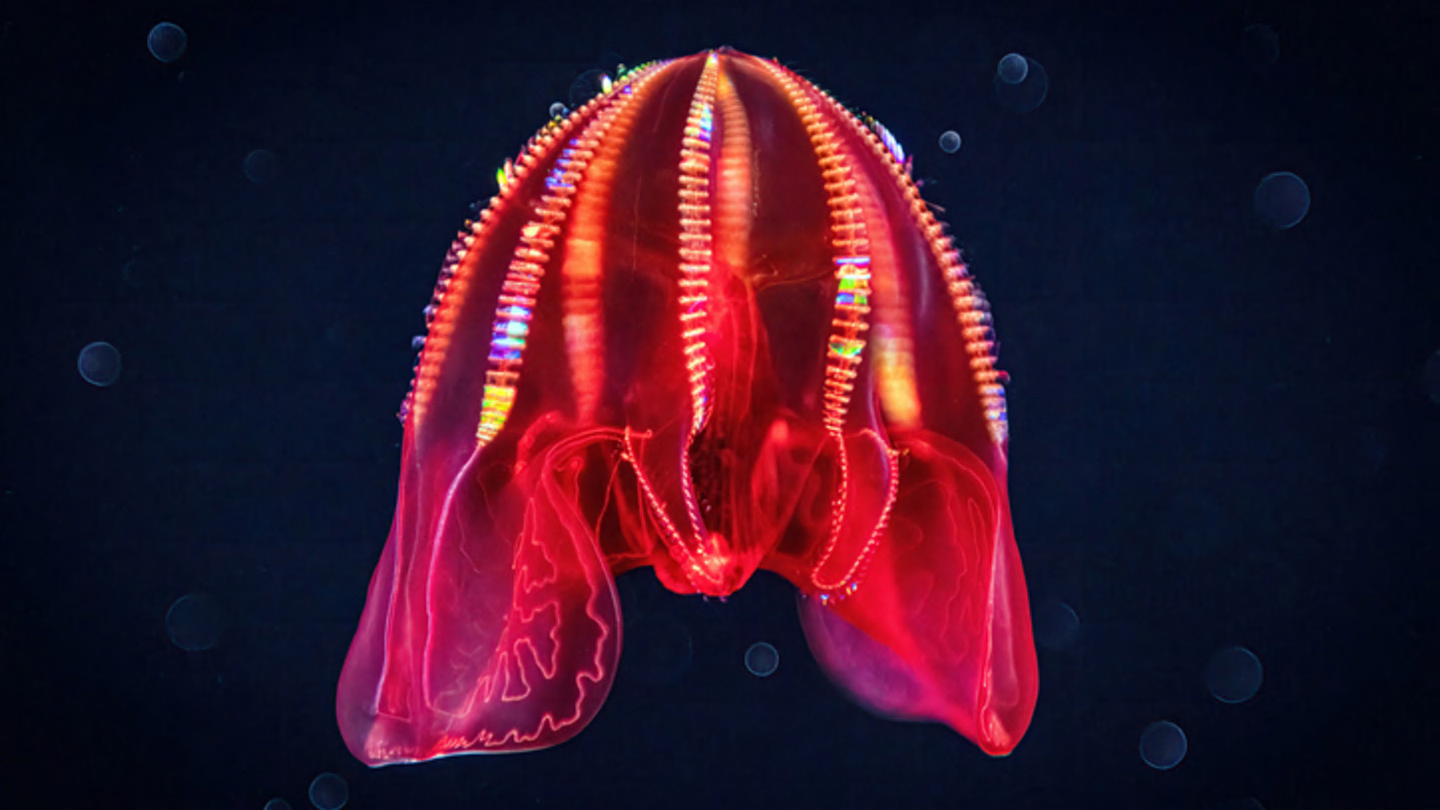
The bloodybelly comb jelly ( Lampocteis cruentiventer ) really is called that by actual scientists. These 6-inch, KONG-shaped globs are deep red to hide themselves in the twilight world, where red coloring acts like camouflage against the darkness. Itâs a necessary adaptation, because the bloodybelly comb jellyâs favorite foods are bioluminescent. Without its red disguise, the comb jellyâs predators would be able to spot its meals glowing through its semi-transparent stomach.
These comb jellies are bioluminescent, too, and may use these signals for communication or as a defense mechanism. Whatever light is available in the oceanâs depths diffracts and refracts off its hair-like cilia, which resemble tiny combs arranged in rows up and down the jellyâs belly. The movement of the cilia help the jelly swimâand make it light up like Times Square.
Weâve met quite a few semi- or fully-transparent denizens of the deep, but the barreleye fish ( Macropinna microstoma ) takes it to the next level. The back half of this guy looks like your average, 6-inch fish. The front half is a different story: the top of its head is completely see-through, revealing its eyes and brain encased in a fluid-filled bubble. Two indentations at the front of its head, which look like they should be eyes, are actually the fishâs olfactory sensors.
Its eyes are bright green and barrel-shaped (hence its name) and point straight up. The green hue might filter out certain wavelengths of light and aid them in seeing other creaturesâ bioluminescence. Research dives by the Monterey Bay Aquarium Research Institute in 2009 revealed that the fish can also rotate their eyes to face ahead, which probably helps them forage for zooplankton more accurately. But why it developed such extreme adaptations to life in the oceanâs twilight zone is still a bit of a mystery.
This story was adapted from an episode of The List Show on YouTube. Donât forget to subscribe for fascinating new videos every week.
Loading recommendations... Please wait while we load personalized content recommendations