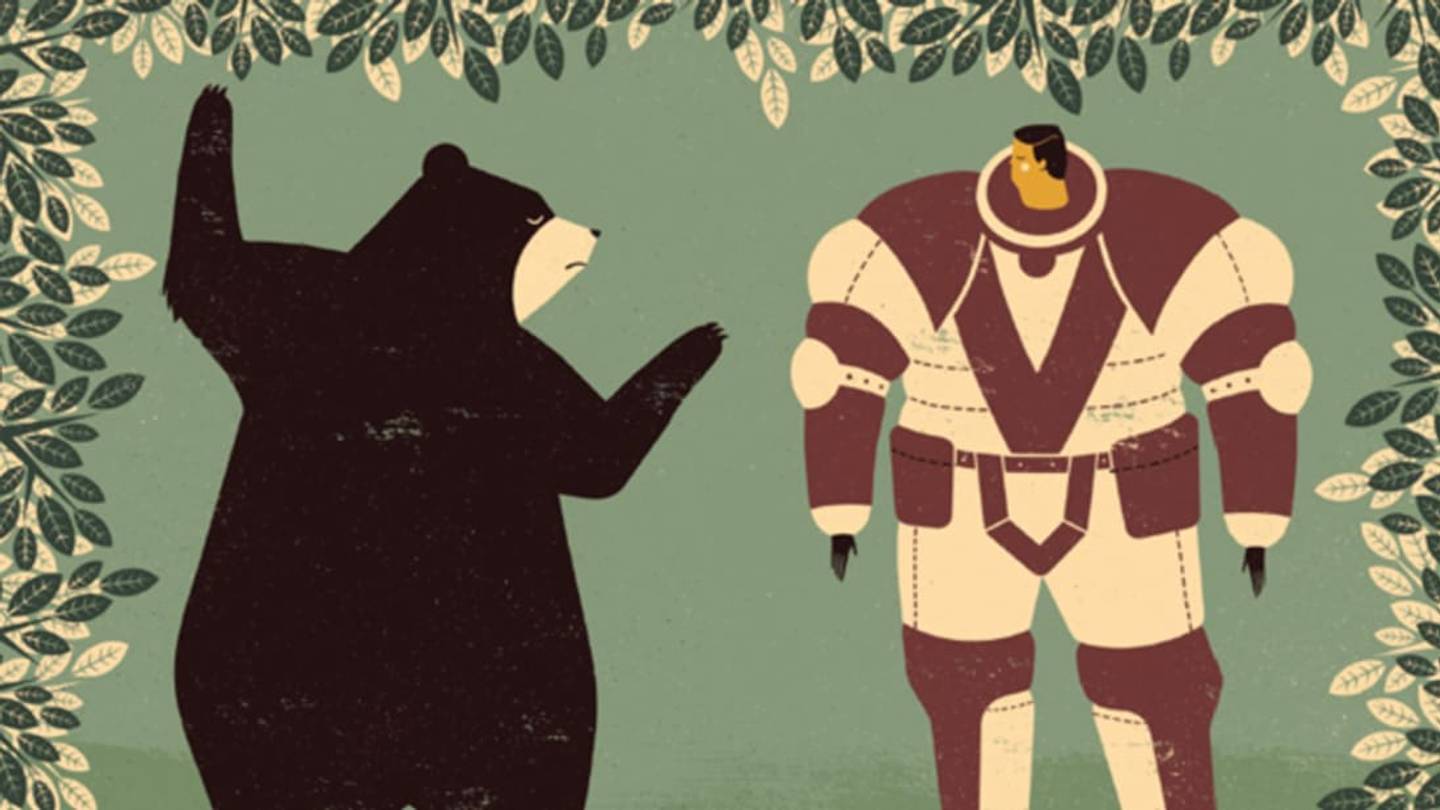
On August 4, 1984, Troy Hurtubise was hiking in central British Columbia when he came face-to-face with a grizzly bear. The grizzly knocked the 20-year-old sportsman down, his .22 rifle careening out of reach. Struggling to his feet, he drew his knife.
The bear, Hurtubise claims, seemed to contemplate its chances before disappearing into the woods. A conservationist later told him that if any cubs had been present, he wouldâve been mauled.
To the grizzly, it was a forgettable encounter with a bothersome human. To Hurtubise, it was a revelation. The Ontario native became obsessed with designing armor that could withstand a full-blown attack. Inspired by the chain mail worn by shark researchers, he began consulting with experts on how to test his ideas. The suitâs seven-year development was chronicled in the 1996 documentary Project Grizzly , a favorite of Quentin Tarantinoâs.
But not all has gone well for Hurtubise. Now 50, the self-proclaimed eccentric doesnât use schematics and often canât explain why his inventionsâfireproof paste, a bulletproof shield, a light he claims shrinks tumorsâwork. Over the years, heâs been forced to declare bankruptcy, sell his prototypes on eBay, and even pawn his wedding ring to make up for the debts run up by his obsessive ambitions.
Since Hurtubise lacks financial or university backing, most dismiss his notions as fanciful or downright senseless; others believe his ideas could save lives. âMy wife has said, âIf youâd just invent some simple refrigerator magnet and do an infomercial, weâd be rich,â â Hurtubise says. âBut I donât know how to do that. I just build what I see in my head and know itâs going to work.â
Years after his encounter with the bear, Hurtubise was watching RoboCop when he was struck by the idea of body armor. He thought there should be a protective suit that would allow researchers to test so-called bear-proof sprays and safely observe grizzly behavior. He spent the next seven years (and $150,000) constructing a series of suits he dubbed Ursus Mark. The 7'2" Mark VIâa blend of air cushioning, titanium, and duct tapeâsuccessfully endured makeshift trials in which it was hit by a pickup truck and beaten by bikers armed with baseball bats, as depicted in Project Grizzly . But the armor weighed as much as Hurtubise himself: 150 pounds.
âMy only complaint was that the filmmakers didnât show five minutes of science behind it all,â he says. âBeing able to get hit by the truck took years of development.â
Ultimately, Hurtubiseâs rematch with a grizzly never came to be. During filming, he was forced to abandon his efforts because the suit was too heavy and he was unable to remain upright on uneven ground. In 2002, a trainer allowed him inside a cage with a Kodiak, which was too confused by Hurtubiseâs appearance to approach him.
âShe was so terrified, she urinated,â Hurtubise recalls. âI didnât look human enough.â Limited mobility and questionable usefulness combined to doom the Mark series. âWe would never use a suit like that,â says Lana Ciarniello, PhD, a bear behavioral expert. âA solid knowledge of bear behavior is the best thing one can use to avoid being attacked, [which is] rare.â
Nonetheless, the armor brought Hurtubise fame. In addition to the documentary, he was recruited for Japanese game shows, and he inspired a 2003 episode of The Simpsons where Homer constructs a bear-proof suit. He even filmed an Audi commercial. Of course, Hurtubise quickly reinvested the proceeds in his pursuits.
After Hurtubise hung up his bear ambitions, he turned his attention toward other inventions. He had a brother in the military, which piqued his interested in flexible armor, and he believed a suit styled after the one in the videogame Halo would keep soldiers and law enforcement better protected. So Hurtubise invented a suit dubbed the Trojan and performed his trademark experiments, enlisting retired military marksman Keith Cunninghamâwho had âcoveredâ Hurtubise during his bear expeditions with nonlethal roundsâto help with field tests.
Once, Cunningham recalls, Hurtubise wanted to be shot point-blank, believing his armor-plated chest could take the bullet. âBut itâs illegal in our province to point a loaded weapon at someone,â Cunningham says. âSo we took the plate out. I shot at it, and the bullet went right through. He turned ashen gray.â
Hurtubise tweaked the Trojan, which he debuted in 2007, to little notice. Eventually, he offered his design to the Canadian military for free, but it can take years for armed forces to evaluate new technology. And existing contracts with equipment vendors render it near impossible for independent inventors without backing or references to succeed. âWith industrial military, contracts are sewn up, and they donât want anyone stepping on toes,â he says. âEngineers pick my brain, but I canât be affiliated with them. Iâm a loose cannon, and my methodology is backward.â Even so, many of Hurtubiseâs inventions have grabbed headlines. His fire paste, a gooey substance that hardens to resist flame, was documented by Canadaâs Discovery Channel as standing up to temperatures in excess of 3,600° F. Hurtubise held a blowtorch to his helmeted head for 10 minutes to prove it. NASA, he says, was interested but never followed up.
During a demonstration for his blast blanket, a plate meant to absorb heavy firepower, a crowd watched as Cunningham shot round after round of 12-gauge shotgun shells into it. When it finally budged, it only fell over; the glass behind it was unharmed. âI told cops about it every chance I got,â Cunningham says. âImagine having that on the doors of patrol vehicles for protection or under military transports. I told them, âTry to look past Troyâ."
There was a reason for Cunninghamâs caution: Hurtubise looks more like a mountain man than an esteemed inventor. Worse, his claims sometimes stretch the boundaries of reason. Hurtubise garnered skeptical looks when he announced that his God Light device had shrunk his sister-in-lawâs cysts as well as tumors in mice. He even believes it can cure Parkinsonâs. âLight is extremely effective against certain cancers,â he says. âAll I did was take all spectrums of light, electromagnetic radiation, and put them together. And it works. I donât know why, but it does.â
Hurtubiseâs claims have never been validated by an outside auditor, in large part because subjecting a group of sick people to a makeshift electromagnetic beam stretches ethical considerations. When Hurtubise turned the light on himself, he experienced what he calls the Hyde effect. His hair began falling out, and he lost 20 pounds. Then the God Light stopped working. Hurtubise has yet to find the money to resurrect it.
Today, Hurtubise operates a scrapyard in Ontario and dismisses notions of patents (âthe stuff is too easy to duplicate, and it costs $80,000 to file an applicationâ). He rejects offers to outright sell his creationsâlike fire pasteâbecause he frequently sells off shares to fund their development. âBy the time I got fire paste to the point of testing, 70 percent of it was owned by investors,â he says. âSo when a university wants it, I have only 30 percent left. Theyâre not interested in that.â And yet, Hurtubise canât stop inventing. He still feels compelled to put in 21-hour days refining his projects. His current plan is to find funding for the Apache, the latest version of his Trojan suit, which he says protects 93 percent of a userâs body and offers 96 percent flexibility. A prototype will cost $70,000. âItâll take six to eight months to build by hand. Iâll try to market it to law enforcement like SWAT.â He needs another $100,000 to rebuild the God Light, renamed the EMR-5, which he now claims will only cure breast cancer. He wants to take it to Johns Hopkins for testing.
As for Hurtubiseâs legacy, itâs hard to predict. Thereâs a chance heâll join the long list of inventors who were once disparaged until time proved them correct. Even the airborne Wright brothers were thought to have faked their maiden flights. If thatâs Hurtubiseâs fate, he seems comfortable with it. âIâve been called a maverick, a nutcase, everything,â he says. âIt never bothered me. Without imagination, science is nothing.â
This story originally appeared in mental_floss magazine. Subscribe to our print edition here , and our iPad edition here .
Loading recommendations... Please wait while we load personalized content recommendations