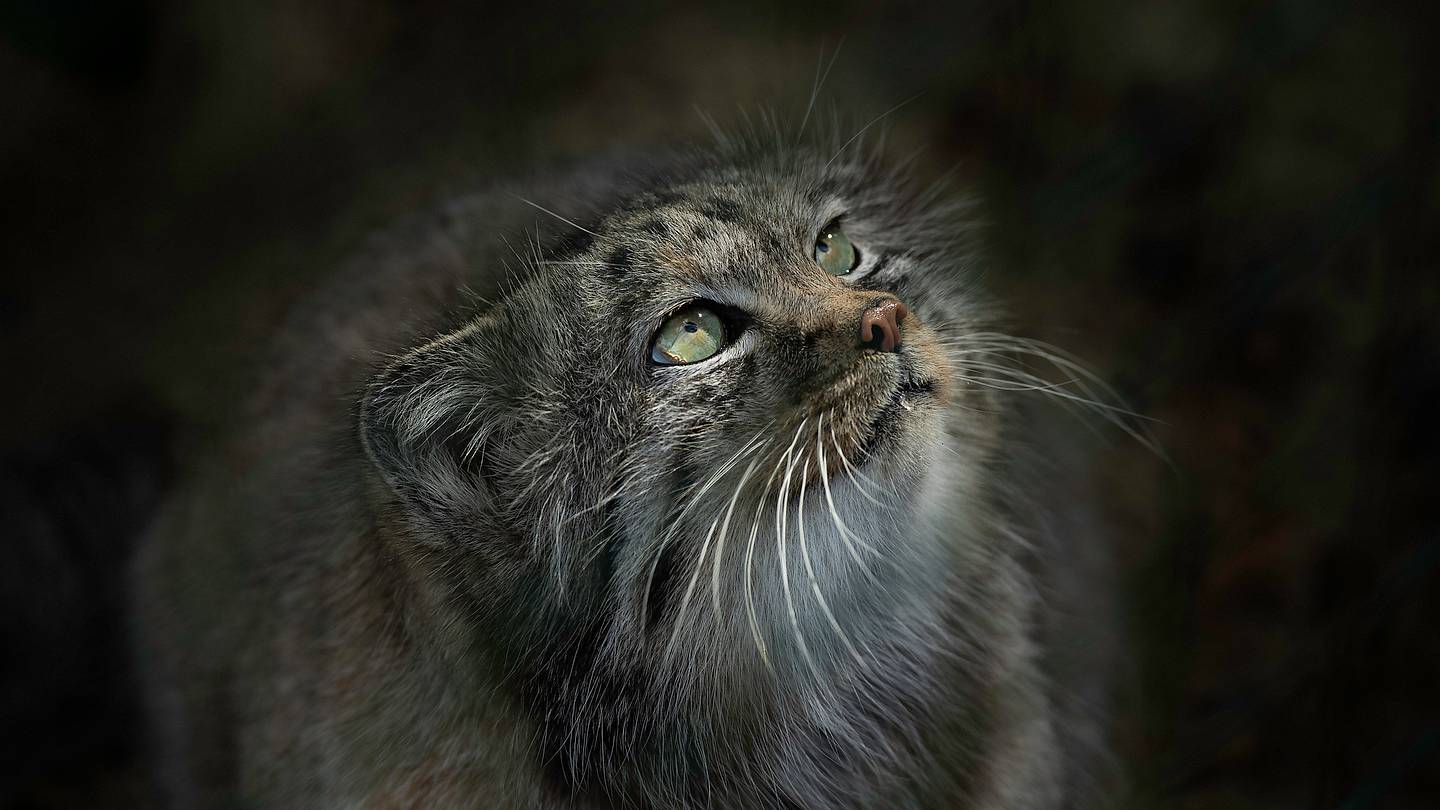
Far across the world, an elusiveâand adorableâwildcat called the Pallasâs cat (also known as the manul) roams the grasslands and steppes of Central Asia and Eurasia. Hereâs what you need to know the flat-faced, furry kitty.
German naturalist Peter Pallas first described the furry wildcat in 1776. He named the kitty Felis manul , and theorized that it was an ancestor of the Persian cat , due to its round face, luxurious coat, and stocky body. (He was wrong.)
Later on, the cat âs scientific name was changed from Felis manul to Otocolobus manul ânot exactly the most flattering moniker, since Otocolobus is Greek for âugly-eared.â
The Pallasâs catâs round earsâwhich sit flat on the sides of its headâare one of the felineâs most distinguishing features. As Crystal DiMiceli, a former wild animal keeper at Brooklynâs Prospect Park Zoo, explains in the above video, having low-positioned ears helps the cat conceal itselfâthey donât poke up to reveal the animalâs position while itâs hiding or hunting.
The coat of the Pallasâs cat is its true crowning glory. Itâs longer and denser than any other coat belonging to a member of the Felid species (growing in even heavier in the winter), and the undercoat on its belly is twice as long as the fur covering the rest of its body. The shade ranges from silvery grey during the winter to a darker, red-toned hue during warmer months. (Some cats are also red, particularly in Central Asia.) Its broad head is streaked and speckled with dark markings, and its bushy tail is banded with stripes and a dark tip. These markings tend to appear darker during the summer.
Pallasâs cats live in areas ranging from Pakistan and northern India to central China, Mongolia, and southern Russia. According to Wild Cats of the World by Luke Hunter, its body isnât adapted for snow, so it sticks to cold, arid habitatsâparticularly grassy or rocky areas, which help conceal it from predatorsâat elevations of around 1500 to nearly 17,000 feet. The stocky cat isnât a fast runner, so when it senses danger, it freezes and crouches flat and motionless on the ground, and its fur helps it blend in with its surroundings.
Pallasâs cats typically weigh less than 12 pounds, and theyâre usually only 2 feet or less in body lengthâmeaning theyâre not that much larger than an ordinary house cat. Yet their dense coat of fur makes them appear much larger.
Pallasâs cats do share one feature in common with larger wildcats, like lions and tigers: their eyes. Their pupils are round , whereas a house catâs pupils are vertical and slit-shaped. Wondering why some cats have round pupils while others have vertical ones? A 2015 study conducted by researchers at the University of California, Berkeley found that animalsâ pupil shapes might indicate their role in the predator/prey food chain. They analyzed 214 species of land animals (including cats), and noted that species with vertical pupils tended to be ambush predators that were active during both day and night.
In contrast, species with round pupils were often âactive foragers,â meaning they chase their prey. Also, predators that are closer to the ground, like house cats, were prone to vertical pupils , whereas larger wildcats had round ones. Pallasâs cats are small, and they are primarily ambush hunters, so the juryâs still out on whether the studyâs findings hold true for all creatures.
Pallasâs cats are ambush hunters and spend much of their time hunting pika , a small mammal, and other critters like gerbils, voles, hares, ground squirrels, birds, and young marmots. Pika typically make up more than 50 percent of the catâs diet.Â
Peter Pallas may have thought the animal was related to the Persian cat, but experts have uncovered evidence that the wildcatâs nearestâyet still pretty distantârelative might be the leopard cat.
The Pallasâs cat is notoriously elusive and spends much of its time hiding in caves, crevices, or abandoned burrows.
Pallasâs cats may be adorably fluffy, but they arenât the worldâs sweetest, most cuddly creatures. In fact, theyâre very aggressive. Case in point: In The Wild Cat Book, authors Fiona and Mel Sunquist recount an anecdote provided by Bill Swanson , the Cincinnati Zooâs director of animal research. Zookeepers thought that a litter of newborn Pallasâs cats were having difficulty breathing, but âwhen they listened closely, they realized that the noise they were hearing was the kittens growling and hissing at each otherâbefore they had even opened their eyes!â
Pallasâs cats mate between December and March; the females typically give birth between the end of March and May after a gestation period of 66 to 75 days. Pallasâs cats usually give birth to three or four kittens, but litters can sometimes have as many as eight kittens. Kittens become independent by four to five months, and when they reach nine to 10 months, theyâre mature enough to reproduce.Â
A version of this story ran in 2017; it has been updated for 2023.
Loading recommendations... Please wait while we load personalized content recommendations