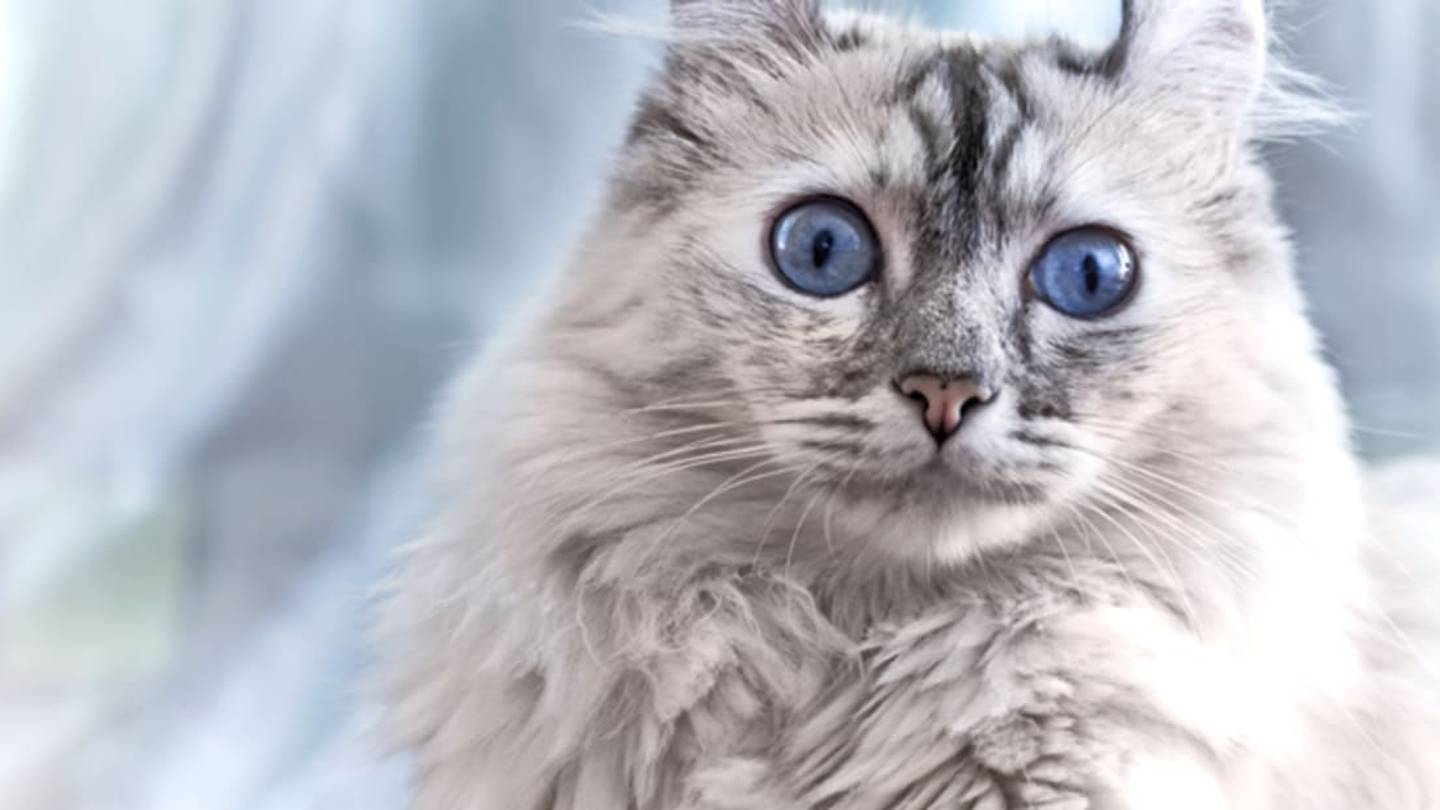
Scotland has the Scottish Fold âbut across the pond, the U.S. has the American Curl. Both cat breeds are known for their unusual ear shapes, which stem from genetic mutationsâbut the Scottish Foldâs ears fold forward, whereas the Curlâs flip backward. Weâve already featured Scotlandâs most adorable export, so here are five facts about the Curl.
Like many catsâthe Manx , Cornish Rex , and the aforementioned Scottish Fold, to name a fewâthe American Curlâs folded ears were likely caused by a spontaneous genetic mutation. The first known cats with this trait were two stray kittens that wandered into a suburban community in Lakewood, California in 1981. There, they landed on the doorstep of a married couple named Joe and Grace Ruga. Grace Ruga fed the cats, and noted that their ears curled back from their heads in an unusual way. One of the kitties had long black hair; the Rugas named her Shulamith.
The Rugas adopted Shulamith, and eventually she gave birth to four kittens. The Rugas noted that two of them had funny ears like their motherâsâand that the kittensâ father, a local tomcat named Mr. Gray, had straight ones. This indicated that Shulamithâs folded ears were caused by a genetic dominant trait, since only one parent with the gene was needed to pass it down to the kittens. Eventually, a geneticist confirmed that the gene was dominant .
Shulamith continued to mate with stray toms, and gave birth to kittens in all colors, patterns, and fur lengths. Eventually Grace Rugaâs sister, Esther Brimlow, gave two American Curls to a former dog breeder named Nancy Kiester, who, in turn, showed them to a cat show judge and Scottish Fold breeder named Jean Grimm. Grimm had never seen cats like these before, and teamed up with the Rugas and Kiester to write the first breed standard for the Curl.
In 1983, cat fanciers began selectively breeding the American Curl, and the first Curl was exhibited at the Cat Fanciers' Association's (CFA) grand show in Palm Springs, California. In 1993, the CFA gave the breed championship status.
Wikipedia // CC BY-SA 3.0
American Curl kittens enter the world with straight ears, which, if they have the gene, begin to curl backwards after a few days. Theyâll continue to unfurl until they finally âsetâ for good after about four months. This moment is pivotal for breeders because it determines whether or not American Curls are "show-quality," or eligible to compete in cat shows.
Not all American Curls have perfectly folding ears, and cat fanciersâ organizations like the CFA have very specific requirements for show-quality Curlsâ appearances [ PDF ]. Their ears must have an arc of at least 90 degrees and no more than 180 degrees. Curls are automatically ineligible for showing if their earsâ tips touch the back of their ear or head. Other disqualifying characters include straight, mismatched, or thick ears; ears with inflexible tips; and a lack of firm cartilage in the earsâ base.
Breeders often mate two Curls together, which always results in kittens with curled ears, but sometimes, they outcross the breed with straight-eared cats to promote genetic diversity. These pairings yield litters that are typically 50 percent straight-eared and 50 percent curly-eared. The straight-eared kittens have all the purr-sonality of an American Curlâthey just don't share their crowning feature.
Janne Ström , Flickr // CC BY-NC-ND 2.0
Aside from their ears, American Curls look like your typical small to medium-sized cat. They can come in any color or pattern, and their coats can be either short or long, with a plumed tail.
People often compare Scottish Folds and American Curls because they both have quirky-shaped ears that stem from genetic mutationsâbut the similarities end there .
Like the Curl, the Scottish Fold is born straight-eared. But unlike the Curl, its ears flatten forward over its front skull shortly after birth. Their ears often have double, or even triple folds, which fanciers developed over time through selective breeding. In contrast, the Curl's ears loop backwards in a smooth arc.
Cat fanciers also say that the Scottish Fold is much more placid than the American Curl, who is reportedly active, attentive, and like a dog in temperament.
Finally, the two cats differ health-wise. The gene that causes American Curlsâ ears to fold isnât associated with any physical malformations. However, Scottish Foldsâ ears tilt forward thanks to an incomplete dominant gene that affects the cartilage in the catâs body. Cats with this gene can develop osteochondrodysplasia, a painful condition that causes defective bone development and bone and cartilage abnormalities. Scottish Folds can also suffer from arthritis; fusing of the tail, ankles, and knees; lameness; misshapen limbs; and an abnormal walk.
American Curl cats are physically robust, but you should be careful when picking them up or petting them so you wonât damage their ear cartilage. (Don't try to bend or tug the ears further back, as you might hurt the cat.) Some Curls are born with narrow ear canals , so you'll have to vigilantly clean them to avoid infections from wax-buildups.
Loading recommendations... Please wait while we load personalized content recommendations