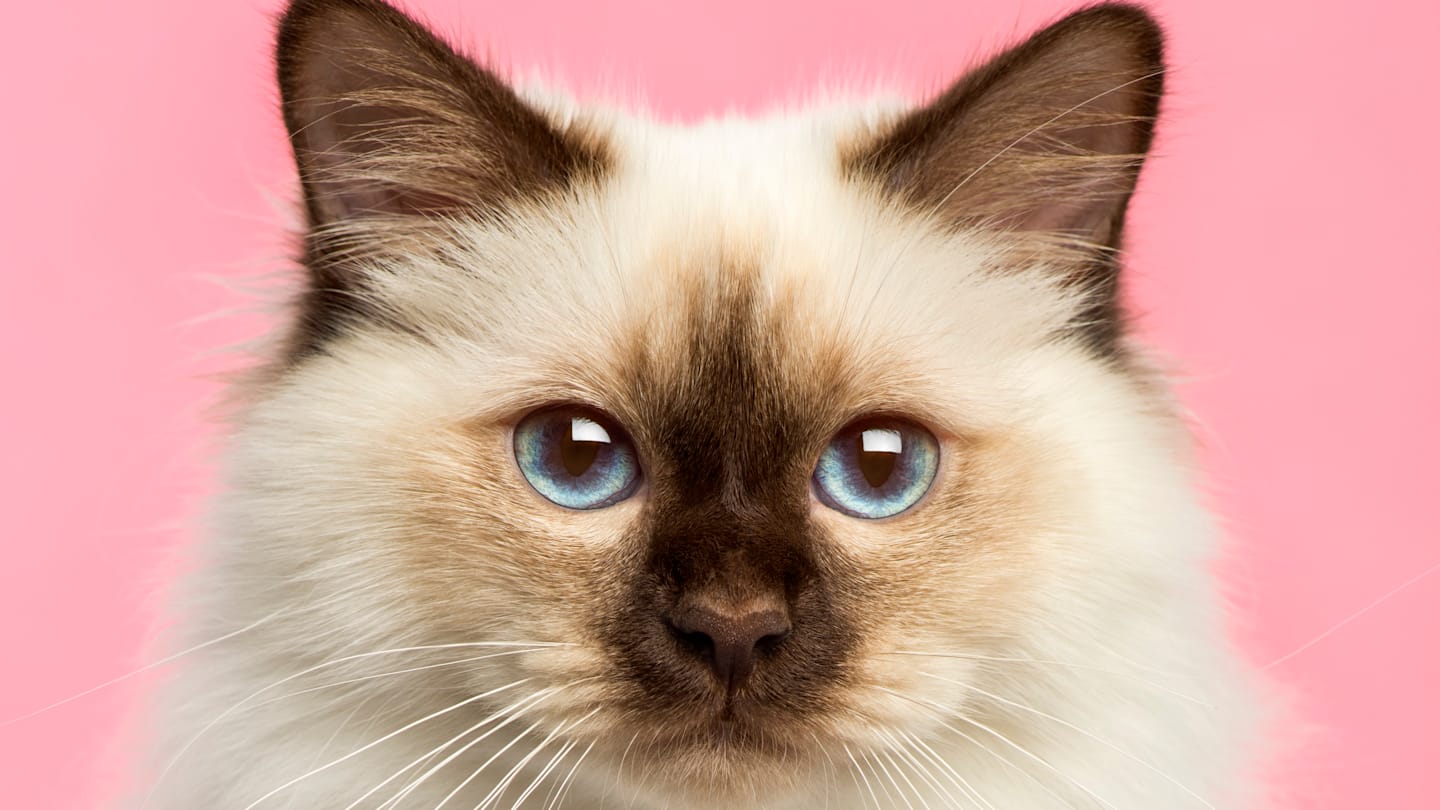
With its silky, light fur and dark-tipped face, ears, and tail, a Birman cat looks kind of like the Siameseâs fluffy cousin (even though the two probably arenât closely related). Here are seven facts about the exotic-looking breed.Â
Like many cat breeds, the Birman has a romantic origin story. According to legend , the feline is descended from a temple cat that belonged to a priest in ancient Burma (known today as Myanmar). Thieves attacked the priest, and as he lay dying, the loyal kitty kept him company. Then, a mystical transformation occurred: The catâs fur gained a golden tint, and its eyes became a deep blue, just like the goddess the priest worshipped.
In reality, no one quite knows where Birman comes from, or when it first arrived in Europe. Many people believe the cats were once sacred companions to temple priests in ancient Myanmar. By some accounts, the cats were later imported from Asia to France.
Some say that in 1919, two Birman cats were shipped from Asia to France to thank two Englishmen living there for their help defending a temple against an invasion. Others claim that shipping and railroad tycoon Cornelius Vanderbilt purchased two Birman cats smuggled from a temple, and sent them to a woman living in France. However, one fact remains certain: The Birman breed was first recognized and shown in France in the 1920s.
According to the Cat Fanciers' Association (CFA)âthe world's largest registry of pedigreed catsâthe Birman nearly became extinct when cat fanciers stopped breeding it during World War II . At one point, they say, there was only one breeding pair of Birmans left in the country. To further the unique cat's bloodline, owners had to outcross it with other breeds, presumably Persians . The fluffy cat prevailed, and it was later exported across Europe.
The Birman didn't reach America until the late 1950s. Cat lovers embraced the new breed, and in 1967 it was officially registered with the CFA. As of 2021, the silky kitty was ranked as Americaâs 7th most popular cat .
The Birman has a medium build, a rounded face, and a distinct Roman nose. However, its most noted feature is its long, single-layer coat, which is soft but isnât prone to matting . The tips of its fur are typically a light beige shade, and the catâs dark color points can come in a variety of colors, including lilac, chocolate, blue, and seal [ PDF ]. (Just like Siamese cats, Birmans are born white and develop their distinct colored coats as they mature.)
In addition to its color points, the Birman also has white âglovesâ on its paws; according to Gloria Stephensâs book Legacy of the Cat , this trait is caused by a piebald white spotting gene, and a pattern gene for the placement of the white on the catâs feet.
The catâs crowning characteristic? Its blue eyes.
Birmans look a lot like another cat breed, the Himalayan, which is a color-pointed variant of the Persian. Because both kitties have a long, dark-tipped coat and some Himalayans have blue eyes, itâs sometimes hard to tell the two apart. If you look closely, however, youâll spot a few subtle differences . For one thing, the Himalayan has a flat face, and a Birman has a more pointed nose. Also, the Himalayanâs fur is much like a Persianâsâitâs long, fine, and mats easilyâwhereas the Birmanâs single-layer coat typically gets fewer snarls.
German fashion designer Karl Lagerfeld famously owned a Birman cat named Choupette. The pampered feline traveled the world with Lagerfeld aboard a private jet, complete with two personal assistants. Choupette even inspired Lagerfeld to design a collection of cat-themed accessories , including totes, shoes, leather goods, and T-shirts. The cat slowly became a star in her own right: In 2014, Choupette made millions of dollars after she starred in two advertisements for a Vauxhall Corsa car calendar and Japanese cosmetics brand Shu Uemura.
After Lagerfeld died in 2019, rumors circulated that Choupette was to inherit part of his fortune. The cat's fans can keep up with her still-busy life via Instagram .
Humans arenât the only ones who engage in compulsive tics and behaviors. Some cats are prone toward sucking, chewing, or swallowing items that arenât food, like wool and plastic. The trait is particularly common among Siamese and Birman cats. Scientists, who studied 204 cats of those two breeds for a 2015 stud y published in the Journal of Veterinary Medicine , donât know for sure why the kitties do itâbut they did notice that risk factors for Birmans who develop this type of compulsion include early weaning and small litter size.
A version of this story originally ran in 2016; it has been updated for 2022.
Loading recommendations... Please wait while we load personalized content recommendations