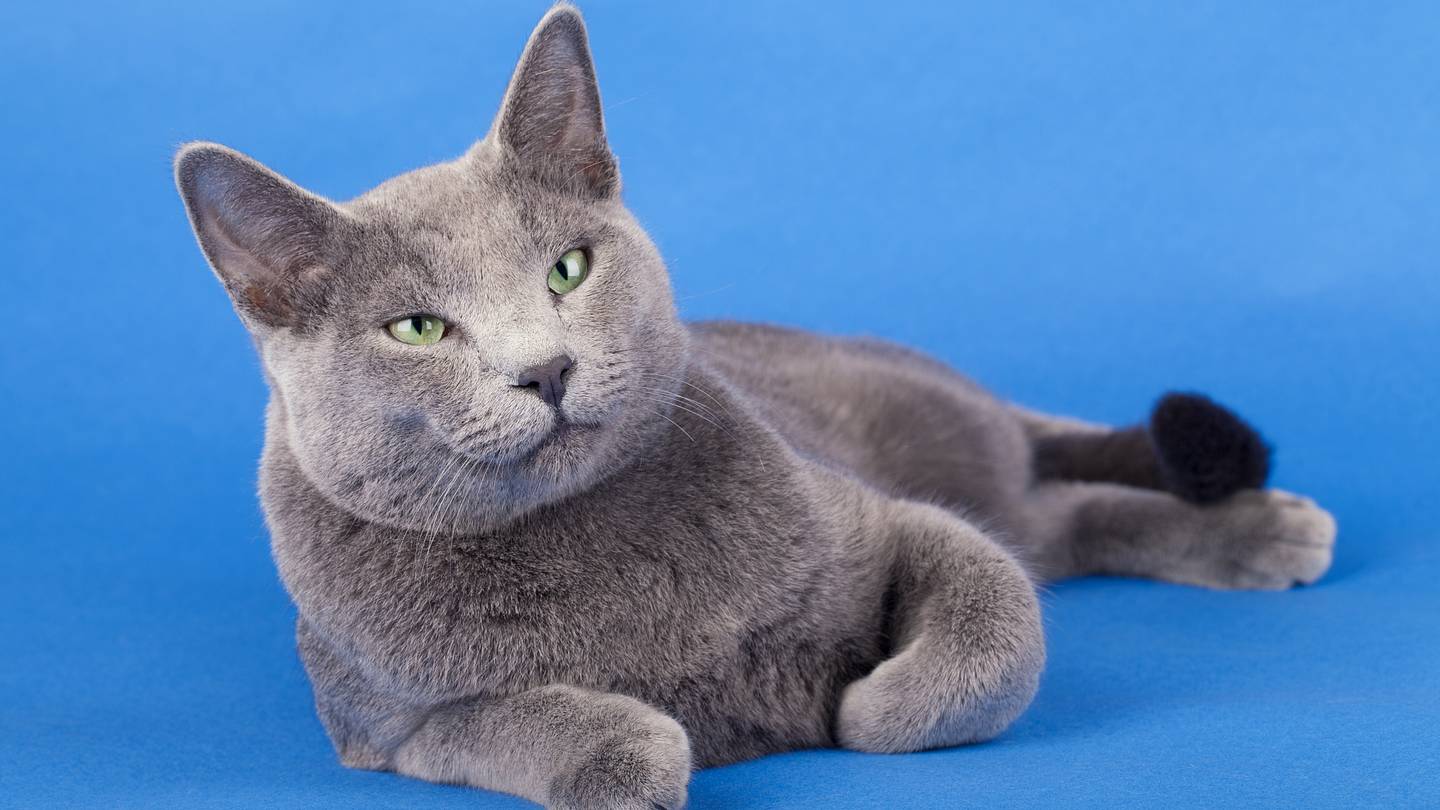
Weâve ogled the British blue shorthair and admired the plush gray fur of the Chartreux from France. Now, itâs time for a crash course on Russiaâs sleekest, most aristocratic-looking feline: the Russian blue.
The Russian blueâs ancestral roots are lost in time . Some people speculate that theyâre descended from the pet cats of Russian czars, but thereâs probably more truth to the claim that the breed originated in northwest Russia. According to legend, the gray kitties lived in the wilderness and were prizedâand sadly huntedâfor their dense, warm fur. Today, itâs said that gray cats resembling the Russian blue still live in the country's coldest regions.
Itâs believed that sailors brought the Russian blue from the port city of Arkhangelsk âwhich sits on the Northern Dvina River in the northwestern part of the countryâto Great Britain and Northern Europe in the 1860s. The city was one of the most important ports in the Russian Empire. Its name means Archangel in English, which may explain why the Russian blue was once known as the Archangel blue. ( Other early monikers include the Maltese and Foreign blue.)
The âArchangel Catâ made an appearance at one of the worldâs first cat shows , held at Londonâs Crystal Palac e in 1875. The breed reportedly drew praise from one writer in attendance, who described it as "a very handsome cat, coming from Archangel ⦠particularly furry â¦. They resemble mostly the common wild gray rabbit."
Sadly, the Russian blue didnât win any prizes: Harrison Weirâthe showâs founder whoâs today remembered as âthe father of the cat fancyââgrouped all the short-haired blue cats into one category, and he preferred the stockier, round-faced British blue.
Britainâs Governing Council of the Cat Fancy (GCCF) recognized the Russian blue as a distinct breed in 1912. The cat was often referred to as a "Blue Foreign typeâ or the " Foreign blue ." But World War II eventually broke out, and many breeders no longer had the resources to continue the kitty's bloodline. The Russian blue dwindled in number, but after the war ended, cat lovers in countries including Britain, Sweden, Finland, and Denmark saved the blue by crossbreeding it with other feline types.
Today, the Russian blue's appearance varies around Europe. Scandinavians mated the cat with Siamese cats, resulting in a longer, more angular look. And in Britain, the kitty was crossbred with bluepoint Siamese cats and British blues, so they developed a stockier silhouette.
Russian blues first arrived in America sometime in the 1900s , but it wasn't until much later that the country's cat enthusiasts started breeding them in earnest. They imported Russian blues from Scandinavia and England, and over time, combined their unique features into the blue-furred, green-eyed cat we know and love today.
A Russian blue cat helped inspire the internetâs most famous 8-bit animated feline. Nyan Catâthe YouTube video-turned-viral Internet-meme of a cat-Pop Tart hybrid flying through space, leaving a rainbow trail in its wakeâ was created in 2011 by then-25-year-old illustrator Chris Torres, who owned a Russian blue named Marty.
Torres was participating in a Red Cross donation drive, and received conflicting suggestions on what to draw. One person wanted him to sketch a cat; another, a Pop Tart. Torres ended up drawing a hybrid of both, but if you look closely, you'll notice that the feline portion of Nyan Cat strongly resembles Torres's beloved cat.
This wasn't a coincidence: Marty, who was named after Marty McFly from Back to the Future , âheavily influenced a lot of my comics and the creation of Nyan Cat,â Torres tweeted after his cat died in 2012 .
Some people say that the Russian blue is a good pet for people with allergies. It doesnât shed a lot , plus the gray kitty allegedly produces lower levels of Fel d 1 protein, the allergenic protein in cat saliva and skin secretions that makes your skin itch and eyes water. But even small amounts of Fel d 1 can cause you to suffer an allergic reactionâplus, Russian blues still have dander. There are plenty of reasons to want the gray cat; just keep in mind that it won't be the solution to your allergy woes .
With its slate-colored fur, the Russian blue resembles other âblueâ short-haired cats like the Chartreux and the British blue. But if you look closely, youâll see subtle differences between the three breeds. For one, the Russian blue has green eyes, whereas the Chartreux has brilliant orange pupils , and the British blueâs are gold, copper, or blue-green. Also, the Russian blue and Chartreux have round faces and stocky (if not slightly chunky) bodies, while the Russian blue is much more elongated and lithe, with a wedge-shaped head. Finally, the Russian blue's dense, double-layered coat is silky to the touch. In contrast, the British blue's plush fur feels slightly crisp, and the Chartreux's is tufted and wooly.
If you're looking for a calm cat with a pleasant disposition, consider the Russian blue . The kitty is shy around strangers, but affectionate with owners. It enjoys sitting quietly by the side of its favorite humansâbut it's also down for a playful game of fetch.
The Russian blue gets its silvery fur from a diluted version of the gene that's responsible for black hairs. If you mate two Russian blues together, they'll produce a litter of all-gray kittens. But if the Russian blue is bred with another cat type, the black Russian Shorthair, the union will result in a mix of blue and black kittens. (Mate the Russian blue with a white feline, and their children will be white, blue, and black.)
A version of this story originally ran in 2016; it has been updated for 2022.
Loading recommendations... Please wait while we load personalized content recommendations