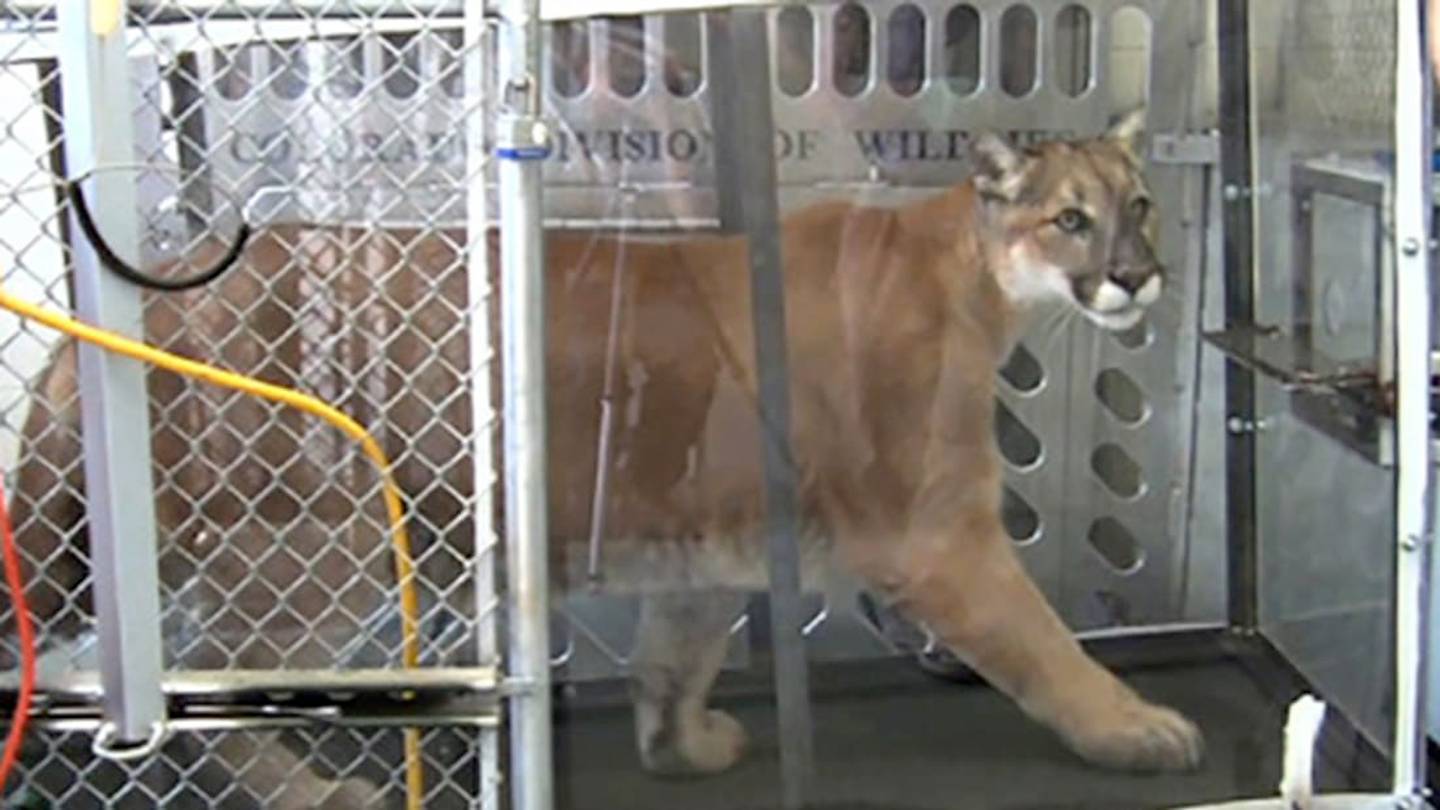
Cat owners everywhere know how hard it is to get their felines to do something when they don't want to. Now imagine your cat is 5 feet long and 135 pounds, and youâll understand the challenge University of California Santa Cruz's Terrie Williams faced when she decided to measure the energeticsâor flow and transformation of energyâin mountain lions, which required getting the big cats to walk on a treadmill. âItâs one of those things that you put into a grant proposal and hope you can pull off,â the professor of ecology and evolutionary biology says. âThereâs a reason why mountain lions and jaguars and leopards are not generally in showsâit's because they're impracticable.  I got ulcers over that part of it.â
Williams, who has been studying animal energetics for most of her career, had always wanted to work with big cats; mountain lions were the natural choice because of their proximity. âTheyâre right in our backyard,â she says. âWe had a young mountain lion come down near the labâit was pouncing on a glass door because it saw its reflection!"
Knowing mountain lion energetics (or any other big predator's energetics) is important because it helps scientists see how many calories a population needs to survive and ensure future generations, which in turn helps conservationists and ecologists make wildlife management and planning decisions. "If you want to have big, charismatic predators around, you better know what they need to eat,â Williams says. âIf you donât pay attention to that, you start to see more and more human/animal conflict.â
In humans, scientists measure energetics by putting people on treadmills with special instruments that measure how many calories they expend, so Williams would have to do the same thing with mountain lionsânot just get them on treadmills, but also outfit them with the teamâs custom-built collars that included radio and satellite tracking as well as an accelerometer, which âallowed us to calibrate the collar both for behavior and energetics,â Williams says. Big cat experts told her that that would be tough to do, too: "Most facilities told me, âYou canât put on a collar!â I was like, â Great .ââ
Still, Williams was determined to do the research; it took her three years to find a facility that was game to try. She found Lisa Wolfe, a veterinarian with Colorado Parks and Wildlife, through a friend; Wolfe had raised three mountain lions from the time they were kittens after their mother had been shot. âI didnât even want to tell her about the treadmill,â Williams said. âI just said, âCan we put a collar on your cats?ââ
Photo by T.M. Williams
Thankfully, Wolfe had no difficulty getting the collars onâit took all of five minutesâso all that was left to conquer was the treadmill, which the veterinarian also had on hand. Getting the cats on that took a little longer, though: Wolfe worked with the cats for 10 months. âThe hard thing about cats on treadmillsâeven domestic catsâis getting them to face forward,â Williams says. âThey donât do well on treadmills because they look at their feet. Dogs will look at you, canids will look up, but cats will want to see where their feet are going on a treadmill, so their head goes down and then they trip and fall and itâs a mess.â To keep the cats facing forward and walking naturally, Wolfe used meat, feeding the animals as they were walking.
There were a number of engineering challenges, too, to get the treadmills ready for the cats. âThe hardest part was the soundsâmountain lions are really intoned to sounds, so I had to be very careful with the instrumentation in the vacuum pumps,â Williams says. âAnd that really took the longest time.â Plus, Wolfeâs treadmill, intended for humans, was too shortâthe cats ended up with their back two feet off the treadmill and their front two feet walking on the beltâso the researchers got a dog treadmill with an 8.5-foot surface. Then they built a clear metabolic box around the treadmill so they could accurately measure oxygen consumption, taking into account not just the length of the animalsâ bodies, but their tails, too. âThe box had to be big,â Williams says. You can see the cats strutting their stuff in the video below:
Williams and Wolfe had the animals sit in the box at rest, then had them walk, trot, and run while wearing the collars. âWe didnât do a lot of running, because when we did the tests with the collars, just with the animals in the enclosures, we decided to stick with what the animals did routinely and not force them to do these high energy things, which we found even for the wild animals, really isnât their style,â Williams says. âTheir style is a stalk and pounce. They walk around a lot, pretty slowly. Theyâre not fast movers unless theyâre being chased or chasing something.â
From collaring the captive cats and making them walk on treadmills, as well as videotaping their behavior in their enclosures, Williams and her colleagues were able to learn how many calories the cats expended for every step they took, whether they were going uphill, downhill, resting, hunting, eating, or drinkingâbasically, any behavior you can think of. âWe had this library that had the signature on the accelerometer, the assigned behavior that goes with it, and how many calories the animals had to expend for that behavior,â Williams says. âThen you multiply that by the time they spend doing each one of those behaviors each day, and suddenly, you know the when and where of how theyâre making a living. Like a diary.â
In the background of this illustration are typical SMART collar accelerometer traces for walking and then running, while the foreground shows a collared puma chasing a black-tailed deer. (Image by Corlis Schneider)
That gave them a base that they could apply to the five wild mountain lions they collared and tracked. Williams and her team decided to examine the most energetically expensive part of the day: The two-hour hunt and kill. âWhat we found was that the more they can sit and wait, or the more they can stalk as opposed to running around the country-side looking for things, the cheaper it is for them,â Williams says. âThey get more calories for a prey item, relative to what they expended to get it, if they can do this normal, cryptic behavior. If you make these cats walk more to try and find food, the harder itâs going to be for them.â
They also discovered that wild cats use more calories than captive cats. âWe were off about two and half times when it came to what we measured versus what had been predicted for energetic costs,â Williams says. âIt makes sense. Think of yourself on a treadmill, and then think about how many calories you spend when youâre running around a trail. Itâs those ups and down and twists and turns and rights and lefts that youâre doing that cost you. For us, we get to lose weight, but for the cats, itâs a tougher way to make a living.â Habitat depletion, either by human development or causes like fires, means more walking for mountain lions.
The SMART collar technology not only helps scientists better understand what these mostly hidden animals are doing, but also help come up with strategies to save them. âPeople want to think that these animals just donât need that muchâit keeps them less fierceâbut we need to face the reality that it takes a lot be a carnivore,â she says. â[Tracking gives us the] ability to create wildlife maps that are based on biology of the animals, as opposed to looking at a map and saying âmountain lions belong here.â Youâre now able to say that animals are able to thrive in a particular area, that thereâs plenty of food for them, and the result is fewer animal-human conflicts. I feel itâs a whole new way of doing conservation.â
Loading recommendations... Please wait while we load personalized content recommendations