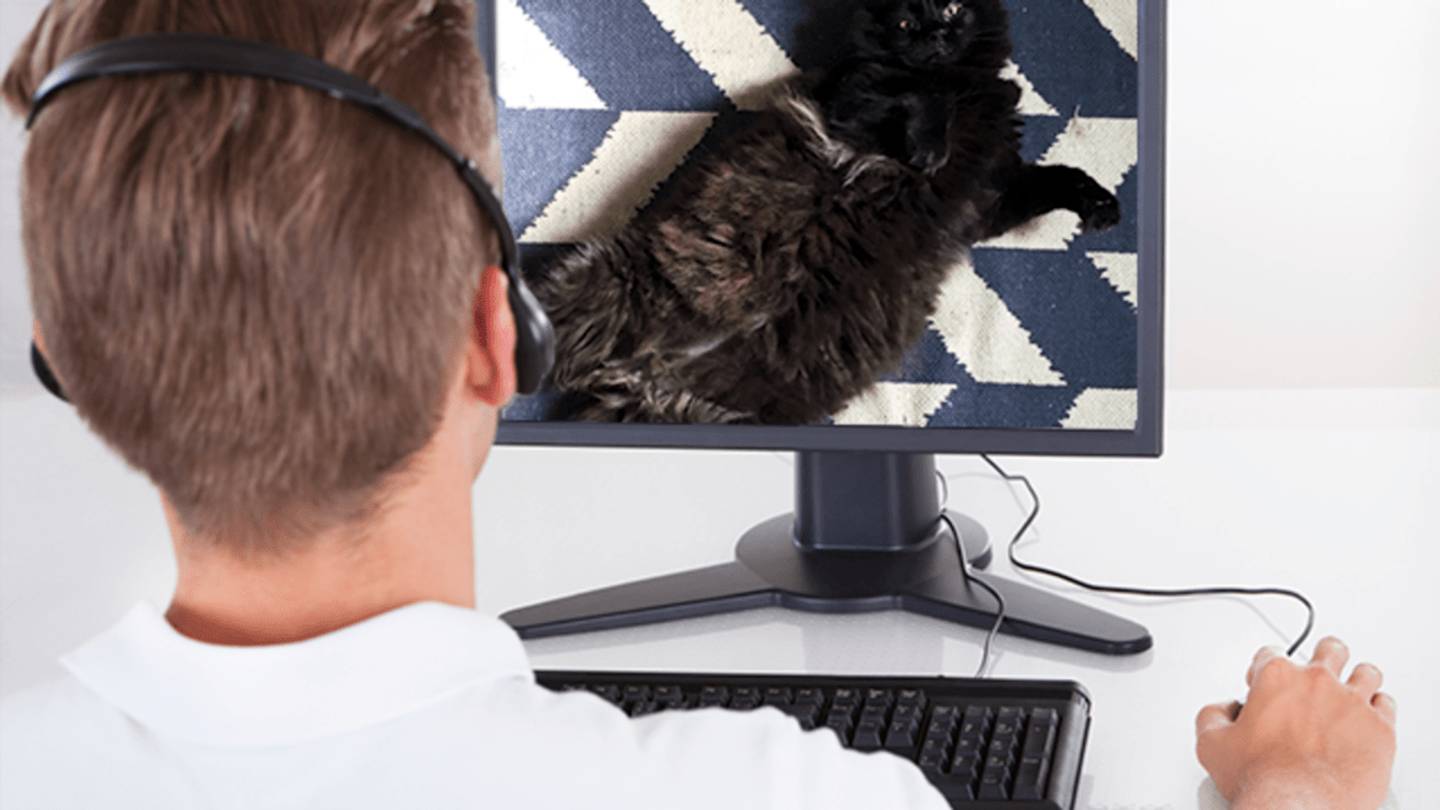
The next time your boss busts you for watching a cat video during work hours, tell him youâre doing it for your well being. A new study , published in the latest issue of Computers in Human Behavior , has found that viewing a video of an adorable feline boosts the viewerâs positive emotions, gives them an energy bump, and decreases negative feelings.
Itâs no secret that cat videos are numerous and popular. As of 2014, more than 2 million cat videos had been posted on YouTube, garnering nearly 26 billion total viewsâan average of 12,000 views per video. It's those kinds of numbers that inspired Jessica Gall Myrick, an assistant professor at Indiana University Bloomingtonâs Media School, to look into why people can't get enough of feline flicks. One particular week she saw a lot of cat-related mediaâânot just videos but also news stories about celebrity cats and cat festivals,â she tells mental_floss . âIt struck me how much of this type of media people must be consuming to turn this into such a phenomenon. As someone who studies media effects for a living, I was curious how watching so many cat videos might impact people.â
After looking for research in scholarly databases and coming up empty-handed, Myrick decided to do her own study. âMy research focuses on the role of emotions in media effects on audiences, so I knew from the beginning I wanted to measure how Internet users respond emotionally to this content,â she says. âI also wanted to figure out if there were any personality traits or background factors, like real cat ownership, that might be related to viewing online cat-related media.â
She created a survey, which was distributed on social media with a little help from Bloomington resident Mike Bridavsky, owner of Internet phenom and mental_floss magazine guest editor and interviewee Lil Bub, who tweeted out a link. (Myrick also donated 10 cents per participant to Lil Bubâs Big Fund for the ASPCA , raising $700.)
Nearly 7000 people took the survey, answering not just questions about how watching cat videos made them feel, but also past and present about feline ownership, whether or not theyâd fostered cats, how often they posted photos and videos of their own kitties, and what other animal-related media they watched. âBecause this was an exploratory study,â Myrick says, âI wanted to measure as many variables as possible that might help explain why cat videos are all over the Internet and who was driving such high viewership of cat-related Internet content.â
Myrick found that people who watched cat videos âtend to have real cats, are active in animal-related charities, somewhat shy, and are agreeable,â she says. âThere was also a very small, but statistically significant, relationship between low levels of emotional stability and higher frequency of viewing cat videos or photos online.â
Participants said they often watched cat videos at work or when they were studying, and typically felt more energetic and more positive after watching the videos. They also had fewer negative emotions, including sadness and anxiety. âSome people did feel guilty if they watched cat videos as a way to procrastinate,â Myrick says. â[But] even if they did feel guilty for procrastinating, if the cat videos they viewed also made them feel happy, then that positive emotion seemed to override the guilt and [they] still reported enjoying the videos.â
But it wasnât all fun and Nyan-cat rainbows : If participants were watching the videos to procrastinate and the videos didnât make them feel happy, then they didnât have an enjoyable experience. âEmotions are complex, and we can simultaneously experience positive and negative emotions, but often one type might dominate the other, as was the case for some cat-video-watching procrastinators,â Myrick says. âI think these results suggest that the motivations people bring with them to media matter for determining how that media will affect the user.â
Myrickâs study shows that watching cat videos online isnât a waste of time, but is instead âa way we subconsciously regulate our emotions and try to get a little boost,â she says. It's likely that cat videos elicit positive feelings because most of them are funny or cute. âI also think [they're] sort of a positive emotional oasis, so to say, between a lot of our other social media content, [which] may be depressing or annoying, even if itâs important, â Myrick says. â But a short cat video can give someone the energy to maybe attend to more important news or tasks afterward.â
Myrickâwho, for the record, owns a pug (sheâs allergic to cats)âthinks dog lovers would probably respond similarly to dog videos. And that makes her think that pet videos might have applications beyond just energy-producing procrastination: âThere might be a way to use pet videos as some form of low-cost, readily available digital pet therapy,â she says, noting that we'll need more research to be sure.
Loading recommendations... Please wait while we load personalized content recommendations