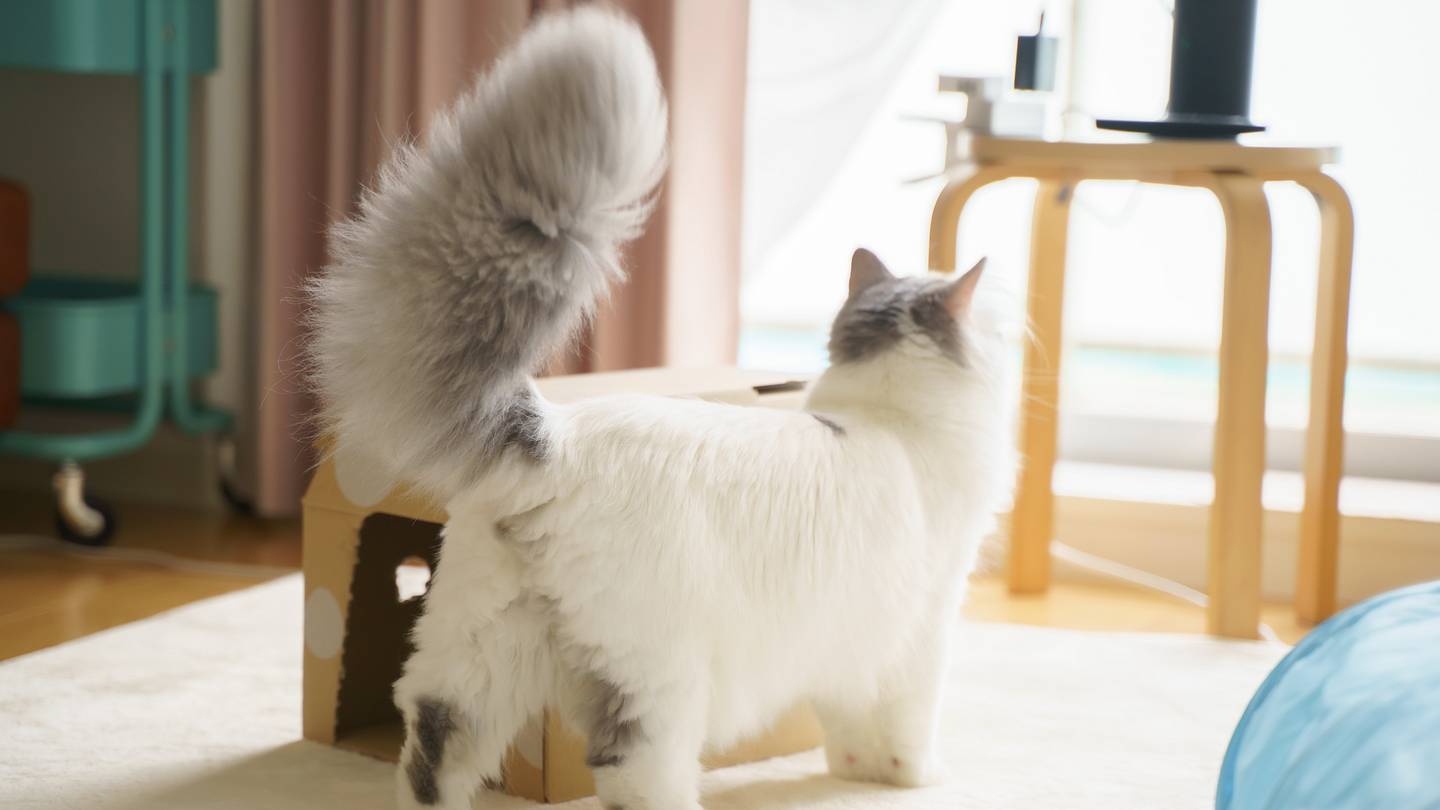
Cats wear their emotions on their tails , not their sleeves. They tap their fluffy rear appendages during relaxing naps, thrash them while tense, and hold them stiff and aloft when theyâre feeling aggressive, among other behaviors. And in some scary situations (like, say, being surprised by a cucumber ), a catâs tail will actually expand, puffing up to nearly twice its volume as its owner hisses, arches its back, and flattens its ears. What does a super-sized tail signify, and how does it occur naturally without help from hairspray?
Cats with puffed tails are âbasically trying to make themselves look as big as possible, and thatâs because they detect a threat in the environment," Dr. Mikel Delgado, a certified cat behavior consultant who studied animal behavior and human-pet relationships as a Ph.D. student at the University of California, Berkeley, told Mental Floss in 2017. The âthreatâ in question can be as major as an approaching dog or as minor as an unexpected noise.
Even if a cat isnât technically in any real danger, itâs still biologically wired to spring to the offensive at a momentâs notice, as it's ânot quite at the top of the food chain,â Delgado said. And a big tail is reflexive feline body language for âIâm big and scary, and you wouldnât want to mess with me,â she added.
An extra-fluffy tail isnât always a sign of fear, though. Cats may also puff their tail when theyâre excited or feeling playful.
A catâs tail puffs when muscles in its skin (where the hair base is) contract in response to hormone signals from the stress/fight or flight system, or sympathetic nervous system. Occasionally, the hairs on a catâs back will also puff up along with the tail. That said, not all cats swell up when a startling situation strikes. âIâve seen some cats that seem unflappable, and they never get poofed up,â Delgado said. âMy cats get puffed up pretty easily.â
In addition to cats, other animals also experience piloerection , as this phenomenon is technically called. For example, âsome birds puff up when theyâre encountering an enemy or a threat,â Delgado said. âI think it is a universal response among animals to try to get themselves out of a [potentially dangerous] situation. Really, the idea is that you donât have to fight because if you fight, you might lose an ear or you might get an injury that could be fatal. For most animals, theyâre trying to figure out how to scare another animal off without actually going [into] fisticuffs.â
In other words, hiss softly, but carry a big tail.
Read More About Cats:
A version of this story was published in 2018; it has been updated for 2025.