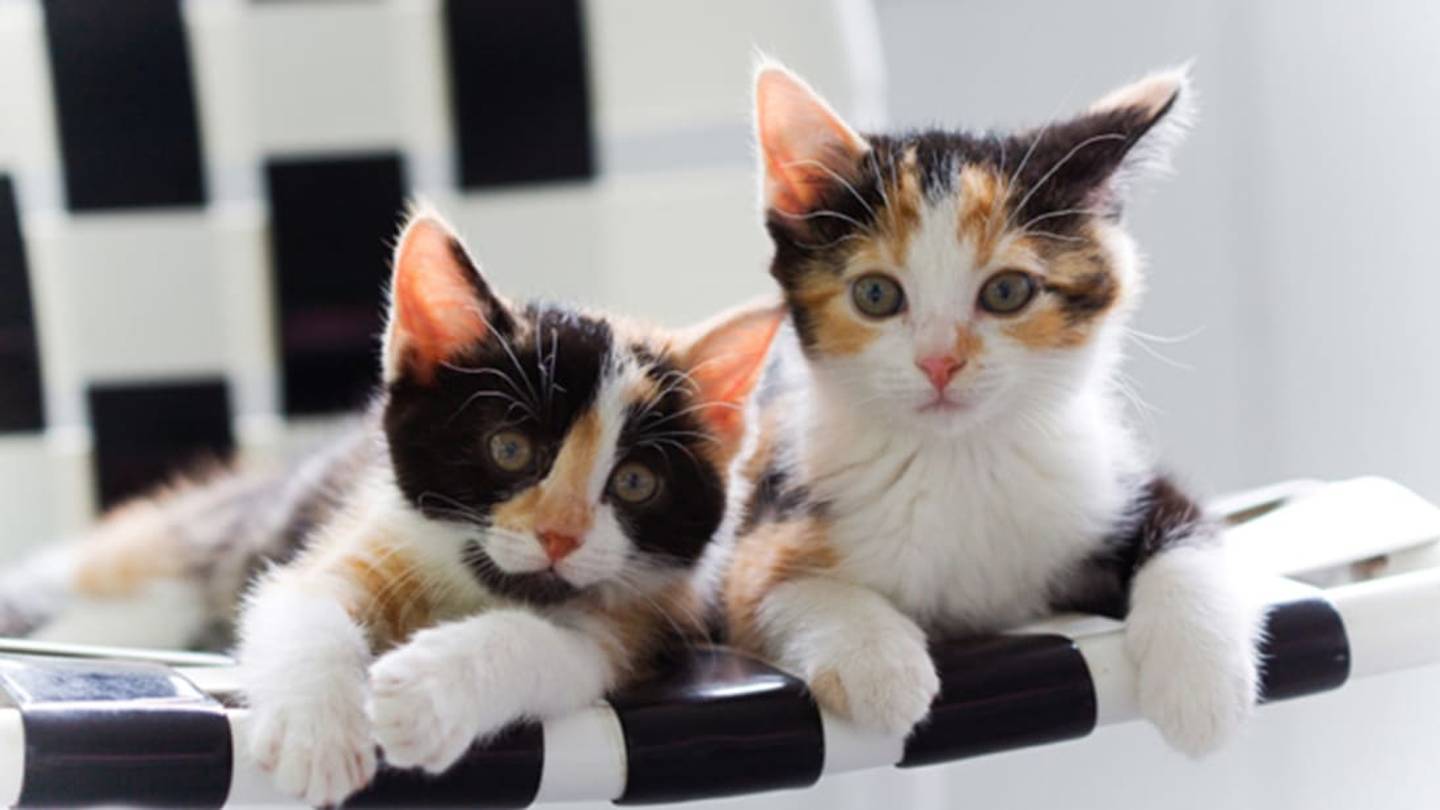
Thereâs a reason that colorful cats, like tortoiseshells and calicos, tend to be female. It comes down to genetics.
Females (of all sorts, not just cats) have two X chromosomes, while males have an X and a Y. Rather than being overwhelmed by the double dose of genes provided by having two X chromosomesâeach carries more than 1,000 genes âlady organisms have developed something called X-chromosome inactivation, a process that effectively hits the mute button on one of the two X-chromosomes in a cell.Â
Kat McGowan explains in Nautilus :Â
The donor cat (left) and resulting cloned kitten (right, with surrogate mother). Image Credit:Â Shin et al., Nature (2002)
No calico cat will ever look identical to another. The particular pattern of a multi-colored catâs coat comes down to chance, meaning that even among the same family, no cat will have the same coloration. Even with the exact same genetic make-up, a calico catâs coloration would be different than her twinâs because itâs random whether a cell codes for orange or black fur. The same goes for clones. In 2002 , when scientists cloned a calico cat named Rainbow, the clone kitten had vastly different coloring from Rainbow, even though their genes were exactly the same.Â
Because X-inactivation only happens if there are multiple X chromosomes in one cell, coloration patterns that stem from the process tend to only pop up in female cats. Rarely, a genetic mutation can result in a cat being born with an extra chromosome  (XXY), leading to a male calico or tortoiseshell cat, but for the most part, itâs purely a ladiesâ club.Â
Loading recommendations... Please wait while we load personalized content recommendations