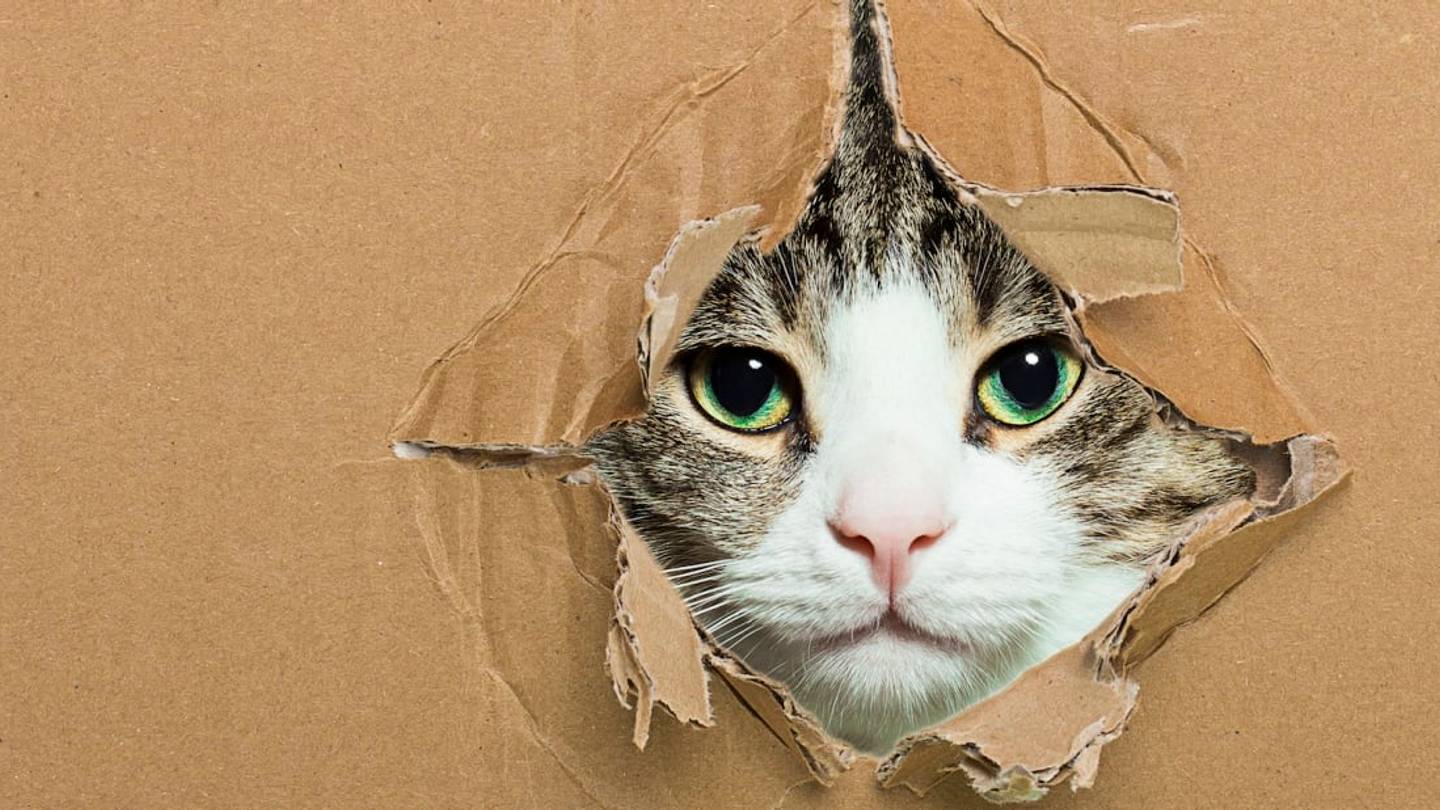
Why do cats like boxes? It's one of those age-old questions. Share your living space with a cat for even a short length of time and youâll quickly begin to doubt everything youâve ever been taught about mass and volume. If given the opportunity, a reasonably sized cat will somehow compress itself into a tiny box and idle there for hours.
Why do cats feel the need to squish themselves into cardboard boxes? Do they not realize their dignity is in question when they lord over a living room from a Zappos shipping box?
âThereâs that adage, âThink outside the box,ââ says Carole Wilbourn , a New York City-based cat therapist. âCats like to think inside of the box.â
Cats, Wilbourn reasons, take comfort in cramped spaces because it makes them feel more secure and dominant. âI think part of it goes back to when they were kittens and inside the womb, feeling safe and comforted. Thereâs a feeling of coziness, being able to do what they want to do, and just feeling untouchable.â
Science has been able to support this theory. Animal behaviorists have studied stress levels in newly arrived shelter cats and found that felines with access to boxes had lower stress levels and faster adjustment periods than those without [ PDF ]. Even if theyâre not quite as protected as they think they areâyou can pretty much do anything to a cat who is inside a box as you could a cat who is outside of oneâtheir perception may very well be that theyâre insulating themselves from harm.
Curling up in an undersized shelter has an additional benefit: it helps the cat retain more body heat. Cats tend to like running at a temperature between 86 to 97 degrees Fahrenheit, which is a reason you might also find them hanging out on a radiator, laptop, or other heat-emitting device. âWhen a cat is warm, the cat feels relaxed,â Wilbourn says.
Though you might find a cat stuffed in a bathroom sink or other tight space, cardboard boxes usually have enough give to them to allow for greater comfort for the feline in question. If youâre still perplexed by the preference, remember that youâve probably endorsed it by melting at the sight. âPeople see a cat in a box and say, âOh, that looks so nice and peaceful,'" Wilbourn says. "Itâs a positive association. Itâs easy for a cat to get blissed out in a box.â
A penchant for small boxes isn't the only seemingly odd cat behavior that science has been able to account for; from climbing to scratching to pouncing, researchers have logged a lot of hours studying the science behind your cat's weird ways . They've also studied cat behavior from the owner's perspective, and discovered a number of ways that having a furry friend can benefit the health of its owner , including the therapeutic effect that the heart-melting sound of a purring cat have on those who hear it. Awww.
Have you got a Big Question you'd like us to answer? If so, let us know by emailing us at [email protected] .
Loading recommendations... Please wait while we load personalized content recommendations