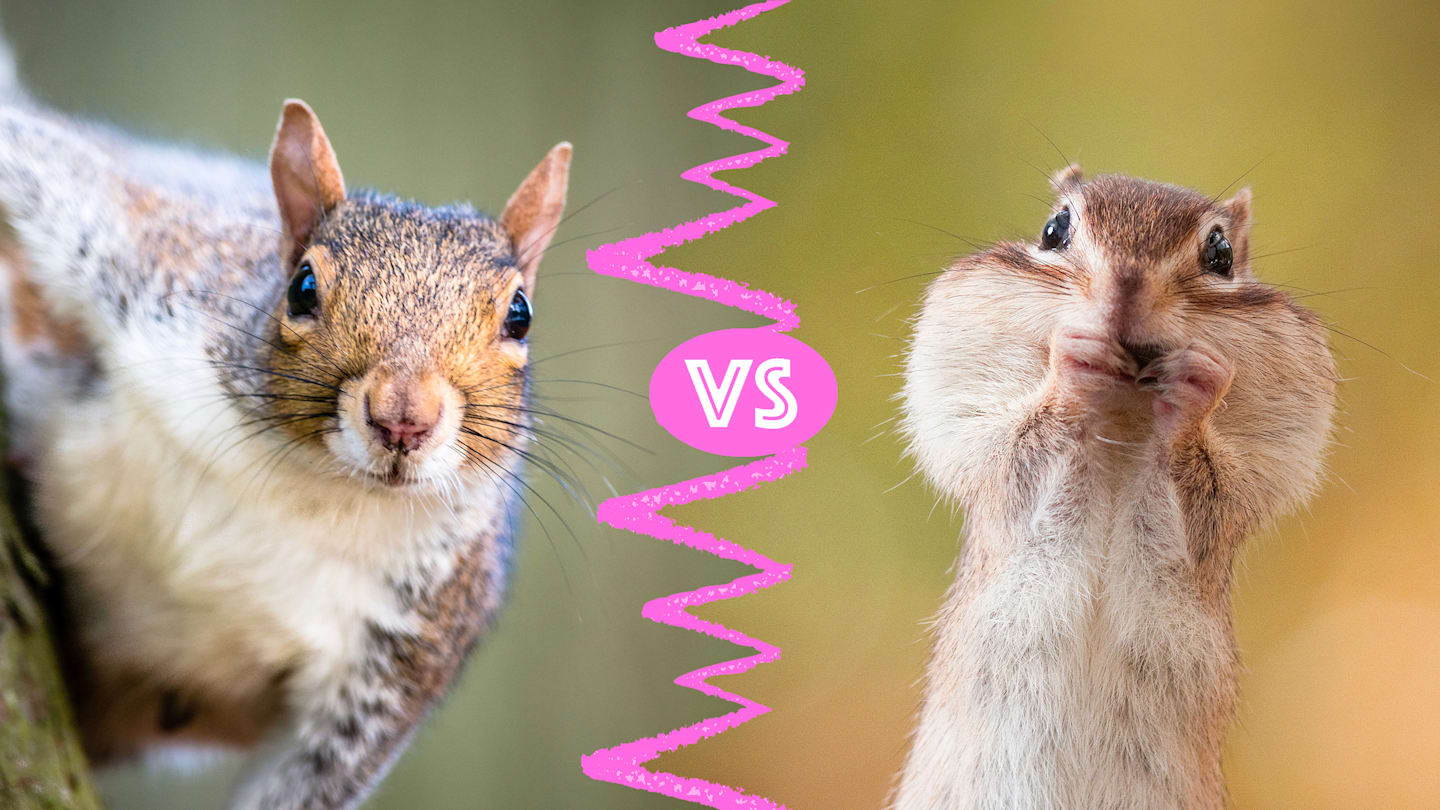
Chipmunks (genus Tamias ) and tree squirrels (genus Sciurus ) can both be spotted scurrying through yards and wooded areas, collecting food, and dashing into their hidey-holes. Both animals are part of the squirrel family, Sciuridae , which also includes prairie dogs, groundhogs , marmots, and flying squirrels. Here are some key differences between the two animals.Â
8â10 inches long from head to tail
Reddish-brown fur with black and white stripes
Prefers open deciduous woodlands; nests in underground burrows
Opportunistic omnivores
High-pitched chirping noises, trills, and a deeper âchuck-chuckâ sound
Usually measures between 16â21 inches long from head to tail
Various shades of gray and brown; may also be black or red
Can be found in woodlands, parklands, suburban, and urban areas; nests in trees
Chatters and include raspier, lower-pitched noises
Chipmunks are easily recognizable, as all of them wear the same striking fur âuniformâ of reddish-brown fur and black and white stripes. The rodents sport five black stripes down their backsâ one down the center and two on each side of its bodyâthat outline streaks of white. Chipmunks also have a lighter-colored underside and a white stripe above and below their eyes.Â
Squirrels, on the other hand, come in a wide range of hues, but most commonly have uniformly colored fur that is predominantly gray, brown, black , or red.Â
Another big clue when determining if a rodent is a chipmunk or squirrel is size. Chipmunks are the smallest members of the squirrel family, growing from 8â10 inches long from head to tail and weighing 1â5 ounces. Most squirrels people typically see bounding across their yards are significantly larger. Gray squirrels , for example, measure between 16â21 inches long from head to tail and typically weigh up to 1.5 lbs. They also sport broad and bushy tails that can be as long as their head and body combined. Red squirrels are smaller, but they, like other squirrel species, have distinctly bushy tails. Fox squirrelsâNorth Americaâs largest squirrel species, with several known subspeciesâclock in at up to 30 inches long and can weigh up to 2.5 lbs.
Chipmunks live and thrive in most parts of the U.S. and Canada; the Siberian chipmunk can be found in northern areas of Russia, China, Korea, and Japan (there are also escaped former pets living in pockets of Europe). They will on occasion settle in suburban or urban settings, but they prefer open deciduous woodlands that can provide them with lots of tree cover, stumps, and logs. Chipmunks donât usually climb trees. Theyâre ground dwellers who live in underground burrows that have multiple tunnels and chambers, including a central nest.Â
Tree squirrels are found on every continent except for Australia and Antarctica. They live in many different habitats including woodlands, parklands, suburban, and even urban settings. The tree-dwellers come down to the ground to forage for food, but they wonât stay there. Squirrel nests are typically built high up in the trees, and are made with twigs, moss, leaves, or other materials the animals scrounge up.Â
Chipmunks arenât picky eatersâthese omnivores will eat vegetation like mushrooms, berries, seeds, nuts, and grains, but they also have an appetite for insects , worms, lizards, baby birds , and bird eggs. The little rodents spend a lot of their time collecting food before hibernating in the winter; their cheeks expand into storage compartments nearly three times the size of their heads! They fill their cheeks with food theyâve foraged, then carry it back to their burrow and add it to their cache.Â
Squirrels also hide food away for winter, although they donât hibernate, instead using fat stores and stashed food to survive the cold months. Squirrels will feast on nuts and seeds (especially acorns), but will also eat fruits, insects, mushrooms, and even plant bulbs they dig out from your garden. Theyâve also been known to raid bird nests and eat whatever meat they can find.
Chipmunk noises can sometimes be mistaken for bird calls. They make high-pitched chirps, trills, and a deeper âchuck-chuckâ sound when threatened. Squirrel sounds resemble chatters and tend to include raspier, lower-pitched noises. Both chipmunks and squirrels will increase their communication when they sense a threat looming nearby; the latter will also use tail signals and foot stomping to warn others about impending danger.Â
Read More About Squirrels:
Have you got a Big Question youâd like us to answer? If so, let us know by emailing us at [email protected] .