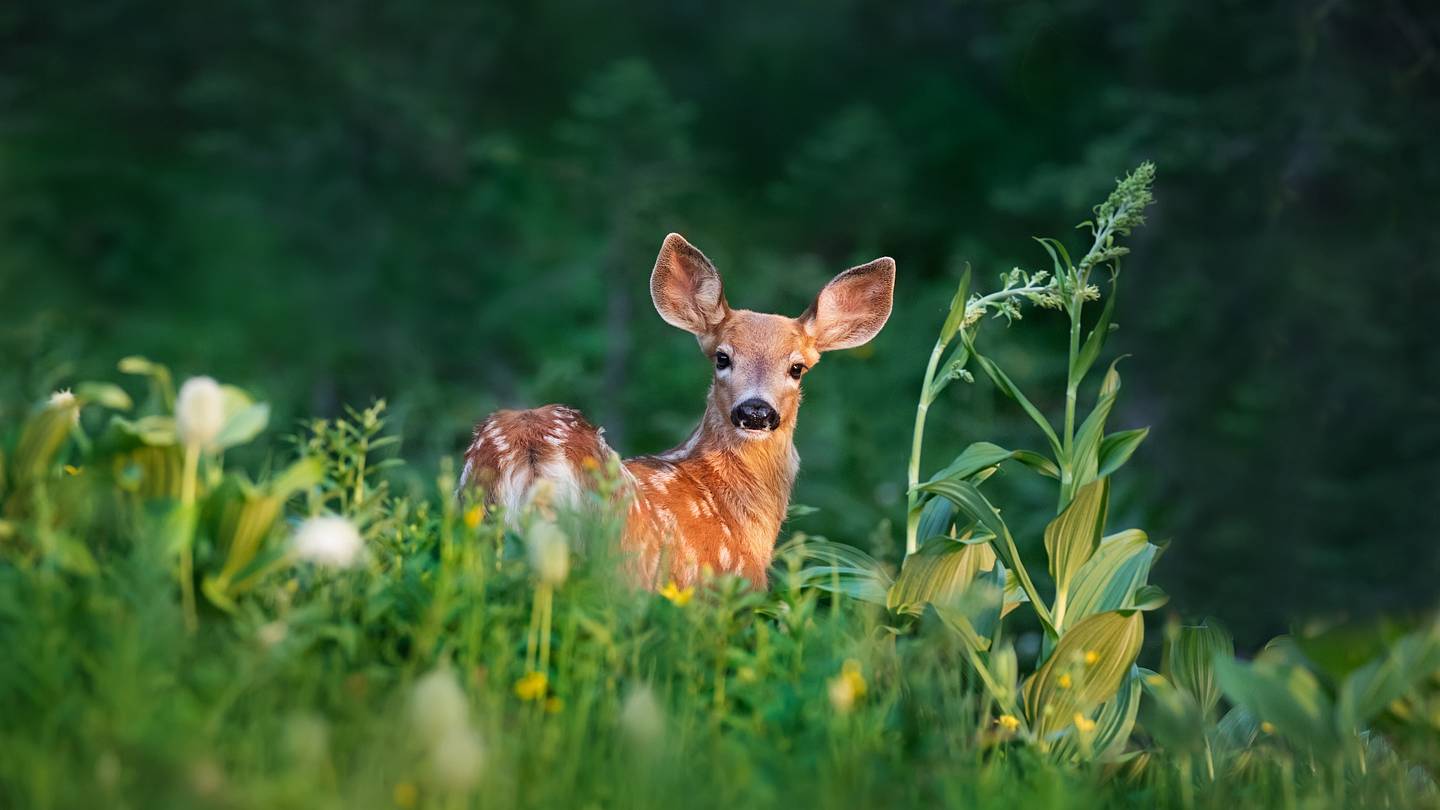
There are several deer species scattered throughout the world. White-tailed deer, Odocoileus virginianus, belong to the same animal family (Cervidae) as moose , elk, and reindeer . Theyâre native to the Americas, but have been introduced to Europe, the South Pacific, and the Caribbean. Here are some fun facts about these common woodland creatures.Â
White-tailed deer are the countryâs most common ungulate; 30-million of them live throughout the U.S. today. The state that contains the largest white-tailed deer population is Texas , which is home to 5.3 million of them.Â
One of the white-tailed deerâs greatest defenses against predators is speed. The animals have been known to run as fast as 35 mph âfor several miles at a time. Theyâre also extra nimble, capable of bounding through the woods to escape a threat at a momentâs notice.Â
While people see color on a broad spectrum, deer mostly pick out short blue and middle green wavelengths of color; they show much less sensitivity to reds and oranges. This essentially means that deer are red-green colorblind .Â
A fully grown bull elk can weigh 700â730 pounds; even the biggest male white-tailed deer only reaches about 300 pounds , though they donât usually even hit that weight. White-tailed deer are North Americaâs smallest deer species and typically clock in between 100â150 pounds.Â
Contrary to common belief, deer are highly intelligent. Theyâre able to adapt their behavior based on past experiences, and have even been known to stay away from certain areas during hunting season. People sometimes think theyâre dumb because the expression deer in headlights suggests the animals react poorly to high-stress situations. However, this reaction is not a result of stupidity . The sudden brightness temporarily blinds the deerâit has a similar effect as when someone turns on the light in a pitch-black roomâmaking them freeze.Â
Males in every deer species except for the Chinese water deer grow antlers. Some species also get tusks, which serve as another defense mechanism. Deer antlers can grow extremely quickly; theyâve even been found to gain a quarter inch in a single day. Bucks will shed them after rutting season ends, then re-grow a new set.
The average male deer has a lifespan of six years while the average female lives for 12. Comparatively, moose tend to survive for 15â25 years , and elk live for 10â13 .Â
Deer can hear upwards of 54,000 hertz âthatâs similar to the average dogâs hearing, and about three times better than what humans can detect. The animals will definitely hear you before you see them, making it hard to sneak up on them in the wild.
Itâs possible to spot deer in the middle of the day, but theyâre typically most active at dawn and dusk. Weather also plays a part in determining how active the deer in your area may be. The ungulates tend to nap during warm weather, and emerge when conditions cool.Â
Most white-tailed deer enjoy meals of grass , fruit like apples and berries, and nuts. The animals can be a real pain for gardeners and orchard owners, as theyâll munch on fruit trees and ornamental plants. They may also resort to eating bark and twigs when other options are scarce, and a camera trap once even caught one eating human remains .Â
Deer that live in places with dwindling food supplies will often migrate to a better location for the winter months; those with year-round access to food tend to stay in the same place. Interestingly, the survival rates for migrational and stationary deer are the same, so any long journeys donât seem to put the animals at a noticeable disadvantage.Â
One of Disneyâs most famous animals is Bambi , who was modeled after a white-tailed deer . An animator who worked on the movie was from Maine and turned to his childhood environment for inspiration. At one point during Bambiâs development, a fawn from the state was even transported all the way to Hollywood.
Bambi isnât the only member of his species to star in a famous film. Though Rudolph the Red-Nosed Reindeer is, as his name suggests, supposed to be a reindeer, he was actually modeled after a white-tailed deer in the 1964 Rankin/Bass holiday special .
When deer feel threatened or are spooked, theyâll raise their tails, exposing a white underside . This tail âflagâ also tells the herd to be wary of whatever threat is lurking nearby. They use their tails to send other signals, too. Does, for instance, will raise their tails to show that theyâre ready to breed during rutting season.Â
Arkansas, Illinois, Michigan, Mississippi, New Hampshire, Ohio, Pennsylvania, South Carolina, and Wisconsin have all named the white-tailed deer their state animal.Â
Young deer are most likely to bear a single fawn, while older deer may have twins, or in some cases, triplets [ PDF ]. Fawns typically weigh 6â8 pounds at birth; theyâll grow to be about 60â70 pounds by their first winter. The adorable white spots theyâre born withâwhich help them blend in with a forest or meadow floorâwill fade as they age.
Read More About Deer: