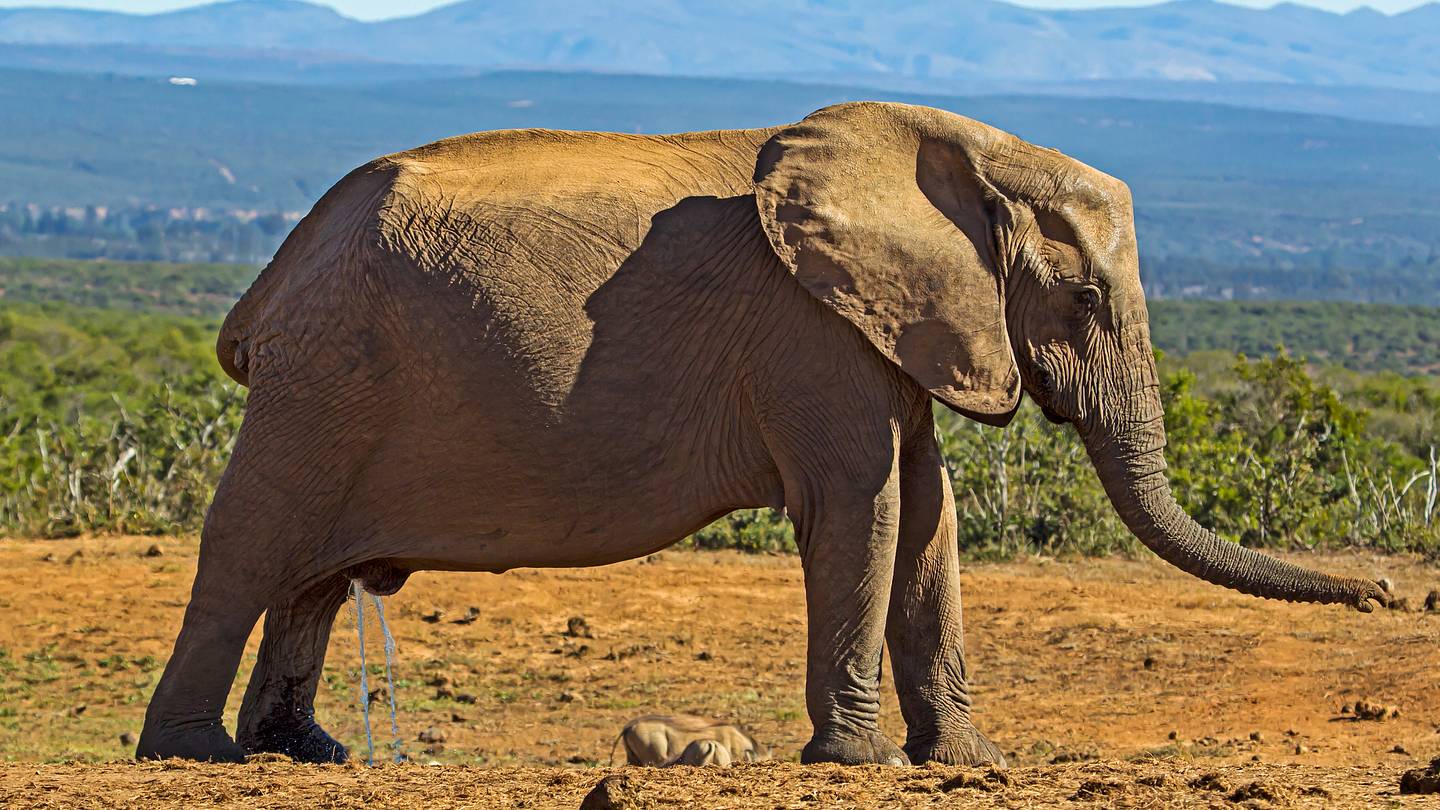
A rhinoceros has a bigger bladder than a dog, and generates urine by the bucketful. So which animal spends more time peeing? In 2014, scientists from Georgia Tech endeavored to figure that out and determined that, in general, larger animals would pee for longer. To test their hypothesis, they set up high-speed cameras to record Zoo Atlanta animals as they âdid their business,â and supplemented that footage with videos from YouTube. Altogether, they analyzed the urination of 32 different animals , from mice to jaguars to gorillas to elephants.
Surprisingly, it turned out that mammals that weigh more than 6 pounds urinate for roughly the same length of time, regardless of their size. Specifically, they pee for an average of 21 secondsâgive or take 13 seconds. âThis invariance is noteworthy," the scientists wrote in the journal Proceedings of the National Academy of Sciences , "considering that an elephantâs bladder, at 18 liters, is nearly 3600 times larger in volume than a catâs bladder at 5 milliliters.â
The reason that an elephant can release the equivalent of nine large soda bottles worth of urine in the same amount of time that it takes a cat to lose a spoonful of urine boils down to flow rates. An elephant pees faster than a cat because its urethraâthe tube that delivers urine from the bladder and out of the bodyâis wider. The elephantâs urethra is also longer, allowing the force of gravity to act more strongly on fluid flowing through it.
Mice and rats and other animals weighing under 6 pounds donât fit the 21-second rule, however. Thatâs because their urinary tracts are so small that they have to battle capillary action, which is the tendency for a fluidâs molecules to stick to themselves and to the walls of a container and flow upwards. The pee is more viscous, and moves so slowly that smaller animals canât generate a jet of urine. Instead, the urine falls out in tiny droplets.
For the rest of the mammals, itâs not clear why the 21-second rule holds across animals with widely varying sizes. The researchers suggest that it is a matter of physics rather than evolutionary adaptation.
The scientists say their research could be helpful in diagnosing urinary problems in animals. For instance, if a zookeeper notices a gorilla is peeing for a lot more or a lot less than 21 seconds, it could indicate that something is wrong.
Oddly enough, this weird area of research could also have implications for infrastructure. As the paper indicates:
[B]y providing a water-tight pipe to direct urine downward, the urethra increases the gravitational force acting on urine and therefore, the rate at which urine is expelled from the body ... Engineers may apply this result to design a system of pipes and reservoirs for which the drainage time does not depend on system size. This concept of a scalable hydrodynamic system may be used in the design of portable reservoirs, such as water towers, water backpacks, and storage tanks.
Who knows, perhaps this research will pave the way for a âbladderâ future.
A version of this story ran in 2014; it has been updated for 2022.
Loading recommendations... Please wait while we load personalized content recommendations