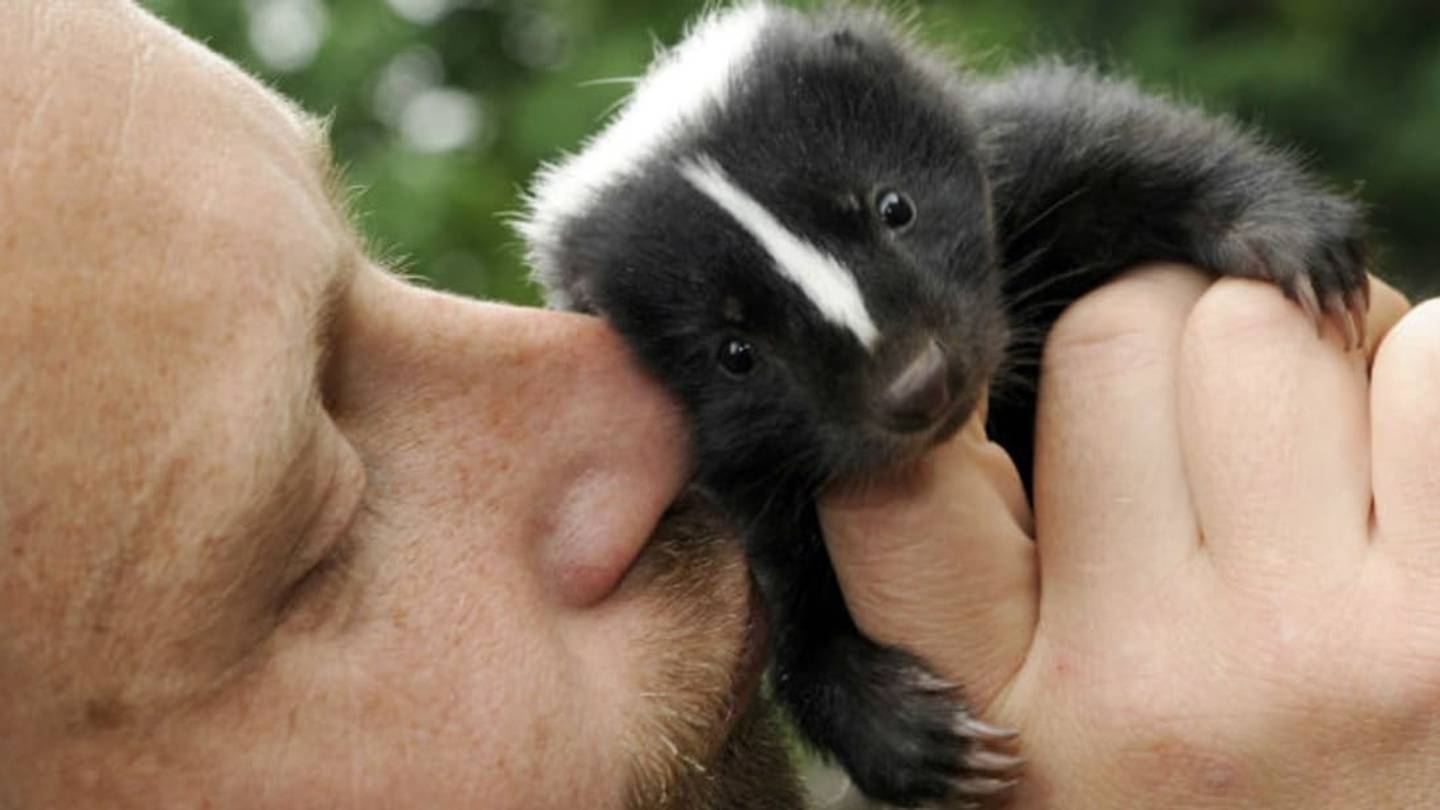
If Pepe Le Pew has taught us anything, itâs that skunks seem to relish their own stench, refusing to let it rob them of their self-confidence. The dual-striped creaturesâthere are 11 species in totalâ are mammals, and they defend themselves against predators by using anus-adjacent oil glands to shoot a plume of sulfurous stink at attackers. They can also aim it like a water gun with surprising force (over a 10-foot  trajectory) and accuracy. But what happens if a skunk is sprayed by another skunk? And does the sprayer find his or her own smell offensive?
As it turns out, Warner Bros. cartoons may not be as scientifically accurate as previously thought. According to Jerry Dragoo, Ph.D., a mephitologist and head of the Dragoo Institute for the Betterment of Skunks and Skunk Reputations, skunks do not find their own odor pleasant. At all. âSkunks do not enjoy the spray of other skunks,â he says. âA skunkâs sense of smell is stronger than a humanâs, so the odor will be as offensive.â Like any other victim, a skunk will rub its face in the dirt, sneeze, or try to groom itself to get rid of the irritant.
Out of courtesy, skunks usually warn one another of a pending squirt before firing awayâand itâs usually a last resort. âSkunks rarely spray each other,â Dragoo says, citing the fact that few skunk-on-skunk conflicts are serious enough to warrant nature's mustard gas. Some juvenile skunks, however, might spray an adult, since mature skunks have been known to kill weaker passersby; females will also spray during mating season if a male is too aggressive in his courtship.
For any skunk, resorting to their special ammunition carries the risk of catching some stink shrapnel. âWhen skunks spray, they rarely get any on themselves, but it does happen,â Dragoo says. âThough they can tolerate [their own] smell, they do not appreciate getting it in the face and eyes.â
Loading recommendations... Please wait while we load personalized content recommendations