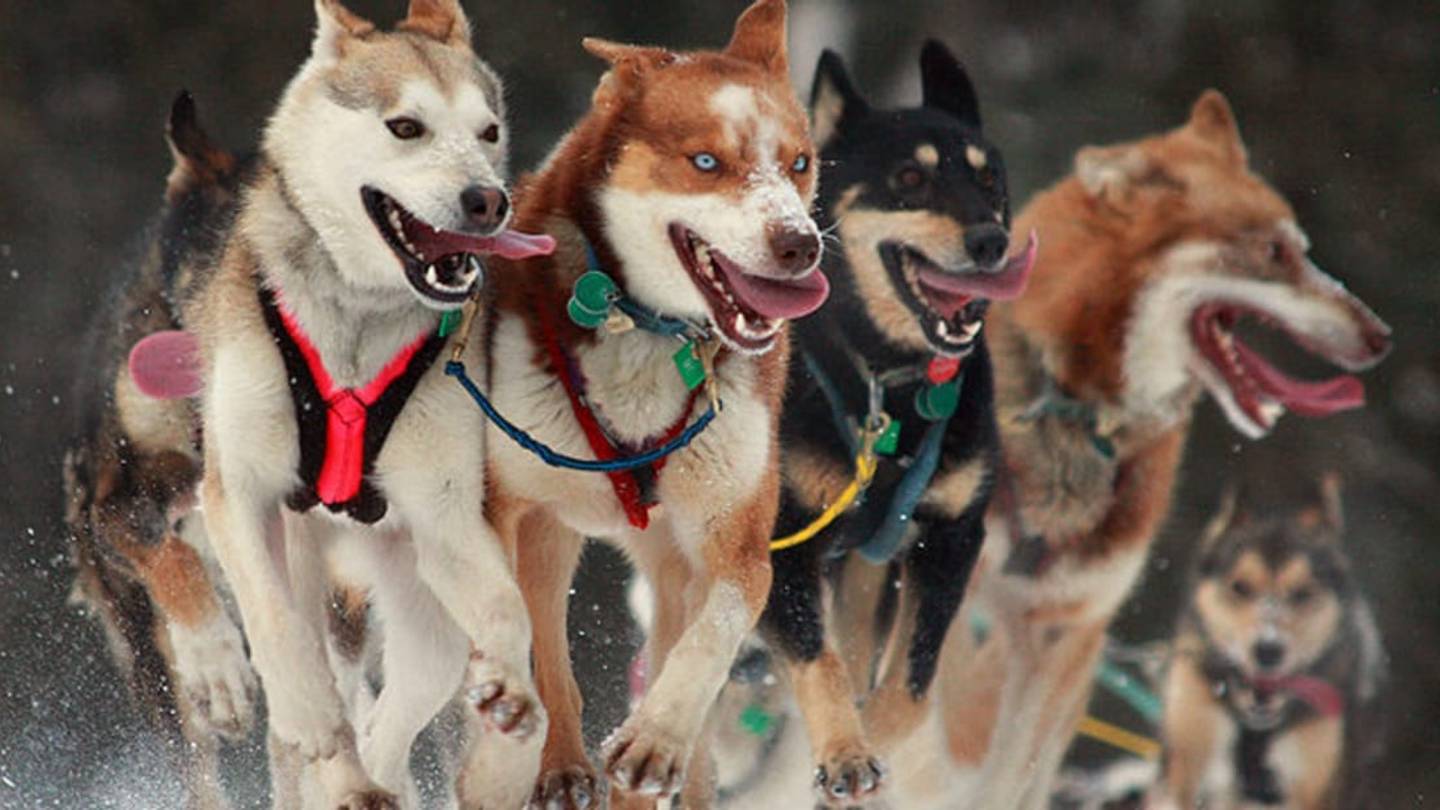
The Iditarod has been called "the last great race on Earth"â a long, blistering competition across nearly 1000 miles of Alaskan wilderness. Though the traditional starting line in Anchorage was used on Saturday for a ceremonial kick-off, the race itself began on Monday, March 6, in Fairbanks, about six hours northâmarking the second time in three years that the conditions in Anchorage were too mild for a proper send-off. While this year's 72 mushers make their way to Nome, here are 11 amazing facts about the brutal and trying, but always exciting, Iditarod.
The first Iditarod took place in 1973, and took about 20 days to complete; currently, it takes about 10 days. Last year's winner, four-time champ Dallas Seavey, set a new record at 8 days, 11 hours, 20 minutes, and 16 seconds. The last place time was 32 days in the beginning, and now itâs about 13 days.
Each sled is pulled by a team of 16 dogs, and they need to keep on eating. On the trail they get frozen snacks like chunks of meat, fish, or soaked dog food. When they stop at checkpoints they get a warm meal, maybe a nice a slurry of beef, Arctic char, vitamin supplements, and kibble mixed with water and chicken fatâcooked in a bucket camp stove that doubles as the driverâs seat on the sled.
Itâs cold out there on the trail, but thatâs not why the dogs have to keep their feet covered. Their fur and efficient circulatory systems keep them warm enough. But the ice, snow, and rocky terrain is hard on their foot pads, so they have to be protected. Mushers usually make their dogsâ booties themselves, and they are required by the rules of the race to have at least eight extra per dog on the sled. "This is easily the most important piece of dog gear I use," 2012's Rookie of the Year Brent Sass told Outside , adding that he actually packs 3000 extra booties for his dogs. "My dogs will race over bare ground, ice, fresh snow, and open waterâand booties are the best way to prevent injury."
Inspired by the Olympic Jamaican bobsled team, a Caribbean tour operator started a Jamaican dog sled team to compete in various races. (It was sponsored by Jimmy Buffett.) In 2010, team member Newton Marshall became the first Jamaican to compete in the Iditarodâhe competes independently as Mushinâ Mon Newton . In 2014, he made Iditarod news when he helped rescue another musher who had broken his ankle chasing a loose dog. That musher happened to be the subject of our next factâ¦
The musher Marshall saved, Scott Janssen, a funeral home proprietor known as the Mushing Mortician (and who is currently racing this year ), made news in the 2012 Iditarod when he saved one of his dogs who had collapsed on the trail by performing mouth-to-snout resuscitation. That huskyâs name? Marshall. Coincidence? Or mysterious karma on the trail?
Thereâs quite a bit of friendly family rivalry in the Iditarod. Last year's winner, Dallas Seavey, became the youngest Iditarod winner at 25 on his first win in 2012. The next year, his father, Mitch, became the oldest winner at 53. Mitchâs father, Dan, had finished third in the original 1973 race. Other Iditarod families include Anna and Kristy Berington , twin sisters who have competed six and eight years each, respectively, and the Mackeysâfather Dick and sons Rick and Lance, who each won the race on their sixth attempt, each while wearing number 13 (Lance went on a four-year winning streak from 2007-2010). Dick's two other sons, Bill and Jason have also competed, with Jason currently out on the trail.
Martin Buser moved to Alaska from his native Switzerland in 1979. He ran his first Iditarod in 1980 and holds the record for finishing the race the most times at 33 (and he's competing this year as well). He also held the previous record for fastest finish time with his 2002 win. Right after that win, he became a U.S. citizen in a naturalization ceremony held under the monument arch that marks the finish line.
Part of sled dog training involves teaching them a set of standard commands.
Or at least for the name of the route than once carried mail, supplies, and gold prospectors to the town of Iditarod. The town was named for the Iditarod River and was once flush with action from an early 20th-century gold rush. But after the gold ran out in the 1930s, everyone left. All that's left of it are a few abandoned shelters and a rusty old bank vault.
The race course is about 1000 miles, but it can vary depending on snow, ice, and other terrain conditions. Also, the race alternates between a northern course and a southern course every year. This way, more of the small towns in the middle of the state get to participate in the action and benefit from a bump in visitors. Officially though, they say the race is 1049 miles, in honor of Alaska being the 49th state to enter the union.
Itâs a race tradition to light a lantern at the finish line in Nome when the race begins and leave it lit as long as there are still mushers out on the trail. Itâs a nod to the old custom of the "widowâs lamp," which was a safety measure to keep track of when sled drivers were out on the trail and whether they had reached their destination or not. Some sled races started handing out lanterns to the last place finisher as a joke, but now the "red lantern" is an official prize to bear proudly. When it comes to the Iditarodâover 1000 miles of snow, ice, frostbite, sleeplessness, danger, and mudâjust finishing is no small achievement.
Follow the action at Iditarod.com .
A version of this story originally ran in 2014.
Loading recommendations... Please wait while we load personalized content recommendations