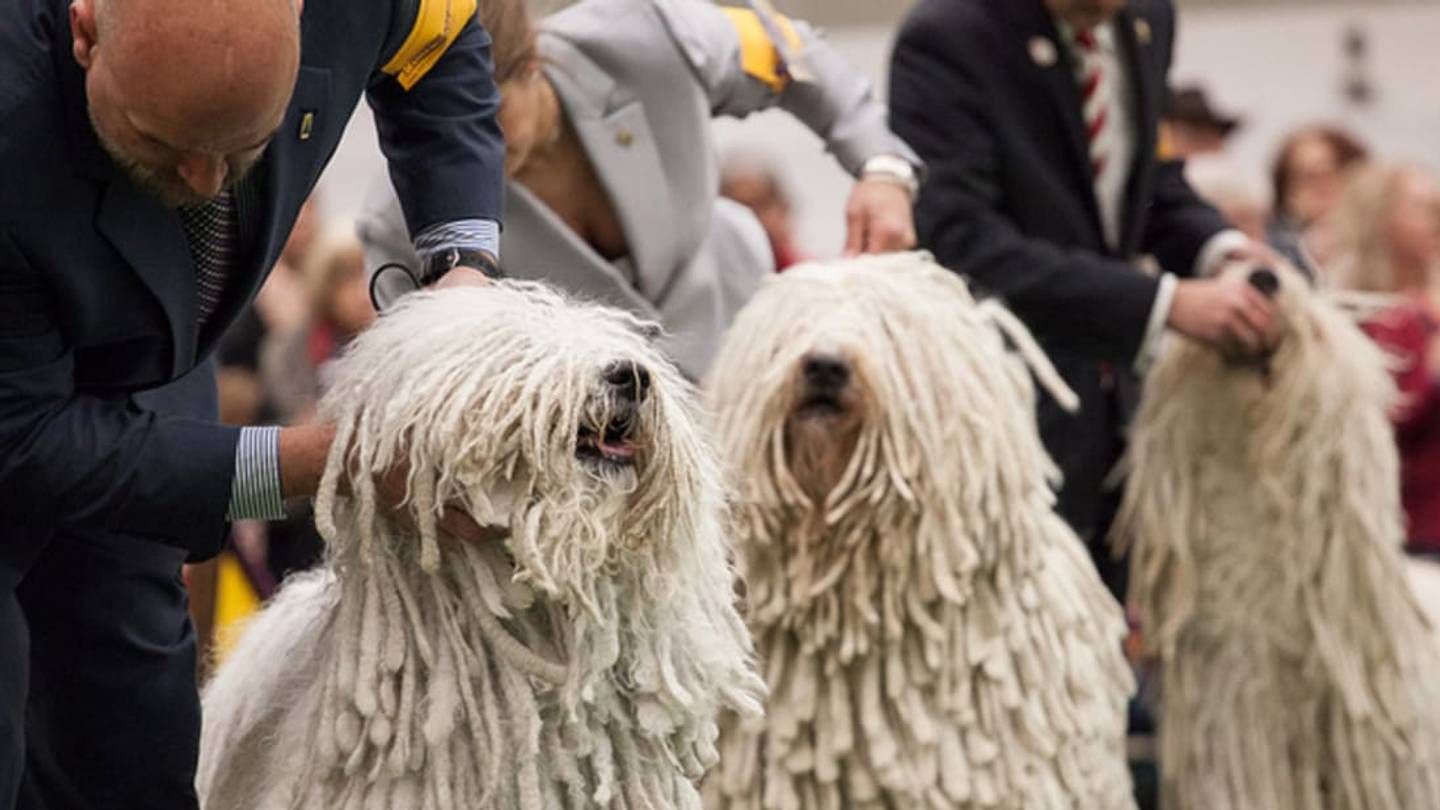
Is that a dog or a mop? Learn more about this dog in sheepâs clothing.
There are a lot of arguments about where these shaggy dogs came from, but many suggest the dogs migrated to Hungary with the Cumansânomadic Turkic people of the steppesâwho were fleeing a Mongolian invasion in 1246. Skeletons resembling the Komondor have been found in Cuman graves. Others suggest that it was the Huns that introduced the dog after coming across the breed while traveling through Russia. The earliest written mentions of the dogs don't pop up until the 16th century, in a Hungarian codex.
Petful //Â CC BY 2.0
The Komondor is said to be a direct descendant of the Aftscharka, or Russian herdsman's dog. Aftscharka were used in southern Russia as guard dogs and to watch herds. They came in all different colors and had thick curly coats.Â
Petful  // CC BY 2.0
In the Hungarian language, the letter k acts a lot like  English's letter s . For example, ember (person) becomes emberek (people).
Believe it or not, this dog was not bred to clean your floors. The mop-like coat is actually used as a clever form of camouflage . When keeping watch over a flock of sheep, itâs easy for Komondorok to blend in thanks to their wooly fur. This works to their advantage when an unsuspecting wolf comes over to snack on the sheep: The guard dogs can surprise the predator and keep it from gobbling up the livestock.Â
Thanks to their pedigree as herd dogs, Komondorok are excellent protectors. But because of this, they tend to be wary of strangers and donât get along very well with pets outside of the family. Itâs important to socialize a Komondor early to prevent any future conflicts with neighbors (or neighbors' pooches).Â
The cover for Beckâs 1996 album,  Odelay, features a shaggy Komondor mid-air. In the years since its release, the image has become one of the most recognizable covers of all time. But the choice to use the photograph was actually a last minute decision: According to the book 100 Greatest Album Covers , Beck arbitrarily picked it so that the record could come out on time. His girlfriend, Leigh Limon, found the picture in a book of dog breeds; well-respected photographer Joan Ludwig had taken the photograph, and Beckâs co-art director Robert Fisher added the text. As Fisher explained to 100 Greatest Album Covers :Â
According to the American Kennel Club , any Komondor that doesnât develop the breed's signature cords will be disqualified in competition. It usually takes about two years for the dogâs coat to get to that pointâbefore that, they have fuzzy, curly hair. On average, a Komondor can have as many as 2000 cords, and their coats can weigh around 15 pounds.Â
Ger Dekker , Flickr //Â CC BY-SA 2.0
Since their coats naturally form dreadlocks, Komondorok donât need to be brushed. Unfortunately, that doesnât mean their grooming routine will be easy. Owners have to be vigilant about keeping their dogâs cords separated. Their coats are also magnets for dirt so the dogs need frequent baths. Baths are time-consuming and the cords take a long time to dry off. Owners are also urged to trim around the muzzle to keep food from their staining their fur. If not properly cared for, their massive coats can start to smell like mildew.Â
Hungaryâs largest dog is also, arguably, its favorite. Hungarians consider the breed a national treasure and fiercely protect the breeding standard from modification. Â
Loading recommendations... Please wait while we load personalized content recommendations