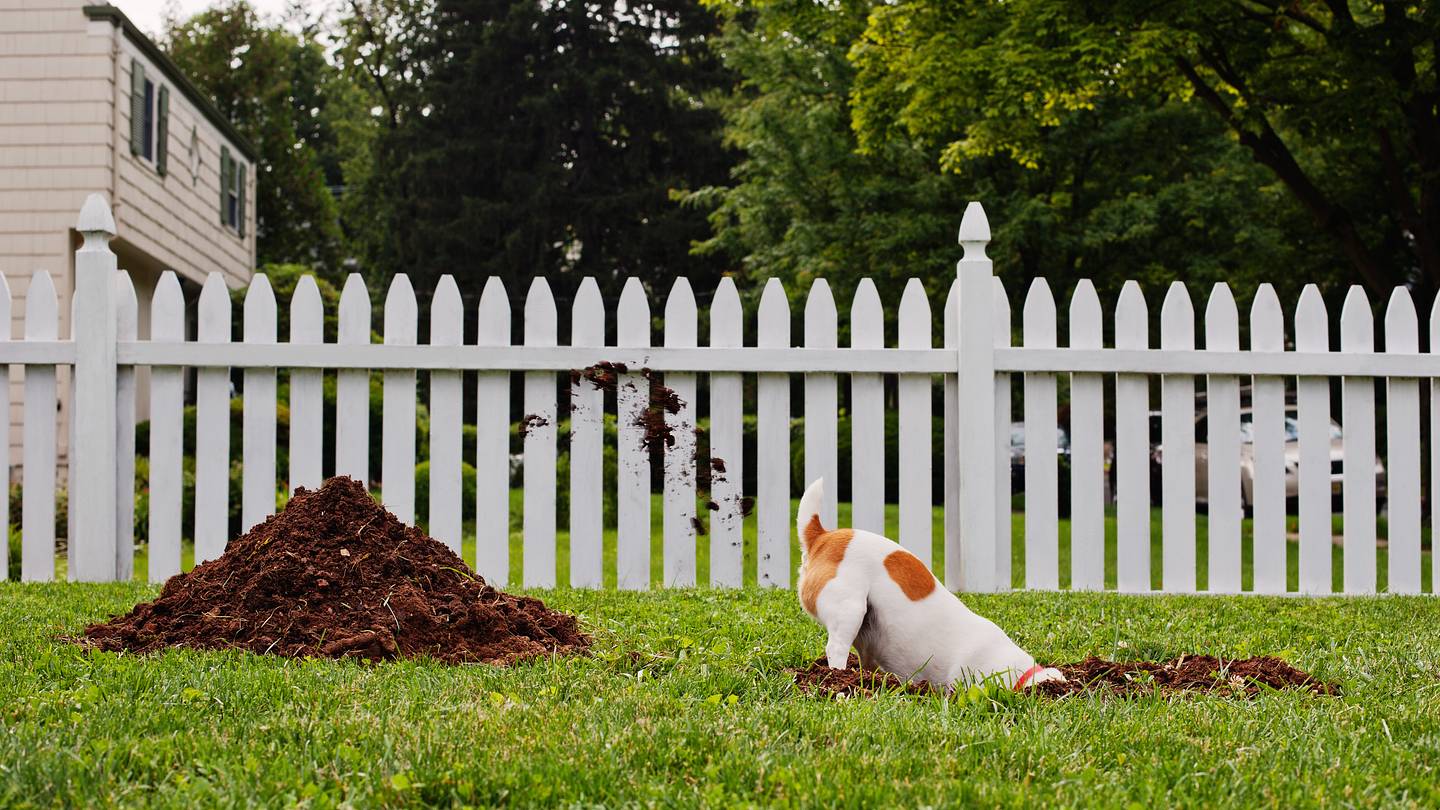
Dogs love to dig âin yards, under fences, and sometimes they may even pretend to dig up their blankets and dog beds. Digging is a problem that often leaves owners frustrated and property destroyed. We asked an expert to explain why dogs do it in the first place, and how pet owners can limit the behavior.
There are several different reasons why your dog might dig. Boredom is the most common cause, especially if your pup isnât getting enough exercise or stimulation. âIf a dog is not fulfilled, theyâll find [digging] fun,â Emma Murdock, professional dog trainer and owner of Walk With Me in Ottawa, Ontario, Canada, tells Mental Floss. âItâs like a kid playing in a sandbox.âÂ
A bored dog may try to dig a tunnel under a fenced-in yard to reach something they think is exciting. Your pet may also be tempted by freshly dug up earth, so if youâre doing yard work or other excavation projects, they may not be able to resist going elbows-deep in or around the places youâve torn up.
Genetics might be another reason your dog seems particularly prone to digging. âTerrier-type dogs are designed to dig and burrow in holes and get critters out of the ground,â Murdock says. Other higher-energy or sporting breeds, like golden retrievers, vizslas, and weimaraners, may be more likely to exhibit the behavior, too, though Murdock cautions that any type of dog may become a digger.
If your dog seems to be trying to paw a hole in their bed or on the couch, donât worry that they have some sort of special home-destroying instinct. That type of digging is just your pup displaying a nesting behavior, a leftover instinct from their wild ancestors to find a safe, comfortable, and cozy place to rest.Â
There are some things you can do that might help curb the behavior if youâre tired of constantly having to fill in the holes your dog has dug around the yard.Â
The first step to take is to ensure your dog has an outlet for all their excess energy. âMake sure they are well-exercised, that goes without saying,â Murdock says. âAnd take time to play proper games with your dog. Most dog toys are meant to be interactive.â Play tug or catch, or incorporate games that involve chew toys or puzzle toys so your dog gets enough mental and physical fulfillment every day.Â
If your dog really seems to love digging and you want to satisfy the urgeâwithout sacrificing your lawnâset up a baby pool and fill it with sand. âThat would be their designated digging spot and you give them an outlet [for digging] that is allowed,â Murdock says. Â
She also recommends distracting your dog by sprinkling some dry food around the yard. âI scatter some kibble in the grass so it keeps them busy and occupied with an activity that is not digging,â she explains. âItâs an adjacent behavior but itâs not destructive, so they can put that energy to good use.â
Teaching your dog to stop the digging behavior involves redirection training. You have to be present, you have to disagree with the behaviorâin this case telling your dog to stop diggingâand you have to give them something else to do, like scattering food or the baby pool filled with sand. Doing any training will help fulfil your dogâs engagement needs, as these sessions will help exercise their mind.Â
If your dog is constantly attempting to tunnel beneath your fence or is a frequent escapee, you could consider adding privacy fencing, dig-proof fencing, or shrubs that block your dogâs ability to dig beneath your propertyâs perimeter. You can also minimize access to the parts of your yard where your dog likes to dig by putting a fence around the garden, for example, or by keeping your pet on a long leash that restricts access to that area.Â
For Murdock, itâs more important to get to the root of the behavior. âIâm holistic in that sense. I would rather understand why your dog is digging. Itâs better to fulfill your dogâs needs instead of putting a bandaid on the problem,â she says. In other words, think of digging as a symptom rather than a standalone behavior. And if your pupâs digging is leaving you frustrated and your attempts to kick the habit arenât working, donât hesitate to call a dog trainer.
Read More About Common Pet Behavior: