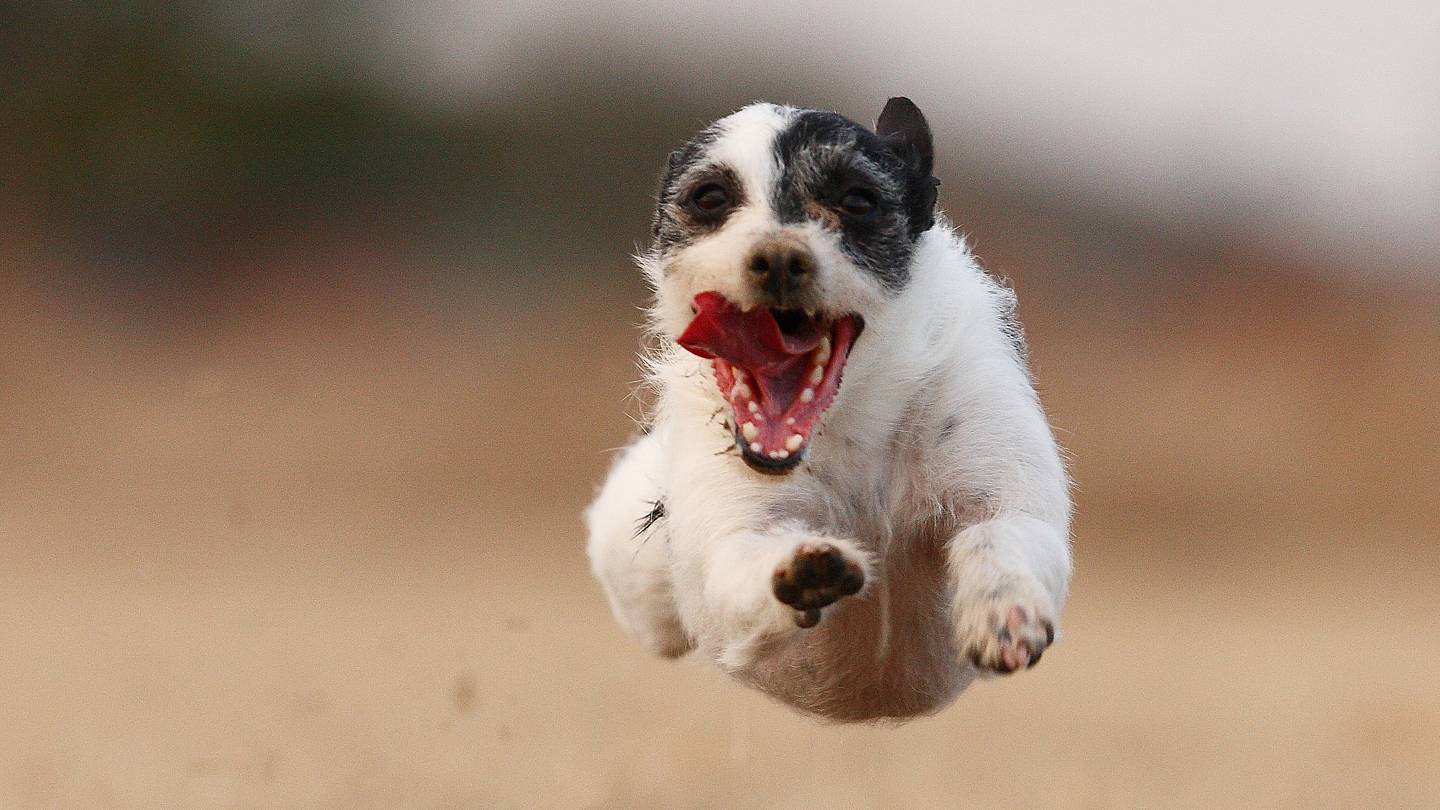
Watching your pet run after a car is something that can make your heart skip a beat. Not only is it tiresome and frustrating to manage, itâs also downright dangerous for dogs and their handlers. Before you start training your dog to stop chasing cars, itâs important to understand what drives the behavior.
Bolting after a high-speed vehicle seems like a bad idea to humans, but the situation is different from a dogâs perspective. âChasing is an instinctive behavior for dogs,â Samantha Mountain , a professional dog trainer at Monkey Business Dog Training in Montreal, Canada, tells Mental Floss. Your pup isnât trying to misbehaveâitâs simply doing what dogs are naturally inclined to do.
âA dog that chases has what is called a âpredatory instinct,ââ Mountain says. âThere are stages that define the instinct: see, orient, stalk, chase, grab bite, and kill bite.â Movement, particularly anything that moves past a dog at a high speed, will trigger that predatory instinct. But even if your pet stops at chase and doesnât try to bite and kill an oncoming vehicle, itâs still crucial to nip that behavior in the bud.Â
Any dog can have a high predatory instinct, but some are more prone to chasing than others. Breed has a lot to do with it; as Mountain explains, terriers and border colliesâwhich were originally meant to hunt and herdâhave a strong chase instinct.
There are some training methods that work to curb this dangerous behavior. But before you start a training routine, ensure your dog is getting enough exercise. âA dog that doesnât have its daily exercise needs met may have extra energy to burn, so they might chase,â Mountain says.Â
Start in your home or your backyard, in places where there arenât any triggers. Then, you can slowly expose your dog to more moving objects, people, or cars. Stay away from busy streets, and stick to quieter places with fewer distractions.
Itâs important to keep your dog on a leash when out for a walk, and be sure to stick with positive reinforcement methods such as praise and treatsâpunishment may suppress the behavior for a time, but makes it more likely your dog will continue chasing cars in the long run.Â
Use training methods that give you the control you need to stop the dogâs urge quickly. âThe most important focus should be on impulse control,â Mountain explains. She suggests recall training , which uses a command (or in some cases, a clicker) to signal to your dog. If you make the signal as soon as your dog is exposed to a trigger such as a car it wants to chase, it will return to you instead of going after the car.
âYou could also try using the verbal cues âleave itâ and âwatch me,ââ Mountain says. With the cue âleave it,â you expect your dog to leave whatever it is that has its attention and return to you; with âwatch me,â youâre directing your dog to immediately look and turn to you.Â
If you find your pet isnât responding well to the training, contact a professional. With careful training and behavior management, you can avoid the stress and worry brought on by a dog who loves the thrill of the chase.Â
Loading recommendations... Please wait while we load personalized content recommendations